🎙 Listen to a summary of this story
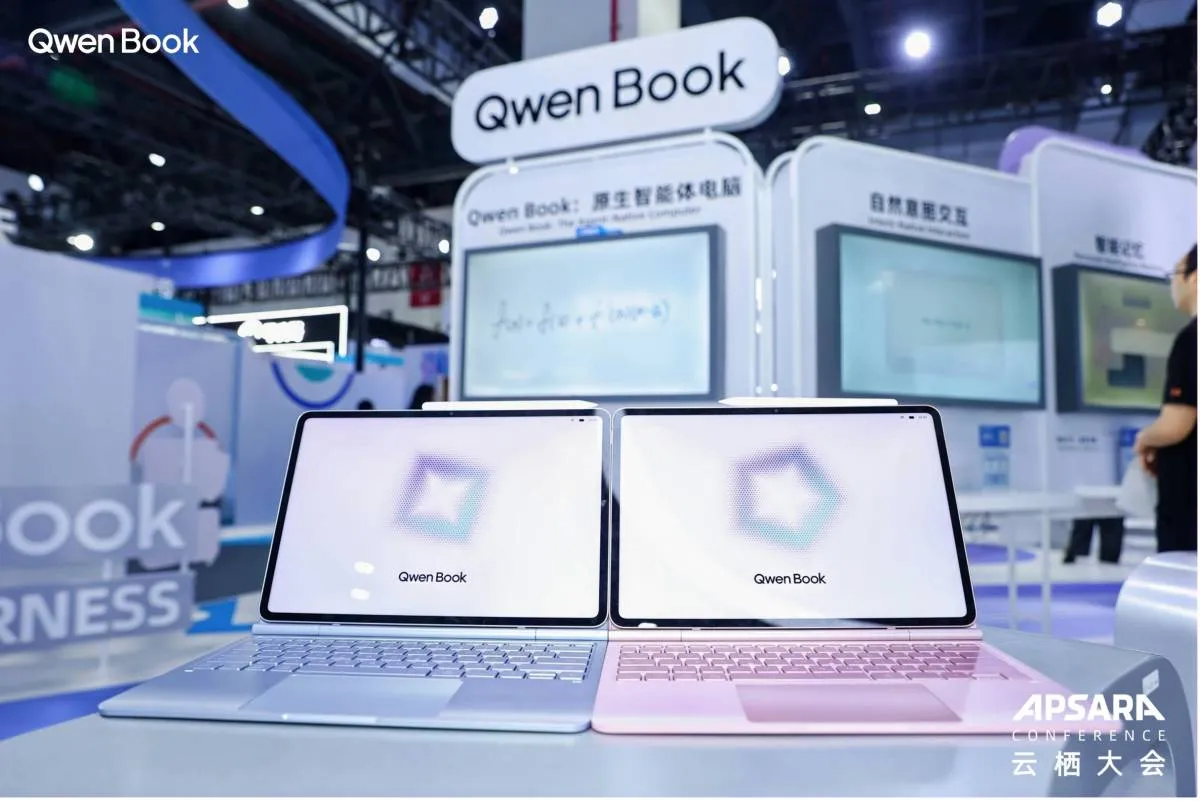
Alibaba Cloud launched the Qwen Book AI Agent PC at the 2026 Apsara Conference, integrating advanced AI capabilities with specialized hardware features like a skill keyboard and an AI Island display.
This new computing device represents Alibaba's concerted effort to embed sophisticated large language models directly into personal productivity tools. The Qwen Book utilizes its proprietary Qwen series of AI models, positioning itself as a next-generation enterprise and professional workstation capable of on-device intelligence processing.
The strategic significance lies in shifting complex AI tasks from cloud reliance to local execution, promising lower latency and enhanced data privacy for users. The device incorporates several distinct hardware innovations designed to optimize the interaction between human input and generative artificial intelligence.
Hardware Integration and Operational Design
Central to the Qwen Book's design is the integration of a dedicated "Skill Keyboard." This component goes beyond standard alphanumeric input, suggesting specialized key functions tailored for prompting, workflow management, or direct invocation of AI agent skills. This feature aims to streamline complex interactions that typically require lengthy text commands.
Furthermore, the inclusion of an "AI Island Display" provides a dedicated visual interface for managing and observing the AI's state, outputs, or running processes. This specialized display is engineered not merely as a secondary screen but as an interactive hub for the embedded agent, allowing users immediate feedback on generative tasks.
The operating system powering this hardware synergy is Omarchy OS, which Alibaba Cloud developed specifically to harmonize the demands of advanced AI agents with traditional desktop functionality. This bespoke OS acts as the middleware, ensuring that the Qwen models operate efficiently within the constrained yet powerful environment of the PC chassis.
Analysts suggest that the combination of localized processing (via the integrated hardware) and proprietary software (Omarchy OS and Qwen models) creates a tightly coupled ecosystem. This vertical integration allows Alibaba to control the entire user experience, from the physical keystroke on the Skill Keyboard to the final rendered output on the AI Island Display.
Strategic Market Positioning
The introduction of the Qwen Book places Alibaba Cloud directly into the burgeoning market segment of "AI PCs." Unlike generic laptops equipped with optional AI features, this device is fundamentally engineered around its native AI agent—Qwen. This focus dictates a targeting strategy aimed at power users, developers, and enterprises requiring reliable on-premise or private cloud AI solutions.
The performance metrics and specific model deployment details were not fully disclosed in the initial announcement, but the emphasis on integration suggests optimization for enterprise workloads rather than consumer entertainment. The ability to run sophisticated models locally is a significant differentiator against competitors whose primary offering may rely heavily on external API calls.
By coupling its cloud infrastructure dominance with tangible hardware innovation, Alibaba Cloud reinforces its strategy of becoming an end-to-end provider in the AI stack. The Qwen Book serves as a physical manifestation of this strategy—a bridge between their massive cloud compute power and the individual user's desktop environment.