Alibaba releases LOGOS for scientific research
Alibaba Group has open-sourced a new artificial intelligence model designed to work across multiple branches of the natural sciences, a move that could lower the cost of early-stage drug, chemistry and materials research while intensifying competition between Chinese and Western technology companies.
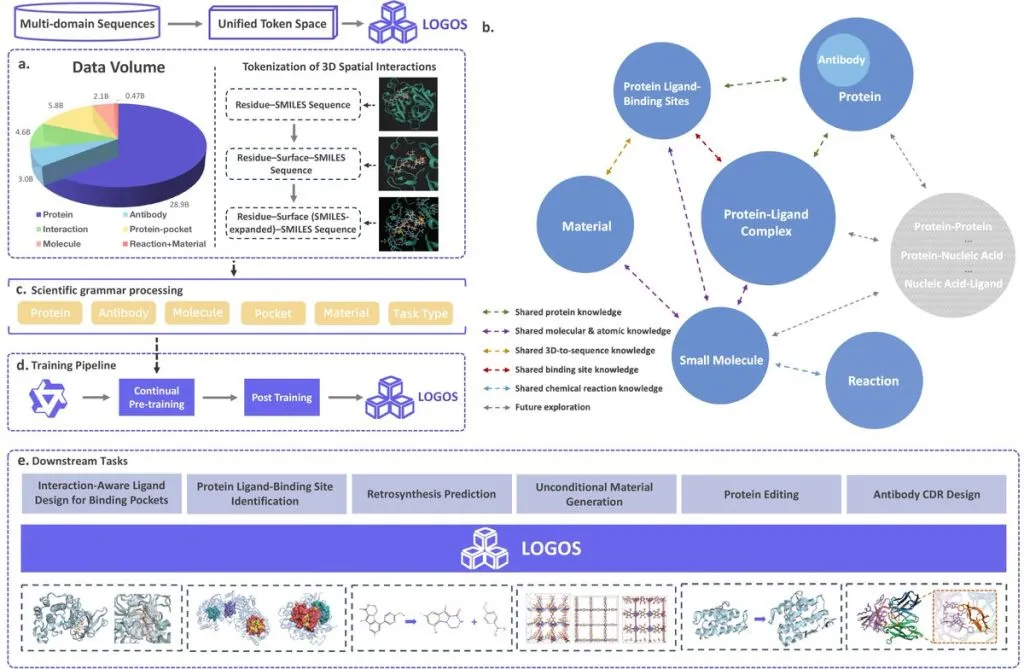
The model, called LOGOS, short for Language of Generative Objects in Science, was developed by Alibaba’s ATH-Token Foundry with researchers from Renmin University of China’s Gaoling School of Artificial Intelligence. It uses what its developers call a unified scientific grammar to represent proteins, antibodies, small molecules, chemical reactions, materials and spatial interactions as token sequences, allowing one autoregressive model to perform generation, prediction and design tasks across fields that usually rely on separate tools.
Alibaba and the researchers say LOGOS can avoid some of the computational complexity of scientific AI systems that depend on explicit three-dimensional coordinates or specialized geometric neural networks. Instead, it converts contact and constraint patterns into discrete tokens that can be processed in sequence. The team says that approach helps align pretraining with downstream tasks, such as ligand design, protein editing, retrosynthesis prediction, materials generation and antibody design.
The release includes model weights and associated resources, according to the arXiv technical report and public model pages. Hugging Face lists LOGOS models under a CC BY 4.0 license, while the project’s GitHub page describes the code as released under Apache 2.0, indicating that researchers and companies can inspect, adapt and build on at least parts of the system rather than relying only on a closed commercial interface.
China presses into AI-for-science race
The announcement places Alibaba more directly in the fast-growing field known as AI for Science, where companies and research labs are trying to use large models to propose drug candidates, design materials and automate parts of laboratory discovery. ChinaTechNews reported that LOGOS-1B, a 1 billion-parameter version, outperformed Microsoft’s larger NatureLM model on several tasks, while Alibaba’s pretraining corpus covered 44.87 billion tokens across seven modalities. Those benchmark claims have not yet been broadly independently validated.
The competitive backdrop is significant. Microsoft has promoted MatterGen, an open-source model for inorganic materials design that can be fine-tuned for property constraints, while Google DeepMind’s AlphaFold helped establish AI as a central tool in structural biology. LOGOS differs by presenting itself as a single framework for multiple scientific objects rather than a model aimed primarily at one class of tasks.
For pharmaceutical companies and academic labs, the attraction is practical. Smaller, open models can be cheaper to run, easier to audit and more adaptable to private datasets than very large proprietary systems. That could matter for smaller biotech firms or university groups that cannot afford extensive cloud computing budgets but want to test AI-assisted molecule generation or protein analysis.
For Alibaba, the release also reinforces a broader open-source strategy around AI. The company has spent the past several years releasing Qwen models and promoting its cloud and model-development platforms, even as pressure has grown across the industry to turn costly AI research into revenue. LOGOS suggests Alibaba still sees strategic value in making some core models public, especially in areas where ecosystem adoption can help establish technical standards.
Whether LOGOS becomes widely used will depend on replication, documentation, safety testing and performance on real laboratory workflows, not only benchmarks. But its release shows that the race to build scientific AI tools is no longer confined to Western labs, and that China’s largest technology companies are seeking influence over the infrastructure that could shape future medicine and materials discovery.