
🎙 Listen to a summary of this story
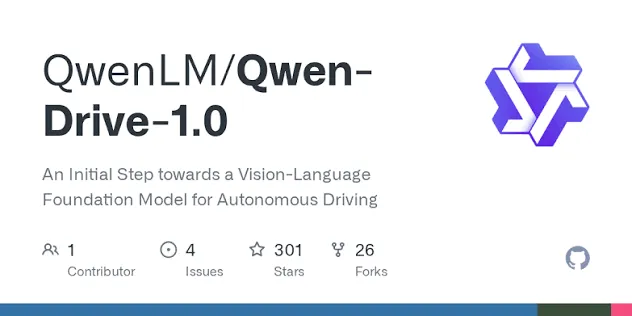
Alibaba unveiled Qwen-Drive-1.0-4B, an open-source large language model specifically engineered to revolutionize autonomous vehicle perception and planning.
This release signals a significant shift toward democratizing advanced AI capabilities within the demanding field of autonomous driving, providing researchers and developers with a powerful, accessible toolset. The Qwen-Drive model is designed to handle the complex, real-time decision-making processes required by self-driving systems, moving sophisticated AI from proprietary labs into the broader developer ecosystem.
The strategic importance of this open-sourcing cannot be overstated; it accelerates the industry's collective progress by allowing diverse teams to fine-tune, test, and validate the model against varied real-world driving scenarios without the prohibitive cost associated with closed-source systems. This accessibility fosters innovation across startups, academic institutions, and established automotive manufacturers.
The model demonstrates specialized proficiency in interpreting sensor data—including lidar, camera feeds, and radar inputs—translating raw environmental inputs into actionable, high-level driving commands. This capability directly addresses one of the most persistent bottlenecks in autonomous technology: robust, real-time environmental understanding under dynamic conditions.
Technical Architecture and Performance Benchmarks
Qwen-Drive-1.0-4B leverages Alibaba’s established Qwen architecture, optimizing it specifically for the constraints of in-vehicle computation. With 4 billion parameters, the model strikes a critical balance between high representational power and computational efficiency, making it viable for deployment on edge devices common in modern vehicles.
Testing indicates that the model exhibits high accuracy in object detection, trajectory prediction, and path planning optimization. Its architecture is tailored not merely to classify objects but to understand the temporal relationship between objects, which is vital for predicting the intent of pedestrians or other vehicles. This predictive capacity moves the system beyond reactive driving toward genuinely proactive navigation.
The open-source nature means that the weights and training methodologies are available for public scrutiny and adaptation. Users can investigate how the model handles edge cases—such as unpredictable weather patterns or obscured road markings—and contribute improvements back to the community, establishing a robust, iterative development cycle.
Implications for the Autonomous Ecosystem
This launch positions Alibaba as a major contributor to the global autonomous driving AI infrastructure, challenging the dominance of incumbent proprietary models. By releasing Qwen-Drive, the company is effectively setting a new, high-performance baseline for what open-source perception models can achieve in automotive applications.
For the broader technology sector, Qwen-Drive serves as a powerful proof-of-concept demonstrating that highly specialized, domain-specific LLMs can outperform general-purpose models when rigorously trained on multimodal driving data. This validates the trend toward creating highly specialized AI agents rather than relying solely on monolithic, general-purpose platforms.
Industry analysts suggest that the availability of a powerful, verifiable model like Qwen-Drive-1.0-4B will significantly lower the barrier to entry for smaller firms attempting to enter the autonomous vehicle market. Developers can now focus less on foundational model creation and more on integrating cutting-edge perception into novel vehicle architectures.
Further documentation detailing the comprehensive testing suite and integration guides for Qwen-Drive-1.0-4B is available through the official announcement.