🎙 Listen to a summary of this story
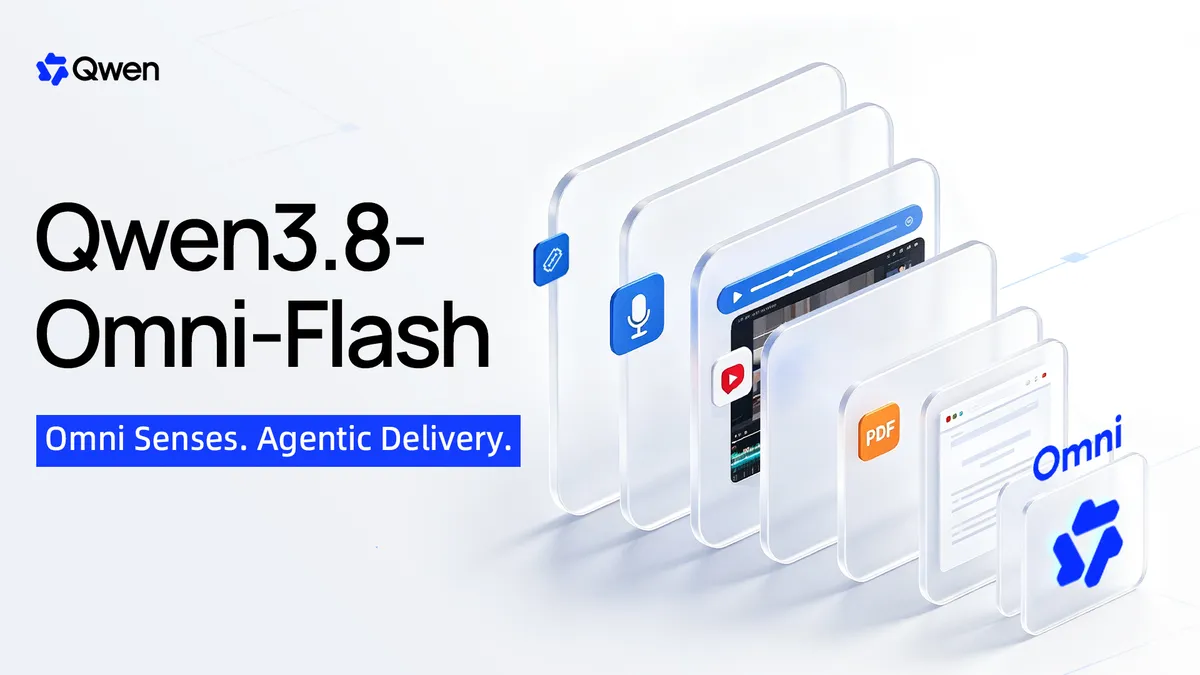
Alibaba has unveiled Qwen3.8-Omni-Flash, a major large language model boasting a groundbreaking 1-million-token context window for enhanced long-form processing.
This release significantly advances Alibaba’s generative AI capabilities, positioning the model to handle extremely complex and extensive datasets previously challenging for standard LLMs.
The new iteration, Qwen3.8-Omni-Flash, represents a substantial engineering leap in multimodal and contextual understanding. Its architecture is designed not only for vast input capacity but also for maintaining high inference speed, a critical requirement for enterprise deployment.
The 1M-token context window allows the model to ingest entire codebases, lengthy legal documents, or comprehensive transcripts in a single prompt, enabling deeper, more nuanced analysis than models constrained by smaller token limits.
Technode reported on the announcement, detailing how this model aims to bridge the gap between massive data ingestion and practical, real-time application within commercial environments.
Model Architecture and Performance Benchmarks
The development of Qwen3.8-Omni-Flash involved extensive optimization across its transformer architecture. Alibaba emphasized the model's commitment to both scale and efficiency, addressing the typical trade-off between context size and computational overhead.
While the source material details the context window, the underlying performance metrics suggest targeted improvements in reasoning and instruction following across various benchmarks. This places Qwen3.8-Omni-Flash in direct competition with leading models from other major technology firms.
For developers, the accessibility of this model is a key strategic component. Alibaba has focused on ensuring that the model can be integrated into existing cloud infrastructure, supporting both on-premise and cloud-based deployments.
The "Omni" designation suggests a broad capability set, implying proficiency not just in text generation, but also in handling multimodal inputs, which is increasingly vital for real-world enterprise use cases.
The strategic significance of this release lies in its ability to unlock entirely new classes of applications. Industries reliant on deep document review—such as finance, legal services, and advanced research—can now leverage AI to synthesize information across documents of unprecedented length.
This capability moves the utility of LLMs from simple Q&A mechanisms to sophisticated knowledge management and synthesis engines.
Implications for AI Deployment
The introduction of a 1M-token model signals Alibaba’s aggressive push into the high-value, high-context enterprise AI market. Context window size is rapidly becoming a defining metric of an LLM's commercial viability.
Companies seeking to implement advanced AI solutions often face bottlenecks when dealing with proprietary, voluminous internal data. Qwen3.8-Omni-Flash directly mitigates this bottleneck by providing a robust, scalable solution.
Furthermore, the focus on "Flash" within the model name suggests optimized latency. High context windows are often associated with high computational cost; maintaining speed while expanding memory is a significant engineering feat.
Analysts suggest that this release solidifies Alibaba’s position as a serious contender in the global AI race, particularly in the Asia-Pacific region, where deep integration with enterprise workflows is paramount.
The continuous evolution of models like Qwen3.8-Omni-Flash dictates the pace of digital transformation across nearly every sector, making this launch a pivotal moment in the current AI landscape.