China’s AI Hiring Race Moves From Labs to Industry
Hiring for artificial intelligence jobs is accelerating across China as companies move the technology from experimental projects into daily operations, intensifying a contest for engineers, product managers and data specialists that is reshaping the country’s technology labor market.
The surge is no longer limited to internet platforms and research labs. Manufacturers, semiconductor firms, robotics companies, banks, health care providers and software developers are recruiting workers who can build, deploy and manage AI systems. The shift reflects a broader industrial turn: Chinese companies are trying to turn large language models, robotics systems and AI chips into commercial infrastructure.
Recent recruitment drives show how quickly the field is expanding. DeepSeek, the Hangzhou-based AI company whose models helped establish China as a serious challenger in generative AI, has begun a major hiring push aimed at doubling core teams as it moves beyond frontier research and deeper into product development. Recent openings include roles in algorithms, product management, operations, data, infrastructure, legal and medical applications, according to recent reports.
The hiring campaign follows reports that DeepSeek has sought its first external funding round, with a valuation above $50 billion, underscoring how capital and talent are now moving together in China’s AI sector. The company is also reportedly working on its own inference chip, a sign that leading AI firms are looking not only for model builders but also for hardware and systems engineers able to reduce dependence on foreign suppliers and manage the high cost of AI deployment.
Talent Demand Spreads Across Chips, Robots and Enterprise AI
The expansion is being driven by the maturation of generative AI and by China’s push to build a more self-sufficient technology stack. Companies are seeking specialists in model training, fine-tuning, data engineering, supercomputing clusters, inference optimization and AI applications for industry-specific products.
Semiconductors are one of the clearest examples. Advanced AI requires graphics processors, high-bandwidth memory and other specialized hardware, and Chinese firms have been racing to develop domestic alternatives as U.S. export controls restrict access to the most advanced foreign chips. That pressure has created a scramble for engineering talent in chip design, packaging, memory, architecture and systems integration.
DeepSeek’s reported chip effort illustrates the same trend. AI firms that once focused mainly on algorithms increasingly need engineers who can work across the full computing stack, from data centers and training frameworks to inference chips and domestic processors. The result is a labor market in which AI jobs now include infrastructure specialists as well as researchers.
Robotics and embodied AI are also becoming major hiring centers. Recent reports on China’s robotics sector point to rising demand for workers who can connect large models with machines that move through physical spaces. That includes perception engineers, motion-control specialists, simulation experts, computer vision researchers and software developers who can integrate AI systems with warehouses, factories and service robots.
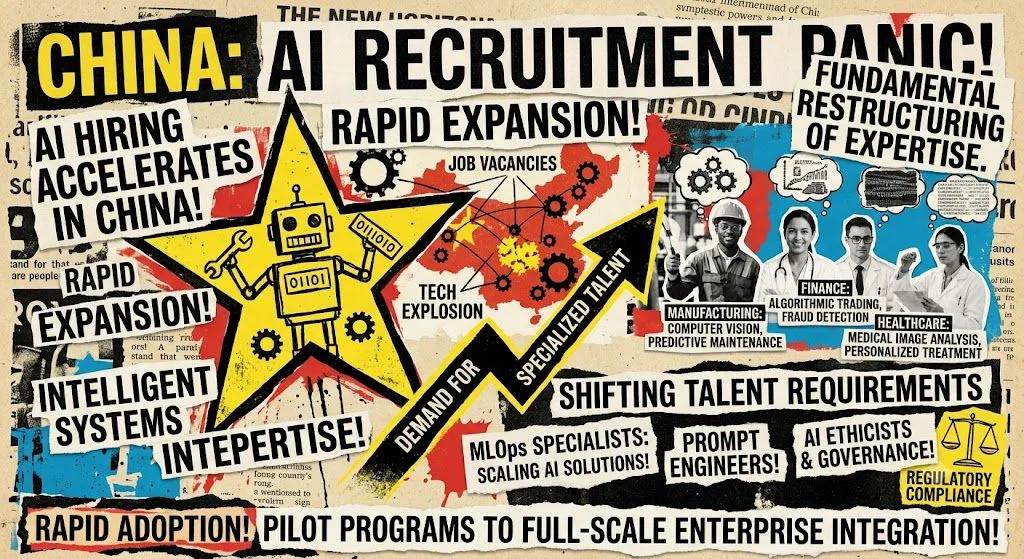
The demand is spreading into traditional sectors. In manufacturing, companies are using computer vision for inspection, predictive maintenance and quality control. In finance, AI jobs increasingly focus on risk management, fraud detection, customer service automation and quantitative analysis. In health care, hospitals and medical technology firms are looking for workers who understand medical imaging, clinical data and model governance.
These positions require more than coding ability. Companies are asking for workers who can combine AI tools with domain knowledge, whether in logistics, medicine, law, manufacturing or finance. That is changing the profile of the ideal recruit: A strong candidate may need to understand both model behavior and the operating environment in which the model will be used.
Skills Shift Toward Deployment, Governance and Product Use
The hiring boom is also changing the kinds of AI skills companies value. Core machine-learning researchers remain important, but the fastest-growing demand is for workers who can turn models into reliable products.
That has raised the importance of MLOps and AI infrastructure roles. Companies need specialists who can monitor models, control costs, keep systems stable, manage data pipelines and update models without disrupting business operations. As AI moves from a demonstration tool to a production system, reliability is becoming as important as raw model performance.
Product jobs are also becoming more central. DeepSeek’s recruitment push includes roles tied to industry applications, suggesting that Chinese AI companies are trying to build services for law, medicine, language, enterprise software and other professional uses. That mirrors a wider shift in the sector, where companies are competing not only on benchmarks but also on whether AI can be embedded in real workflows.
Governance is another emerging hiring category. As AI systems become more autonomous and widely deployed, companies face growing pressure to manage compliance, privacy, bias, cybersecurity and content controls. That is creating demand for legal, policy and ethics specialists who can work with engineers rather than sit outside the technical process.
The competition is expected to remain intense. McKinsey has estimated that China’s need for AI-skilled workers could grow from 1 million to 6 million by 2030, while domestic and overseas training pipelines may provide only about one-third of that demand, leaving a shortage of roughly 4 million workers.
For employers, the shortage means higher salaries and earlier recruitment. For workers, it means AI skills are becoming valuable beyond traditional technology jobs. The most competitive candidates are those who can bridge models, data, infrastructure and business problems.
The broader labor-market signal is clear: China’s AI boom is no longer only about building larger models. It is about building the workforce needed to deploy them. As investment flows into chips, robotics, enterprise software and industrial automation, hiring has become one of the clearest measures of how deeply AI is being woven into the country’s economy. As we covered in our story on Tech Giants Pivoting to Embodied Intelligence, this trend continues to shape the strategic landscape.