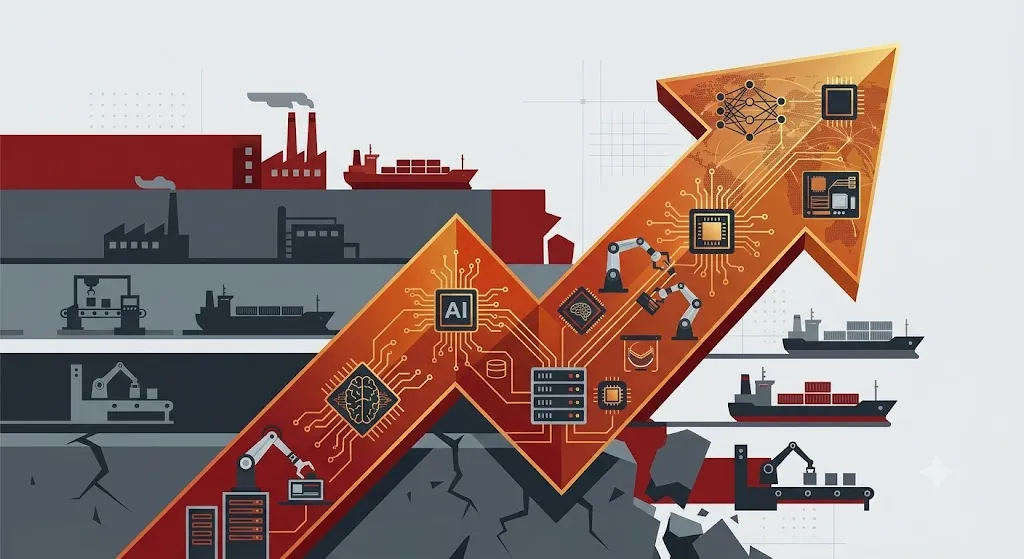
China's overall trade expanded, driven primarily by a robust boom in artificial intelligence (AI) and high-tech manufacturing, successfully masking significant weakness in several other domestic sectors.
AI Fuels China's Trade Resurgence
The surge in global demand for Chinese technology, particularly components integral to AI development, provided the necessary impetus to push trade figures upward despite broader economic headwinds. Semiconductor production and advanced computing hardware remain central pillars of this expansionary trend.
According to analysis from Nikkei Asia, the export performance of high-value electronics has substantially outperformed expectations in recent reporting periods. This strength is directly linked to multinational corporations heavily investing in localized AI infrastructure within mainland China.
The appetite for advanced microchips and specialized processing units required by large language models and other generative AI applications created a consistent, high-volume demand stream. Chinese manufacturers capitalized on this global technological pivot, positioning their supply chains advantageously against regional competitors.
Furthermore, the integration of domestic innovation into international supply chains has become a strategic priority for Beijing. This push ensures that while certain traditional industries face contraction or stagnation, the growth trajectory remains anchored in future-facing technology sectors.
Underlying Sectoral Pressures
Despite the headline strength provided by AI-related exports, an examination of China's trade data reveals persistent structural vulnerabilities within other parts of its economy. Several traditional manufacturing and consumer goods sectors continued to register disappointing performance.
The weakness in these lagging sectors points to deeper domestic challenges, including shifts in consumer sentiment and the lingering effects of regulatory adjustments across various industries. These areas are not currently contributing meaningfully to offsetting the high-tech gains.
For instance, certain segments reliant on traditional capital expenditure or export markets outside of specialized tech niches experienced muted order books throughout the quarter. This disparity highlights a widening economic gap between cutting-edge technological production and legacy industrial output.
Analysts suggest that while AI provides an essential lifeline to aggregate trade figures for now, sustained, broad-based domestic recovery requires addressing these underlying sectoral imbalances. Relying solely on high-tech demand presents a concentration risk should the global appetite for AI hardware or software experience any deceleration.
The current dynamic illustrates a bifurcated Chinese economy: one segment aggressively capturing global technological momentum, and another grappling with structural headwinds typical of mature industrial economies transitioning into new paradigms. Investors are closely monitoring whether the AI-driven buoyancy can sustain itself long enough to catalyze broader economic revitalization across all industrial bases.