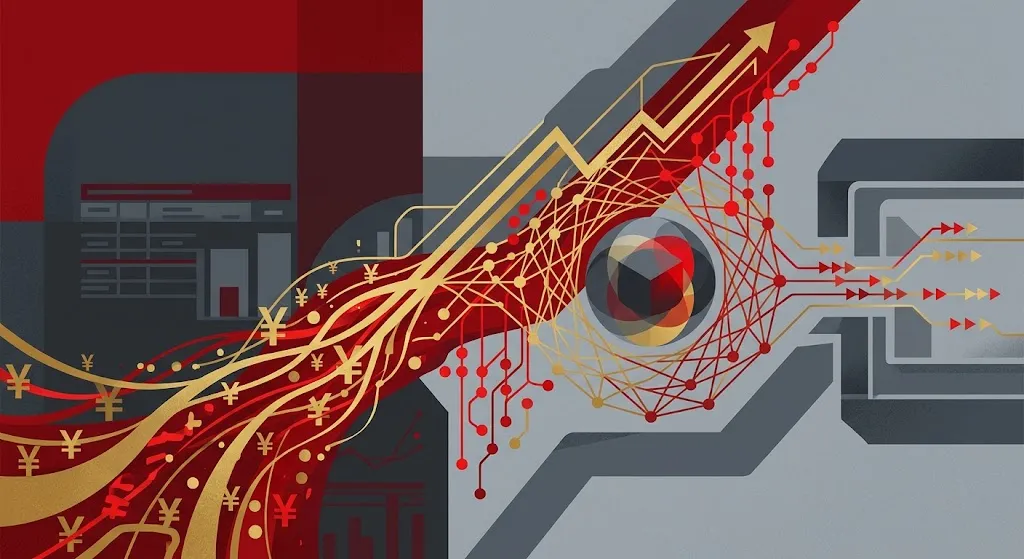
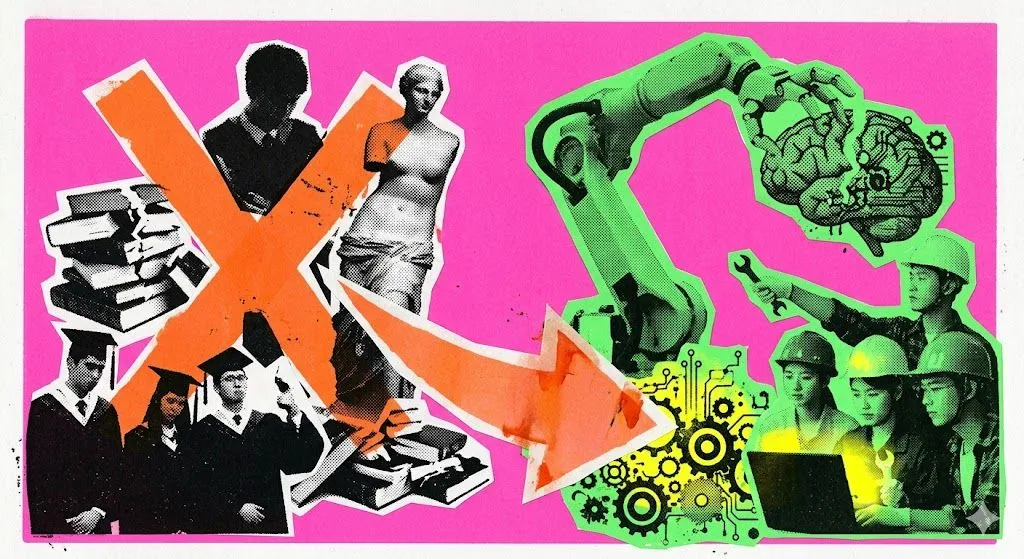
China’s universities are moving quickly to reshape what students study, cutting thousands of undergraduate programs seen as out of step with the country’s economic priorities and replacing many of them with courses tied to artificial intelligence, robotics and other emerging technologies.
The overhaul, which has unfolded across the 2021-25 period, is one of the clearest signs yet that Beijing sees higher education as a tool of industrial policy. According to Ministry of Education data cited by state media and reported by the South China Morning Post, Chinese higher education institutions revoked or suspended about 12,200 undergraduate degree programs while introducing roughly 10,200 new ones. More than 30% of university programs were adjusted during the period.
Universities pivot toward the AI economy
The changes have fallen hardest on arts, humanities, foreign languages and management-related programs, fields officials and university administrators increasingly view as crowded, less directly tied to employment or less useful to the country’s next stage of development. In their place, universities are expanding offerings in technology-heavy disciplines, including artificial intelligence, advanced manufacturing, agricultural robotics, biomanufacturing, digital trade and what China calls “embodied intelligence,” a field that combines AI with physical machines such as robots.
The shift comes as China seeks to become a global leader in “future industries” while also confronting a difficult labor market for young graduates. Record numbers of university students have entered the job market in recent years, only to face slower growth, a weaker private sector and fierce competition for positions that match their qualifications. Youth unemployment has remained a persistent concern, and employers in many sectors are rethinking hiring needs as AI automates tasks once assigned to entry-level workers.
That pressure has turned university majors into a national policy question. For students and families, the choice of degree has long been tied to the promise of security and upward mobility. For the government, it is increasingly tied to whether universities can produce engineers, programmers, robotics specialists and applied researchers fast enough to support strategic industries.
The new majors are being designed not merely as academic additions but as signals to schools, students and employers. Nine universities have added programs in embodied intelligence, reflecting Beijing’s push to integrate next-generation AI with manufacturing and the real economy. Other new fields, including agricultural robotics and digital finance, point to the government’s effort to spread AI-driven productivity beyond internet companies and into factories, farms, logistics systems and services.
For China’s leaders, the timing is critical. The country is competing with the United States and other advanced economies to dominate key technologies. It is also trying to reduce reliance on imported expertise and equipment in sensitive areas. Universities, especially elite institutions with strong engineering and computer science departments, are being asked to train graduates who can serve national priorities as well as private-sector demand.
Questions remain over what students lose
The rapid pruning of degree programs has raised a more complicated question: whether cutting majors solves the underlying mismatch between education and employment, or simply shifts students toward new fields that may themselves become crowded.
Experts cited in reports on the overhaul have warned that repeatedly replacing one major with another may not be enough. Some discontinued programs were launched only a few years ago and had little time to mature. A deeper reform, they argue, would make Chinese higher education more flexible, allowing students to combine disciplines, update skills during their studies and move more easily between academic tracks as labor market needs change.
That flexibility may matter because AI is not only creating new jobs. It is also changing the skills required in old ones. A graduate in marketing, finance, consulting or management may need AI literacy as much as a computer science student needs communication, ethics and domain knowledge. Removing humanities and language programs too aggressively could leave universities with fewer graduates trained in critical thinking, cross-cultural understanding and public communication, skills that remain important even in a technology-driven economy.
The tension is familiar beyond China. Universities around the world are under pressure to prove that degrees lead to jobs. Students are questioning the cost of programs with uncertain returns. Employers complain that graduates lack practical skills, while educators warn against reducing higher education to short-term labor market training. China’s difference is the scale and speed of state-directed change.
In China, where the education system is closely tied to national planning, universities have limited room to ignore government priorities. The Ministry of Education’s catalog of approved undergraduate majors shapes what institutions can offer and what students can apply to study through the highly competitive college entrance system. When the catalog changes, the signal travels quickly across campuses.
For students entering university, the message is clear: technology is where opportunity is supposed to be. Yet the promise of AI-centered education will depend on more than changing course names. Universities will need qualified instructors, updated laboratories, industry partnerships and curricula that keep pace with rapid advances. Without those, new majors could become the next generation of programs judged obsolete.
The overhaul also reflects a broader bargain China is trying to strike with its young people. After years of expanding higher education, the country now has millions of graduates whose expectations do not always match the jobs available. By steering students toward AI and strategic industries, Beijing is betting that education can help absorb employment pressure while feeding the industries it wants to dominate.
Whether that bet pays off will become clearer as the first cohorts from the new programs graduate. For now, China’s universities are being remade around a blunt assessment of the future: in an economy transformed by artificial intelligence, what students study is no longer just an academic choice. It is part of the country’s industrial strategy.