🎙 Listen to a summary of this story
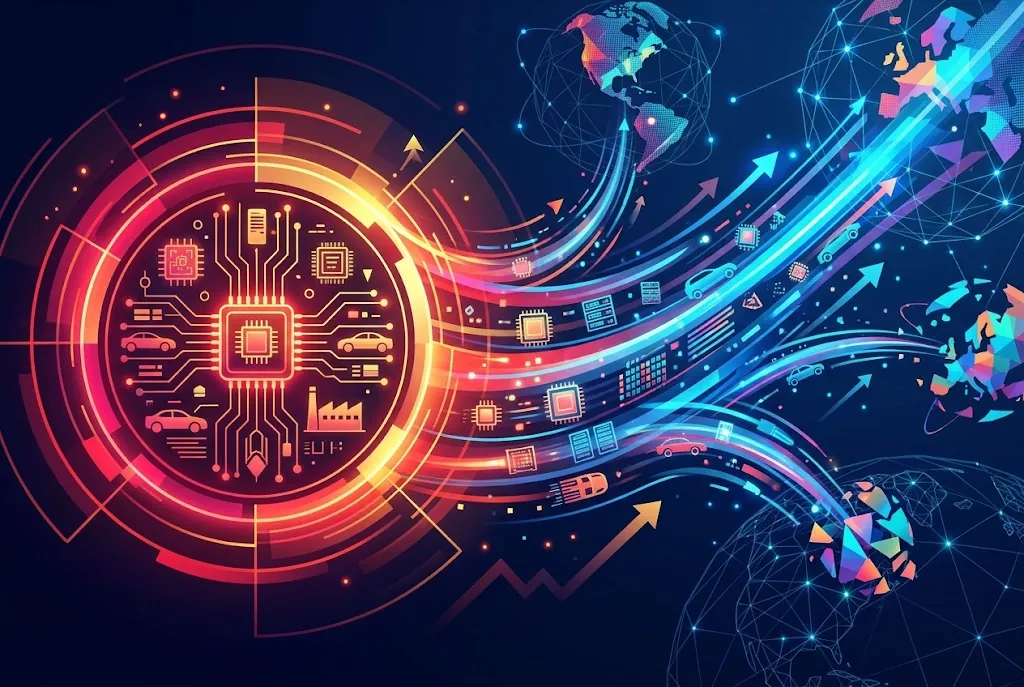
China is moving to restrict the overseas transfer of artificial intelligence, semiconductor and solar-manufacturing technologies, giving Beijing greater control over strategic expertise developed by Chinese companies as technological competition with the United States intensifies.
The Ministry of Commerce and Ministry of Science and Technology said Friday that they proposed adding 40 technologies to China’s catalogue of prohibited or restricted exports. The list includes 23 AI technologies involving large models, autonomous agents, computing clusters, chip design and information processing.
Five biotechnology fields and 12 solar technologies would also be covered. The solar provisions encompass techniques used to manufacture polysilicon, wafers and cells — areas in which Chinese companies occupy powerful positions in global supply chains.
The proposed catalogue remains open for public consultation until Nov. 15. A temporary registration requirement, however, took effect immediately under the ministries’ official announcement.
Companies must register covered transfers before selling intellectual property, licensing technology for use abroad or allowing the ownership or effective control of a Chinese technology holder to pass to a foreign entity. Transactions that have started but have not been completed also fall within the registration system.
China adopts a familiar export-control strategy
The measures represent a significant development in China’s technological rivalry with the United States. Washington has spent years restricting China’s access to advanced processors, semiconductor-manufacturing equipment and other technologies that American officials say could strengthen Chinese military and surveillance capabilities.
Beijing is now building a broader system for controlling technologies in which Chinese companies possess, or may soon possess, a competitive advantage. The approach suggests China increasingly regards its own technical knowledge as a strategic resource rather than simply an export commodity.
Fourteen of the 40 technologies are proposed for prohibition. They include AI systems designed to generate or modify malicious computer code, as well as certain biotechnology and advanced solar-production techniques. Another 26 technologies would be restricted, meaning that companies would require government permission before transferring them abroad.
The proposed rules could affect foreign acquisitions of Chinese AI companies, international licensing agreements and plans to install Chinese models or computing systems overseas. They may also complicate partnerships in which foreign businesses seek access to Chinese chip designs, specialised algorithms or factory processes.
The ministries said the revision was a normal regulatory measure that did not target any particular country, region or company. In an explanatory statement, the Commerce Ministry said controls were needed to prevent sensitive technologies from being misused or spreading beyond effective oversight.
The move nevertheless reflects the increasing similarity between Chinese and Western technology policy. Both Beijing and Washington now describe control over advanced technology as a matter of national security, even while arguing that their restrictions remain limited and do not prevent legitimate commercial cooperation.
AI expansion meets tighter government oversight
The ownership provisions could give Chinese authorities an important role in reviewing foreign purchases of domestic technology companies. Beijing used similar powers after adding content-recommendation technology to its export-control catalogue in 2020, a decision that complicated any potential sale of TikTok’s algorithm by its Chinese parent company, ByteDance.
AI companies now represent an even more sensitive category. Chinese developers have produced increasingly capable and inexpensive models that are attracting users abroad. Beijing has promoted open-source AI as a way to expand China’s technological influence, particularly in developing countries that may be unable to afford American systems.
At the same time, Chinese authorities have an interest in preventing valuable model designs, training techniques and proprietary data from being acquired by foreign competitors. The new framework attempts to preserve overseas access to Chinese services while maintaining control over the technology beneath them.
The proposals therefore stop short of preventing Chinese AI companies from serving international customers. Technologies already placed in the public domain through open-source releases or academic publications are generally excluded from the controls.
Foreign users could also continue accessing Chinese models through application programming interfaces, websites, apps and software-as-a-service platforms. The government said such arrangements do not normally constitute an export of the underlying model technology.
Deploying a restricted model locally in another country would be treated differently because it could involve transferring the model or associated expertise outside China. Overseas deployment on infrastructure owned and operated by a Chinese company may qualify for simplified or automatic licensing.
Those distinctions could allow developers such as Alibaba and DeepSeek to continue expanding their international services while giving Beijing greater oversight when foreign organisations seek direct possession of models, source code or specialised training methods.
Companies using overseas factories to manufacture Chinese-designed chips, participating in international standards work or conducting joint research with foreign resources may also receive streamlined approval. That reflects Beijing’s need to preserve access to global manufacturing and research networks even as it increases control over strategic transfers.
Solar technology adds another point of leverage
The inclusion of solar technology broadens the measures beyond AI and semiconductors. China dominates much of the global production chain for solar panels, including polysilicon, wafers, cells and manufacturing equipment. Foreign governments seeking to establish their own solar industries often depend on Chinese machinery and technical expertise.
Restrictions on the transfer of factory processes could make it harder for overseas competitors to reproduce China’s scale and efficiency. They could also complicate efforts by Europe, India and the United States to build domestic solar-production capacity while reducing reliance on Chinese imports.
Finished products manufactured using controlled technologies are generally outside the proposed rules. The main target is the transfer of technical knowledge, not routine exports of chips, solar panels, vehicles or consumer electronics. Some specialised solar-production equipment may nevertheless be covered when it embodies listed manufacturing techniques.
The development was reported by Reuters and the Associated Press as part of a widening global contest over control of strategically important industries.
The registration requirement does not itself prohibit a transaction, and most additions to the catalogue remain proposals. Their full effect will depend on the final technical thresholds, licensing decisions and how regulators interpret foreign ownership, overseas deployment and cross-border research.
But the direction of Chinese policy is becoming clear. Beijing no longer sees export controls only as barriers imposed by Washington and its allies. It is increasingly treating China’s own technological expertise as leverage — and asserting that its movement across borders should take place on the government’s terms.