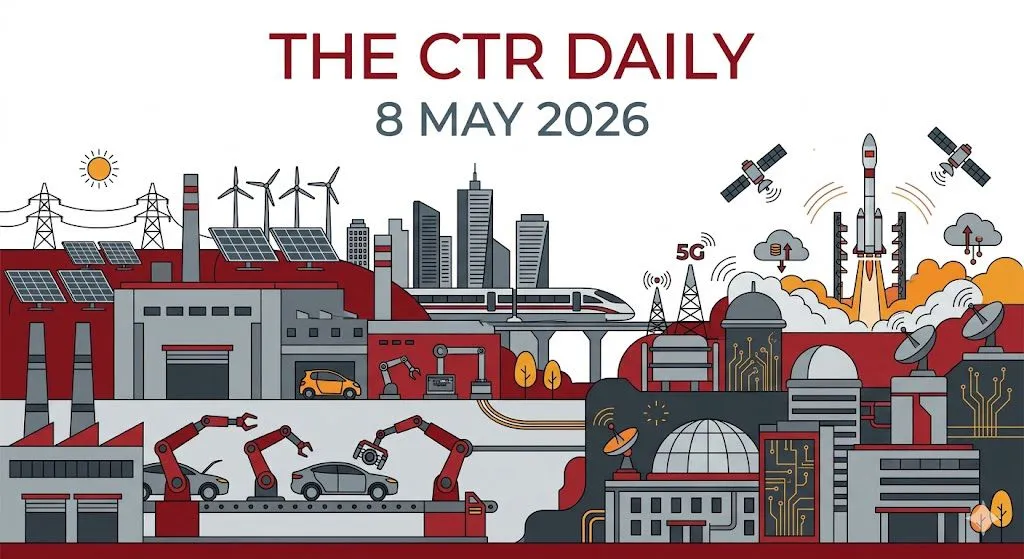
Today's CTR: The Chinese technology landscape is currently defined by a dual-track momentum: high-stakes geopolitical maneuvering and aggressive industrial scaling. While Washington and Beijing establish critical guardrails to prevent artificial intelligence (AI) competition from escalating into kinetic conflict, domestic players are moving from theoretical models to physical implementation. From the integration of sophisticated voice-driven intelligence in desktop computing to the industrialization of embodied AI in manufacturing, the focus has shifted toward practical, high-value applications. This convergence of regulatory diplomacy and hardware-software integration marks a pivotal moment for China's technological sovereignty.
US-China AI Safety Summit in Sight
Reports emerging on May 7-8 indicate that high-level discussions regarding artificial intelligence (AI) safety and "abnormal AI behavior" are being scheduled for an upcoming summit in Beijing. Both nations are reportedly working to establish a "red line" for AI usage within nuclear command and control systems and autonomous weaponry.
The move suggests a growing recognition that AI rivalry could spiral into a crisis without shared safety protocols. Establishing these boundaries is essential to prevent unintended escalations in military technology.
Diplomatic guardrails may be the only way to manage the rapid pace of dual-use technology development.
Alibaba Qwen Integrates Advanced PC Voice Input
On May 7, Alibaba launched an AI-powered voice input feature for its PC client utilizing the Qwen (Tongyi Qianwen) model. The tool goes beyond standard dictation by performing real-time "clean-up" of filler words, formatting text, and providing context-aware responses directly within desktop applications.
This integration represents a significant step in making large language models (LLMs) a seamless part of daily professional workflows. By moving intelligence directly into the desktop environment, Alibaba is positioning Qwen as a core productivity layer.
The evolution of voice interfaces suggests that the next frontier of productivity lies in reducing the friction between thought and digital execution.
China Approves 6G Trials to Accelerate Connectivity
China has officially approved trials for sixth-generation (6G) wireless technology to accelerate the development of next-generation connectivity. This move is part of a broader strategic push to lead the global telecommunications landscape.
The commencement of these trials signals China's intent to leapfrog current 5G standards and set the foundation for a hyper-connected future. Securing early dominance in 6G infrastructure is a critical component of national technological strategy.
The race for the next generation of connectivity is officially entering its experimental phase.
Spirit AI and Bosch Form Strategic Partnership for Embodied AI
The Beijing-based startup Spirit AI (千寻智能) has announced a partnership with Bosch China to industrialize "embodied AI" for robotics. The collaboration will integrate Bosch’s industrial sensors and actuators with Spirit AI’s "Universal Brain" architecture to scale autonomous robotic deployment.
This partnership aims to deploy advanced intelligence within Bosch's Chinese logistics and manufacturing centers, moving AI from digital screens into physical, autonomous machines. It represents a significant convergence of German engineering and Chinese software innovation.
The scaling of embodied AI in manufacturing could redefine the efficiency of global supply chains.
Chinese Solar Industry Signals Recovery
Fresh data released on May 7 indicates a surge in Chinese solar exports, suggesting a recovery for the photovoltaic (PV) sector. Despite years of overcapacity, rising overseas shipments and firming equipment prices suggest a stabilization phase as manufacturers transition to more efficient N-type cell technologies.
The shift to higher-efficiency technology is helping the industry move past the era of pure volume-based competition. This is essential for maintaining global competitiveness in renewable energy.
A stabilizing solar market provides a much-needed boost to China's green technology export economy.
Hangzhou International Humanoid Robot Exhibition
The 2nd Hangzhou International Humanoid Robot and Robot Technology Exhibition 2026 is set to showcase the latest advancements in robotic systems.
This event serves as a critical venue for observing the rapid commercialization of humanoid robotics in the Chinese market.