
🎙 Listen to a summary of this story
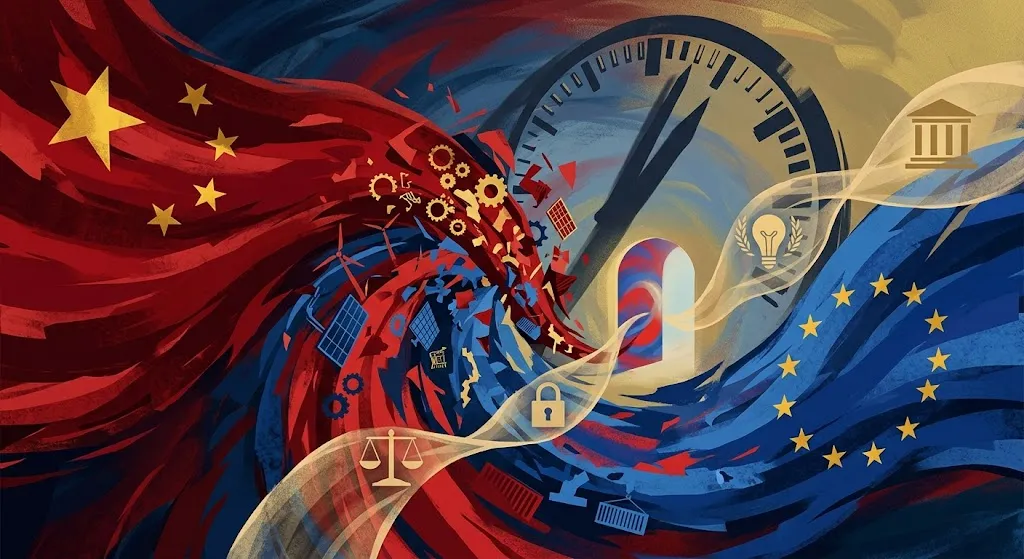
Former European Council President Charles Michel has expressed optimism that China and the European Union can make meaningful progress in negotiations aimed at easing mounting trade tensions, even as an October deadline set by Brussels approaches and Europe's trade deficit with China continues to widen.
Michel, who led the European Council from 2019 to 2024, said during a media briefing in Shanghai that he believed Beijing and Brussels were moving toward common ground after establishing a new consultation mechanism earlier this year. The talks cover four areas: trade and investment, export controls, intellectual property rights and reform of the World Trade Organization, according to the South China Morning Post .
His comments represent a comparatively upbeat assessment of a relationship that has become increasingly strained by European concerns over Chinese industrial subsidies, manufacturing overcapacity and barriers facing European companies in China. Beijing, meanwhile, has objected to European trade restrictions and rejected accusations that its industrial policies amount to unfair competition.
Michel said European officials expect progress on the four negotiating tracks by October or November, or at least before the end of the year. His assessment comes as Brussels faces pressure to demonstrate that negotiations can produce measurable changes rather than simply extend a long-running dialogue over structural trade problems.
Europe Presses China to Rebalance a Widening Trade Relationship
The scale of the imbalance has become central to Europe's concerns. The EU imported €559.4 billion ($650 billion) of goods from China in 2025 while exporting €199.6 billion, according to Eurostat . That left the bloc with a €359.8 billion goods deficit. Compared with 2024, EU exports to China fell 6.5%, while imports increased 6.4%.
The imbalance has continued into 2026. Eurostat reported that the EU's goods deficit with China reached €98 billion during the first quarter, its highest quarterly level since 2022. China is the EU's largest source of imported goods, while European policymakers increasingly worry that Chinese manufacturing capacity is putting pressure on industries ranging from automobiles and machinery to renewable-energy technologies.
Those concerns led European and Chinese trade officials in June to establish the four-track consultation mechanism after lengthy negotiations in Brussels. The EU called for "tangible results" by October and the two sides agreed to establish a mechanism to monitor trade flows, according to the South China Morning Post .
Michel argued that Europe's enormous single market gives Brussels significant negotiating leverage. China remains heavily dependent on overseas markets at a time when domestic consumption remains relatively weak, while European consumers represent an important destination for Chinese manufacturers. The former Belgian prime minister said China needs continued access to the European market and has few comparable alternatives.
That argument has gained additional significance as China's export surpluses expand. Chinese customs figures showed the country's trade surplus widening with 24 of the EU's 27 member states in July compared with the same month a year earlier, according to calculations reported by the South China Morning Post .
Electric Vehicles Illustrate Europe's Tougher Approach
The dispute over Chinese electric vehicles has become the clearest example of Brussels' willingness to combine negotiations with defensive trade measures. Following an anti-subsidy investigation, the European Commission imposed countervailing duties on Chinese-made battery electric vehicles, concluding that state support created a threat of economic injury to European manufacturers.
The Commission has nevertheless kept negotiations open. In January, it issued guidance allowing Chinese electric-vehicle exporters to propose price undertakings as an alternative mechanism for addressing the effects of subsidies. Those proposals can include minimum import prices, sales arrangements and commitments involving future investment in Europe. The existing countervailing duties range from 7.8% to 35.3%, depending on the manufacturer and circumstances, according to the European Commission .
The broader dispute extends well beyond automobiles. Brussels says China's economic model produces systemic distortions through industrial policies and support for priority sectors. European officials are demanding greater reciprocity for European companies, improved market access and a more level competitive environment. The European Commission's overview of EU-China trade relations says the bloc continues to favour dialogue and World Trade Organization-based solutions while reserving the right to deploy European trade-defence instruments.
European industry is also demanding action. German business groups have urged Chancellor Friedrich Merz to take a firmer position toward China, arguing that extensive state support gives Chinese manufacturers advantages that European competitors cannot match. Germany recorded an €89.3 billion trade deficit with China in 2025, intensifying concern in Europe's largest industrial economy, according to Reuters .
Michel's optimism therefore does not signal a return to the era when European policy was largely built around expanding economic integration with China. Instead, negotiations are taking place within the EU's broader "de-risking" strategy — an attempt to maintain trade and investment while reducing dangerous dependencies in strategically important sectors.
October Deadline Tests Whether Dialogue Can Deliver
The negotiations could become an important test of whether the EU can use access to its single market to change Chinese economic behaviour without triggering a wider trade confrontation. Failure to achieve sufficient progress could strengthen European arguments for additional tariffs, procurement restrictions, investment screening or other measures intended to protect strategically important industries.
At the same time, both sides have strong incentives to prevent relations from deteriorating further. Europe remains an important market for Chinese manufacturers, while China remains a major destination for European machinery, vehicles, chemicals and luxury goods. Despite the political tensions, the scale of their commercial relationship makes economic separation enormously costly.
The debate is also unfolding against a wider shift in global trade. Governments in Europe, China and the United States are increasingly using subsidies, tariffs, export controls and investment restrictions to protect strategic industries. The EU-China negotiations therefore concern more than the size of a bilateral trade deficit: they are testing whether two economic powers with sharply different industrial systems can manage their disagreements through negotiated rules rather than escalating protectionism.
Michel's comments suggest he believes that remains possible. But the next several months will determine whether improved diplomatic language is accompanied by concrete changes in market access, intellectual property protection, export controls and trade flows. With the October benchmark approaching, Brussels will increasingly judge the talks not by expressions of cooperation but by whether they produce measurable results.
```