🎙 Listen to a summary of this story
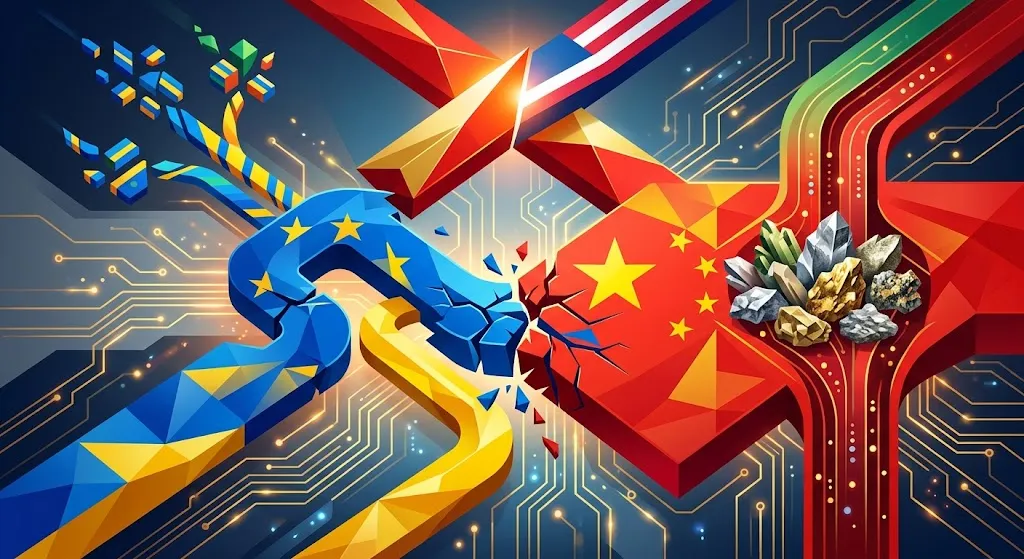
The European Union signaled persistent rare earth material vulnerabilities during the Trump-Xi summit, even as a US-China trade truce extension was confirmed.
Delegates noted that despite diplomatic assurances stabilizing immediate bilateral tensions between Washington and Beijing, strategic supply chain risks—particularly concerning critical minerals controlled heavily by China—remain a core concern for Brussels. The European delegation stressed the necessity of diversifying sourcing away from single points of failure to safeguard its industrial base against geopolitical volatility.
The summit provided a platform where high-level dialogue managed expectations regarding trade normalization, yet the underlying structural dependencies in global technology manufacturing were clearly brought to the fore by EU representatives. This divergence between diplomatic easing and strategic anxiety highlights the complexity of decoupling from China's dominant position in advanced materials.
EU Concerns Over Critical Mineral Dependencies
European officials articulated specific anxieties regarding rare earth elements, which are indispensable components in high-tech applications ranging from defense systems to renewable energy technologies. These elements form the bedrock of modern industrial output, making any disruption to their flow a severe economic threat to European manufacturers.
The discussions indicated that while the US and China have reached agreements extending existing trade understandings, these accords do not inherently resolve Europe's systemic reliance on Chinese extraction and processing capabilities. The EU views this dependency not merely as an economic risk but as a national security imperative in an increasingly competitive technological landscape.
Sources present at the talks suggested that the European Union is actively pursuing legislative and investment strategies aimed at bolstering domestic mining capacity and forging alternative supply agreements with nations outside the immediate US-China sphere of influence. This proactive diversification strategy underscores a long-term recalibration of economic risk assessment within Brussels.
The Trump administration, while focused on securing broader trade concessions and market access improvements during the talks, appeared receptive to the EU's concerns regarding critical inputs, recognizing that decoupling is an industry-wide challenge requiring multilateral coordination rather than purely bilateral fixes.
Implications for Global Trade Dynamics
The confirmation of a truce extension between the United States and China provides short-term relief to global markets concerned about escalating tariff wars. However, the EU's persistent focus on rare earths signals that the narrative surrounding US-China relations is evolving beyond simple bilateral trade disputes.
Instead, the conversation has shifted toward resilient supply chain architecture—a concept that transcends specific political disagreements and addresses fundamental technological choke points. The stability of high-tech manufacturing across North America, Europe, and Asia now hinges significantly on mineral access security.
This dynamic suggests a gradual fragmentation of global production lines, where regional blocs are increasingly prioritizing self-sufficiency or "friend-shoring" for strategically vital materials. For the EU, this pursuit of supply chain sovereignty remains paramount, even amid diplomatic agreements that temporarily suspend aggressive trade disputes with Beijing.