🎙 Listen to a summary of this story
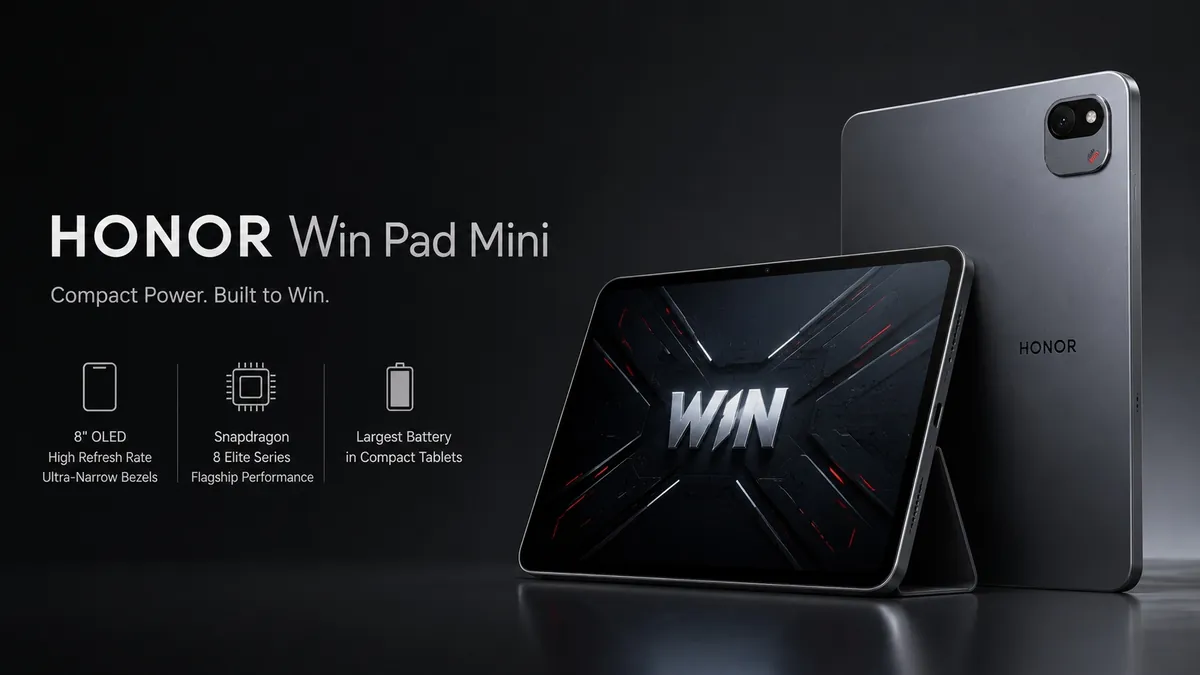
Honor is signaling a significant design evolution for its upcoming WIN 2 and WIN tablet series, prominently featuring an integrated cooling fan mechanism. This incorporation of active thermal management addresses a critical performance bottleneck in modern high-demand mobile computing devices, suggesting Honor is targeting users who require sustained peak processing power.
The teasing of this feature implies that the new hardware iterations will be engineered to handle more intensive workloads—such as prolonged gaming sessions or demanding multitasking environments—without suffering from thermal throttling. This move positions the WIN line not merely as a consumption device, but potentially as a productivity and performance tool capable of competing against established computing ecosystems.
The strategic integration of active cooling indicates a commitment to pushing hardware envelopes beyond previous passive designs. For Honor, this signals a direct challenge within the increasingly competitive tablet market where raw processing capability often requires sophisticated thermal solutions for optimal user experience.
Technical Innovations and Design Philosophy
While detailed specifications remain under wraps pending official launch announcements, the presence of an active cooling fan suggests advancements in both chipset selection and chassis engineering. Such a system demands precise internal component placement to ensure airflow efficiency while maintaining a slim profile—a perennial design challenge in premium mobile hardware.
The WIN series has historically occupied a segment balancing performance accessibility with refined aesthetics, and the addition of this cooling technology elevates that proposition significantly. It suggests Honor is optimizing its thermal design solution to maintain high clock speeds across extended usage periods, directly impacting real-world application responsiveness.
This engineering focus indicates a shift toward more robust hardware architecture. Users can anticipate devices capable of maintaining consistent performance metrics during intensive tasks, moving beyond the typical short bursts of speed often seen in passively cooled counterparts.
Market Positioning and Industry Implications
The development of actively cooled tablets places Honor squarely in the premium segment of the tablet market, where thermal management is becoming a key differentiator rather than just an engineering footnote. Competitors are under pressure to match this level of thermal sophistication if they wish to capture the high-performance user base.
From a broader industry standpoint, this development reflects the maturation curve of mobile processing power; as System-on-Chips (SoCs) become exponentially more powerful, the ability to dissipate that generated heat efficiently becomes the primary limiting factor for sustained performance. Honor is effectively solving one of the most persistent physical constraints of mobile computing.
If successful, this cooling innovation could set a new benchmark for mid-to-high-tier tablets globally. It suggests Honor intends to leverage hardware superiority—backed by sophisticated thermal engineering—as a core selling point against rivals relying solely on software optimization or brand legacy.