Huawei has launched the OpenPanGu 2.0 Pro, a significant advancement in its AI capabilities designed to enhance enterprise-level applications and operational efficiency.
OpenPanGu 2.0 Pro Features
The new iteration of Huawei's large language model incorporates substantial architectural improvements, positioning it as a more robust tool for complex business environments. This updated version emphasizes enhanced reasoning abilities and greater contextual understanding compared to its predecessors.
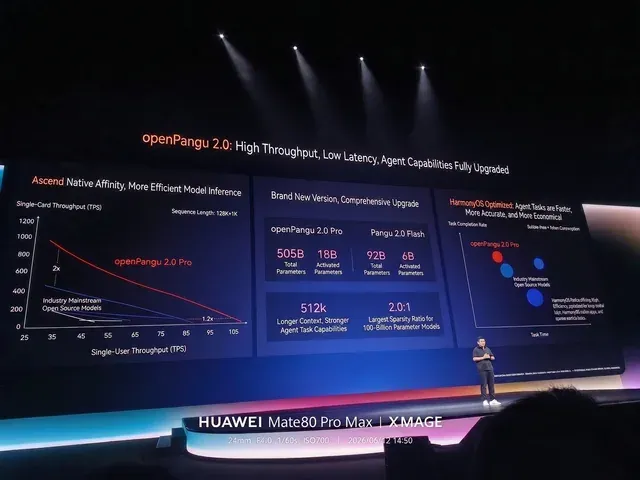
Technically, the OpenPanGu 2.0 Pro boasts optimizations across its core structure, allowing for faster processing times while maintaining high levels of accuracy in diverse tasks. Huawei asserts that these improvements translate directly into more reliable outputs for mission-critical enterprise deployments.
A key strategic focus of the release involves expanding its applicability within vertical industries. The model has been refined to handle industry-specific jargon and complex workflows common in finance, manufacturing, and healthcare sectors, demonstrating a tailored approach to business needs.
Furthermore, the platform maintains a commitment to open standards. By continuing to support an accessible architecture, Huawei aims to facilitate easier integration of OpenPanGu 2.0 Pro into existing legacy systems utilized by large organizations globally.
The development signals Huawei's ongoing aggressive push in the domestic and international AI market, challenging established players with domestically developed, high-performance models.
Deployment and Market Implications
Deployment of OpenPanGu 2.0 Pro is structured to support both on-premise installations and cloud-based access, offering enterprises flexibility regarding data sovereignty and operational infrastructure requirements. This hybrid deployment capability is a critical factor for multinational corporations operating under varying regulatory frameworks.
The introduction aligns with Huawei's broader strategy of providing comprehensive digital transformation solutions rather than merely selling standalone AI components. The model serves as a centerpiece in their suite of intelligent enterprise services.
Analysts suggest that the emphasis on improved reasoning and domain specialization will allow OpenPanGu 2.0 Pro to move beyond basic conversational AI into true cognitive assistance roles within corporate settings. This shift represents a maturation point for many Chinese LLM offerings.
Huawei has detailed specific performance benchmarks demonstrating superior handling of long-context prompts and complex multi-step instructions, areas where previous models often exhibited limitations. These benchmarks underscore the engineering depth applied to this new release.
For businesses seeking to leverage generative AI without relying solely on proprietary Western platforms, OpenPanGu 2.0 Pro offers a powerful, locally optimized alternative. The availability of this advanced model underscores Huawei’s commitment to establishing a competitive, high-performance ecosystem for enterprise artificial intelligence solutions in the coming fiscal cycles.