
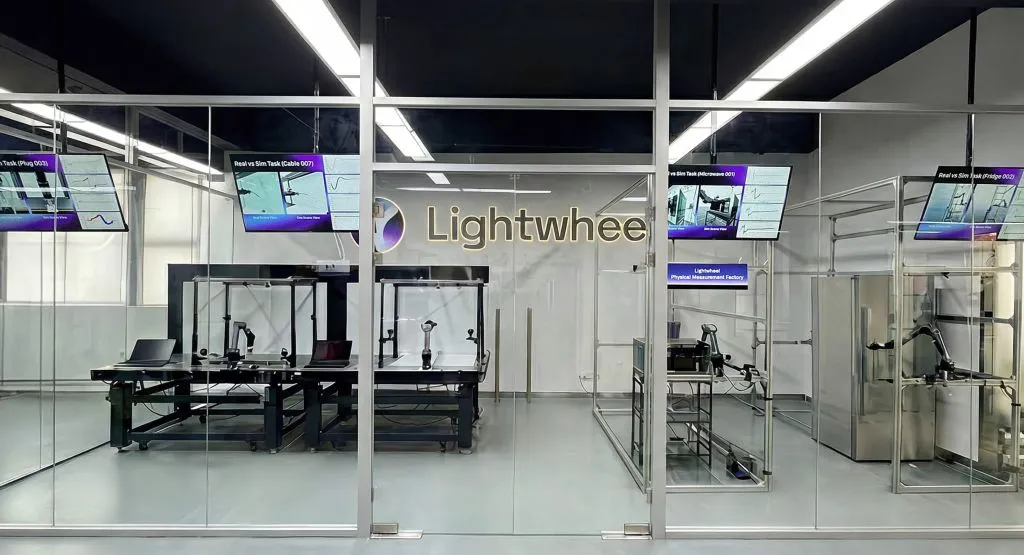
Lightwheel AI secured a new funding round to accelerate the construction of proprietary physical infrastructure for training next-generation artificial intelligence models.
Investment Fuels Physical AI Data Engine
The capital infusion will be strategically deployed to build out sophisticated, real-world data capture and simulation environments necessary for advancing embodied AI capabilities.
Lightwheel AI is positioning itself at the critical intersection of advanced software modeling and tangible physical reality, addressing a growing bottleneck in AI development where purely digital training sets often lack the nuance of the real world.
The company’s focus remains on creating high-fidelity data pipelines that bridge the gap between virtual simulations and complex physical interactions. This approach is central to developing AI agents capable of reliable performance outside controlled laboratory settings.
Funding rounds are increasingly targeting companies capable of generating unique, proprietary datasets, as access to vast amounts of clean, labeled real-world interaction data has become a significant competitive moat in the current technological landscape.
Lightwheel AI's strategy emphasizes moving beyond purely synthetic data generation toward creating physical "data factories." These facilities allow researchers to capture complex sensor readings—including tactile feedback, dynamic environmental interactions, and nuanced spatial awareness—that are difficult or expensive to replicate entirely through simulation alone.
The infrastructure being built is designed not merely for data collection but also for rapid iteration on robotic behaviors. By tightly coupling physical interaction with high-speed data logging, Lightwheel AI can significantly shorten the loop between algorithmic hypothesis and real-world validation.
This capability directly supports the development of general-purpose agents that exhibit robust generalization across varied operational domains, a key objective for researchers in robotics and autonomous systems.
Next Steps for Embodied Intelligence
The investment signals a broader industry shift away from solely cloud-based model training toward grounding AI intelligence in physical experience. This trend acknowledges the inherent limitations of purely abstract mathematical representations when applied to messy, unpredictable physical environments.
By controlling the data generation process—from hardware selection to simulation parameters—Lightwheel AI maintains stringent control over the quality and bias within its training corpus.
This proprietary dataset advantage is expected to provide a significant lead in performance benchmarks for tasks requiring fine motor skills, environmental navigation under uncertainty, and complex object manipulation.
The company’s technical execution involves integrating advanced sensor technology with bespoke robotic platforms capable of executing intricate sequences of actions. This physical layer acts as the ultimate validator for machine learning algorithms developed upstream in the software stack.
Stakeholders view Lightwheel AI's move into dedicated physical infrastructure as a necessary evolution, mirroring how early breakthroughs in deep learning required massive computational power; embodied AI now requires massive physical data throughput.
The successful scale-up of this physical data engine will enable the company to commercialize specialized AI solutions for demanding industrial applications, such as advanced manufacturing and logistics automation. Further details regarding the scope and timeline of infrastructure deployment are expected as the funding round closes, according to reports reviewed by The China Technology Review.