🎙 Listen to a summary of this story
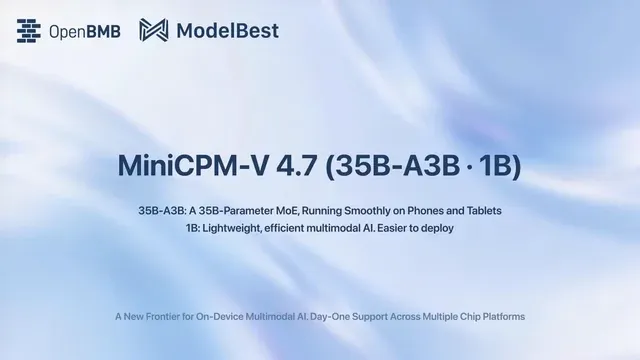
ModelBest has unveiled MiniCPM-V 4.7, a pioneering open-source multimodal model that achieves significant performance while operating within an extremely constrained footprint of just 3GB on mobile hardware.
This release marks a critical advancement in the democratization of advanced AI capabilities, particularly through its architecture as one of the first MoE (Mixture-of-Experts) models to achieve such high efficiency for multimodal tasks. The ability to run sophisticated vision and language processing directly on consumer smartphones challenges previous assumptions about the necessary computational overhead for state-of-the-art local inference.
The immediate significance lies in its potential to drive on-device AI adoption across low-power devices, moving complex reasoning away from centralized cloud servers. This shift enhances user privacy while simultaneously lowering the barrier to entry for deploying sophisticated multimodal applications globally.
Technical Architecture and Deployment Efficiency
MiniCPM-V 4.7 leverages a Mixture-of-Experts architecture within its 35B parameter structure, allowing it to selectively activate only relevant subsets of parameters during inference rather than engaging the entire model uniformly. This sparse activation mechanism is directly responsible for the drastic reduction in memory and computational requirements.
Crucially, benchmark testing confirms that this model can execute complex multimodal tasks—integrating visual input with natural language understanding—using a mere 3GB of memory when deployed on an iPhone platform. This level of optimization places it in direct competition with highly optimized proprietary models designed specifically for edge deployment.
The open-source nature of MiniCPM-V 4.7 is equally important, allowing researchers and developers worldwide to inspect its inner workings, fine-tune it for domain-specific tasks, and build upon its foundation without incurring significant licensing costs associated with closed-source counterparts.
Industry Implications and Future Trajectory
The emergence of highly capable, small-footprint open models like MiniCPM-V 4.7 signals a major inflection point in the AI landscape: the maturation of truly effective edge AI. Geopolitically, this trend supports decentralized computation, reducing reliance on massive data centers located primarily within specific economic blocs.
From an industry perspective, this capability enables entirely new use cases previously relegated to cloud-only services. Imagine real-time, private image analysis for enterprise inventory management or instantaneous visual assistance without any uplink latency.
This development accelerates the race toward ubiquitous on-device intelligence. While larger models will continue to push peak performance benchmarks in data centers, MiniCPM-V 4.7 demonstrates a robust pathway to deploying high-quality AI inference directly where the user interacts with it, fundamentally altering the software architecture of mobile and IoT ecosystems.