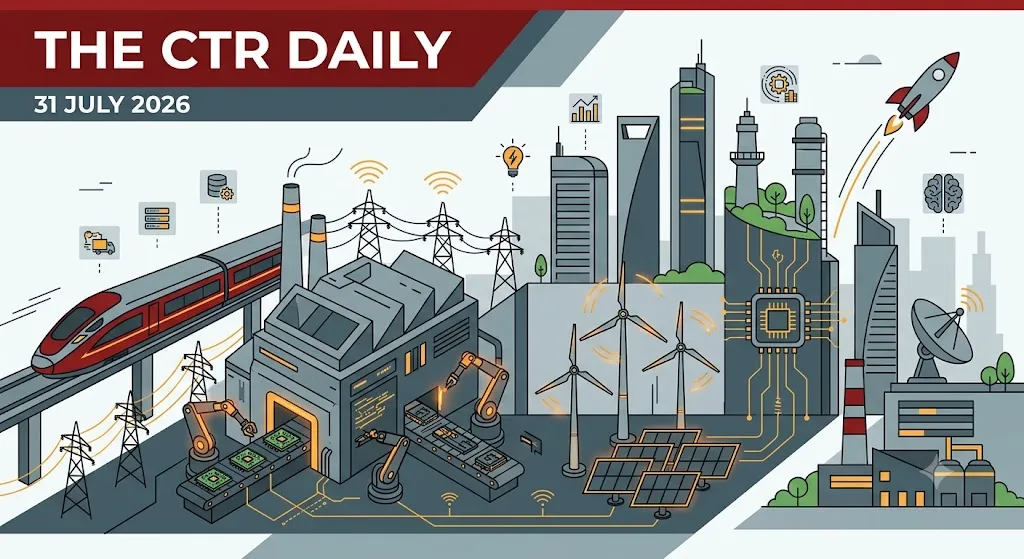
Today’s CTR: China tech’s mood over the past 48 hours is less “moonshot” than “machine room.” The big story is execution: carmakers are designing their own chips, factories are stuffing more artificial intelligence [AI] into robots, and DeepSeek is squeezing more output from existing hardware rather than waiting for perfect silicon. Beijing, meanwhile, is trying to stop brutal price wars from eating the supply chain alive. The strategic through-line is clear: China is building resilience by making technology cheaper, more local and more deployable. Glamour is optional; throughput is not.
Chinese carmakers turn chip design into the next electric-vehicle battleground
Chinese electric vehicle [EV] makers are accelerating efforts to design more of their own semiconductors, with BYD showcasing its Xuanji A3 autonomous-driving chip and peers including Nio, Geely and XPeng pursuing more control over in-car computing. The push does not yet mean full self-sufficiency: high-end fabrication still leans heavily on overseas players such as TSMC, Samsung and Infineon.
Impact: The direction matters more than the present capability. China’s EV industry won batteries by integrating fast and relentlessly; it is now trying to apply the same playbook to chips, where the reward is not just lower cost but insulation from sanctions and supplier bottlenecks.
The closing thought: in China’s car market, the dashboard is becoming a semiconductor policy document. Source
AI pushes Chinese factory robots beyond the usual assembly line
China’s industrial automation drive is moving into a new phase as AI helps robots handle more complex factory tasks, from visual recognition to quality control and remote monitoring. The Financial Times reports that companies are applying these systems beyond traditional heavy manufacturing into sectors such as textiles and footwear.
Reach: This is where China’s robotics advantage becomes economically interesting. The goal is not merely to replace workers in advanced plants, but to make automation viable in messy, lower-margin industries where conventional robots were often too rigid or too expensive to justify.
The closing thought: the robot revolution may arrive first not as a humanoid but as a better pair of factory eyes. Source
China’s factory activity gets a lift from AI-linked exports
China’s official manufacturing Purchasing Managers’ Index [PMI] rose to 50.3 in June from 50 in May, with Associated Press reporting that stronger exports of AI-related hardware helped drive the expansion. New orders and production also improved, although domestic demand remains weighed down by consumer caution and the property slump.
Impact: The data reinforces a familiar imbalance: China’s technology manufacturing engine is still strong, but much of the momentum is being pulled from abroad. AI hardware demand is providing a useful tailwind, yet it also leaves the economy exposed to trade friction and export-cycle volatility.
The closing thought: AI is helping China’s factories hum, but it has not fixed the household wallet. Source
DeepSeek focuses on speed, not just scale
DeepSeek has documented DSpark, a new inference acceleration framework that it says improves how large language models [LLMs] run in production. The company claims the framework can raise serving efficiency by up to 85%, using speculative decoding rather than bigger models, new weights or additional hardware.
Impact: This is strategically important because China’s AI sector faces constraints on access to top-end graphics processing units [GPUs]. If domestic labs can extract more performance from existing compute, the competitive gap narrows without waiting for a perfect domestic Nvidia substitute.
The closing thought: in a chip-constrained world, clever plumbing can be a moat. Source
UBTECH pitches humanoid robots for the home
Shenzhen-based UBTECH unveiled its UWORLD U1 series of full-size ultra-bionic humanoid robots at a June 30 launch event, positioning the machines around human-robot companionship. The lineup includes the U1 Lite, U1 Pro and U1 Ultra, with pricing starting from 119,800 renminbi [RMB].
Reach: The launch shows how China’s robotics market is splitting into two tracks: industrial deployment for productivity, and consumer-facing humanoids for companionship, services and spectacle. The latter will be harder to scale commercially, but it gives Chinese firms a high-visibility testing ground for embodied AI.
The closing thought: China’s humanoid makers are learning that the hardest factory floor may be the living room. Source
Beijing extends the 60-day payment squeeze to EV and energy-storage batteries
China has extended stricter supplier-payment rules to the EV and energy-storage battery sector, requiring payment within 60 days as part of a wider effort to curb destructive price competition. The policy is aimed at easing cash-flow pressure on smaller suppliers and stabilising a sector squeezed by intense capacity growth.
Impact: This is industrial policy with a balance-sheet scalpel. Beijing is not ending competition; it is trying to stop dominant manufacturers from financing price wars on the backs of small and medium-sized enterprises [SMEs]. That matters because a brittle supplier base would weaken the very clean-tech ecosystem China wants to export.
The closing thought: even in China’s breakneck battery race, someone eventually has to pay the invoice. Source