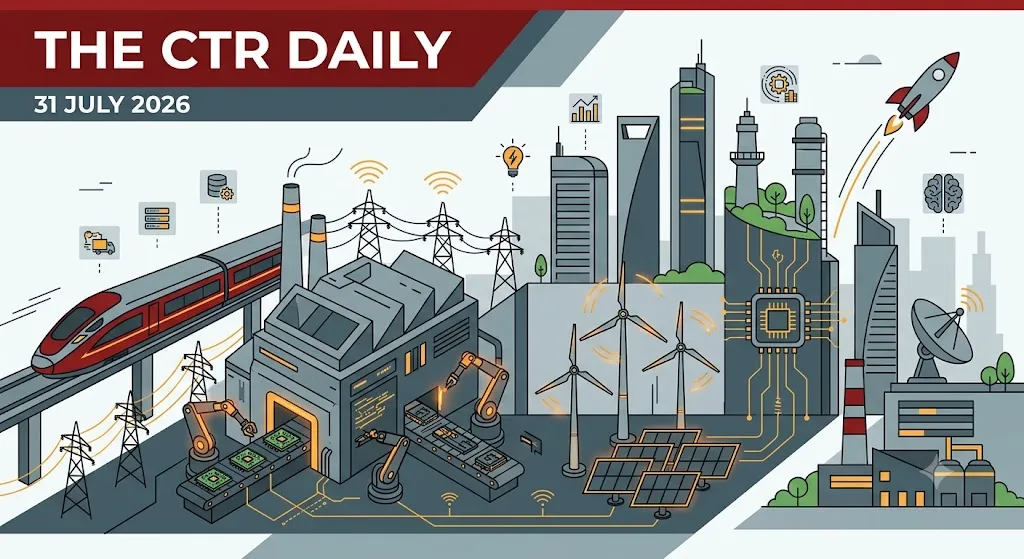
Today’s CTR: China’s tech mood over the past 24 hours is less “move fast and break things” than “move fast and standardize the infrastructure before someone else does.” Beijing is leaning into computing power, embodied artificial intelligence [AI], agentic payments, commercial space hardware and municipal automation. The through-line is familiar but sharper: China wants technology to leave the demo hall and enter the operating manual. The day’s stories show a system trying to turn AI from a chatbot race into a stack of national assets, industrial tools and payment rails. Silicon Valley gets the slogans; Beijing is busy writing procurement rules.
China pushes ahead with a national computing-power network
China’s National Development and Reform Commission said the country will accelerate construction of a national integrated computing-power network, arguing that computing capacity has become a core productive force in the digital economy. By the end of March, China’s intelligent computing capacity reached 1.882 million petaflops [PFlops], about 2.5 times the level a year earlier.
Impact: The story is not merely about more data centers. Beijing is trying to make compute behave more like electricity: planned, routed, allocated and priced as strategic infrastructure. That matters because AI leadership increasingly depends less on isolated model launches and more on whether companies can reliably access cheap, scalable computing power.
The catch is that “market forces” and central coordination are being asked to share the same server rack. China’s cloud providers, telecom carriers and chipmakers will all want a seat at the switchboard.
Closing thought: China is turning compute into industrial policy with a power cord. Source
Beijing’s AI infrastructure ambitions keep climbing
Separate reporting said China is drafting a plan that could direct roughly 2 trillion yuan, or about $295 billion, toward a nationwide AI computing network, with state-backed telecom operators expected to run much of the grid. The plan reportedly targets heavy use of domestic chips and infrastructure, with a goal of linking data centers into a unified platform by 2028.
Reach: This is the clearest expression yet of China’s answer to American hyperscale AI spending: not just corporate capital expenditure, but a quasi-national buildout. The domestic-sourcing target would be a windfall for Chinese chip suppliers such as Huawei-linked ecosystems, but it also tests whether the country can supply enough competitive accelerators, memory and networking gear at scale.
The strategic implication is blunt. China is trying to reduce the pain of US chip controls by building an AI stack that is large enough, local enough and centrally coordinated enough to be useful even if it is not always best-in-class.
Closing thought: The grid may be national; the bottlenecks will still be microscopic. Source
JD and Ant move agentic payments from concept to plumbing
China Daily reported that JD has unveiled an Agent Autonomous Payment Protocol designed to let AI agents complete payments within user-defined rules and spending limits. The system includes six levels of payment autonomy, separates primary accounts from agent-driven spending and requires validation of the user, agent version and operating environment.
Impact: Agentic commerce is one of the first AI use cases where the liability question arrives before the revenue model. If an AI agent buys the wrong product, pays the wrong merchant or gets spoofed, the problem is not philosophical; it is a refund queue, a fraud dispute and possibly a regulator’s afternoon.
Ant International is also pushing an Agentic Mobile Protocol and a “Know Your Agent” trust framework, suggesting Chinese payment players want to export standards as much as products. This is classic platform competition: control the rails and you shape the market that rides on them.
Closing thought: The next wallet may not belong to a person, but it will still need a spending limit. Source
Humanoid robots are being pushed into real work, not just stage walks
Caixin reported that China is targeting 10,000 humanoid robots in commercial use by the end of 2026, with a national initiative directing local governments and state-owned firms to test robots across manufacturing, logistics, retail, healthcare and emergency response. The emphasis is on moving humanoids from demonstrations into application scenarios.
Reach: This is less about whether humanoid robots are ready for prime time and more about how China creates prime time. By ordering pilots across state-linked industrial systems, Beijing can generate the field data, procurement demand and supplier discipline that private robotics markets often struggle to produce on their own.
The risk is familiar: policy can create deployment before product-market fit. China’s robotics sector may get scale quickly, but it still has to prove that humanoids can outperform cheaper, less theatrical automation.
Closing thought: A robot that files a pilot report is still more useful than one that only waves at a trade show. Source
China’s commercial space suppliers chase lighter launches
A Tianjin aerospace company, iStar-space Technology, says its homegrown carbon-fiber composite payload fairings can cut rocket weight by more than 20 percent and are now used in more than 90 percent of China’s domestic commercial launch vehicles. The company has supported 45 successful commercial orbital missions, including a June 15 launch that carried eight satellites.
Impact: The fairing is not the glamorous part of a rocket, which is precisely why it matters. Cheaper, lighter and more reliable components are what turn space from a prestige program into an industrial supply chain. China’s commercial launch sector is now building out the boring middle: materials, adapters, insulation, repeatable production and supplier specialization.
That matters for satellite internet, earth observation and defense-adjacent aerospace capacity. The more China localizes these components, the more resilient its launch ecosystem becomes.
Closing thought: In commercial space, shaving weight is another way of printing margin. Source
Xi’an’s self-driving cleaning boat shows autonomy’s municipal lane
China Daily highlighted a self-driving cleaning boat in Xi’an that patrols waterways at night, collecting floating rubbish with a 15-meter-wide arm before returning to shore-based charging stations. The system is being used to reduce early-morning manual work by cleaning crews.
Reach: This is not the flashiest autonomy story, but it may be one of the more commercially honest ones. Restricted routes, predictable tasks and public-sector customers are far easier than open-road robotaxis. China’s autonomy market is likely to advance through these narrow, useful deployments as much as through headline-grabbing passenger vehicles.
The bigger signal is that cities are becoming testbeds for practical robotics. The future may arrive first as sanitation, inspection and maintenance, which is less cinematic but easier to budget.
Closing thought: Sometimes the killer app for autonomy is picking up trash while everyone sleeps. Source