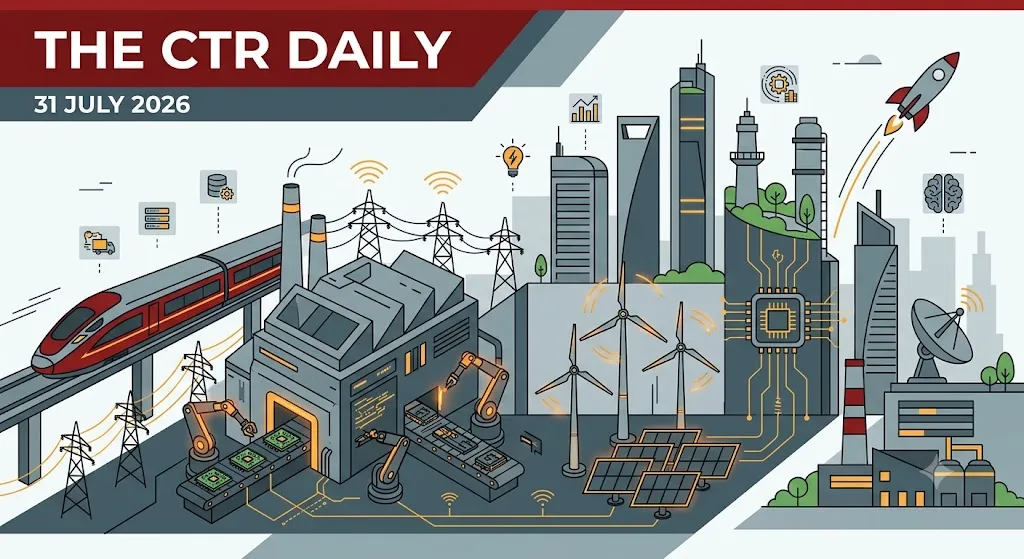

Today’s CTR: The mood in China tech is disciplined, defensive and a little jumpy. Artificial intelligence (AI) products are being trimmed before new rules bite; Alibaba is treating a foreign coding tool as a security problem; chip designers are scaling revenue but still staring at the Nvidia software moat; and robotics firms are rediscovering that the hand, not the head, may be the hardest part of humanoids. The through-line is clear: China’s technology sector is no longer just racing to build. It is racing to control the stack, the data, the supply chain and, increasingly, the regulatory blast radius.
ByteDance and Alibaba pull back AI agents before Beijing’s new rules land
ByteDance and Alibaba are disabling customised, humanlike AI agent features in Doubao and Qwen ahead of new Chinese rules on AI personified interaction services taking effect on July 15. Doubao told users its agent feature would go offline on that date, while Alibaba’s Qwen is also moving to disable similar customised features.
Impact: This is a reminder that China’s AI race is not a Silicon Valley-style product sprint with regulators jogging behind. In China, the rule book can arrive mid-race and force the leading runners to change shoes. Consumer-facing agents, especially those mimicking personalities or sustained human interaction, now sit in a more sensitive regulatory category.
Reach: The near-term loser is experimentation at the consumer layer. The likely winner is enterprise AI, where identity, audit trails and approved use cases are easier to package for regulators and corporate buyers.
China’s agent boom is not ending; it is being house-trained. Source
Alibaba bans Anthropic’s Claude Code and points staff to its own tool
Alibaba will prohibit employees from using Anthropic’s Claude Code from July 10, according to reports, after classifying the programming assistant as high-risk software. Staff have been directed toward Alibaba’s own Qoder coding tool instead.
Impact: The move turns AI coding assistants into another front in the broader technology decoupling. Hardware restrictions get most of the attention, but developer tools are becoming strategic infrastructure too. A coding assistant can see proprietary code, internal workflows and engineering habits; that makes it less like a word processor and more like a very chatty contractor with a security badge.
Reach: For Chinese cloud and AI vendors, the incident is useful commercially. Every foreign tool that becomes politically or operationally awkward gives domestic alternatives a stronger procurement pitch.
The coding-agent market is discovering geopolitics at compile time. Source
China’s integrated circuit design boom nears RMB 1 trillion, but software remains the wall
China’s integrated circuit (IC) design industry is nearing RMB 1 trillion, roughly US$150 billion, ahead of schedule, according to DigiTimes. Yet the report notes that AI is exposing deeper gaps in computing architecture, high-end talent and ecosystem control, especially around Nvidia’s CUDA software platform.
Impact: This is the uncomfortable middle chapter of China’s chip self-sufficiency story. Revenue scale is real, and domestic demand from AI servers, electric vehicles (EVs), industrial automation and consumer electronics is enormous. But in advanced AI computing, chips alone do not win; compilers, libraries, developer familiarity and optimization tools are the invisible empire.
Reach: Expect Chinese policy and private capital to push harder into chip software, not just chip fabrication. The next bottleneck is not merely whether China can design accelerators, but whether developers will enjoy using them.
In semiconductors, silicon is the body; software is the nervous system. Source
Chinese robotics firms focus on the hardest humanoid problem: hands
Chinese companies are accelerating efforts to build dexterous robotic hands, one of the toughest challenges in robotics. Start-ups such as LinkerBot and Wuji Technology are using China’s manufacturing base, embodied AI research and teleoperation data to push robotic hands closer to practical use.
Impact: Humanoid robots often attract attention for walking, talking or looking vaguely employable. But the real commercial question is whether they can manipulate messy physical environments. A robot that cannot reliably pick up, grip, sort, twist, fold or feel is less a worker than an expensive mascot.
Reach: China’s advantage lies in the overlap between robotics, EV supply chains, sensors, motors and low-cost manufacturing. If dexterous hands become standardized modules, Chinese suppliers could occupy a role in robotics similar to the one battery makers hold in EVs.
The future of humanoids may be won not by the company with the best face, but by the one with the best fingers. Source As we covered in our story on The Daily Review: 5 July 2026, this trend continues to shape the strategic landscape.