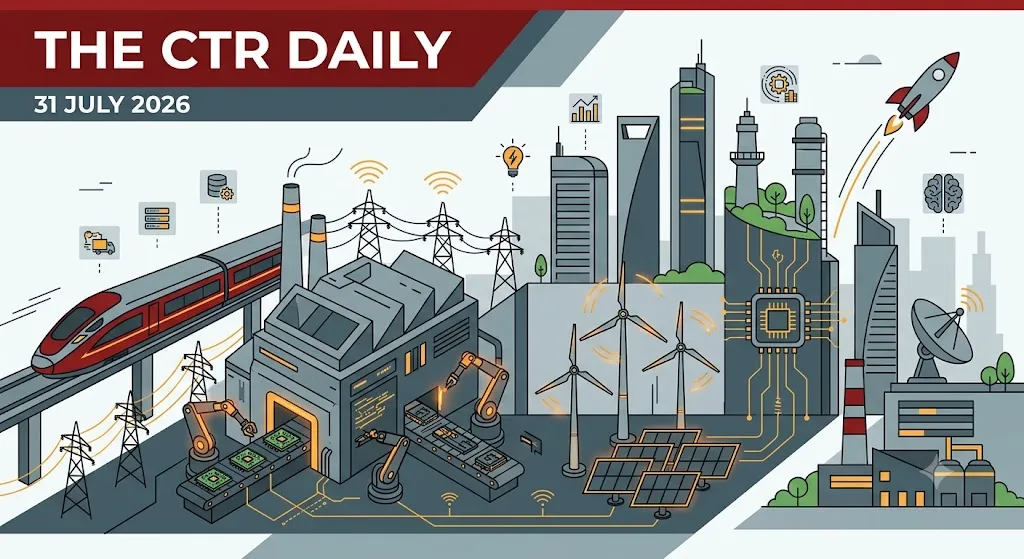

The Week in Tech: The Chinese technology landscape is moving beyond the race for raw computational power toward a more sophisticated, self-sufficient ecosystem. Hardware sovereignty—driven by domestic chip development and strategic pivots away from Western dependencies—is fueling a rapid maturation of AI applications. We are seeing a decisive shift from passive chatbots to autonomous agents capable of complex workflow execution. Simultaneously, regulatory bodies are beginning to draw lines in the sand regarding anthropomorphic interaction, signaling that technological advancement is now being carefully synchronized with societal stability goals.
Domestic Chip Sovereignty Narrows Global AI Gap via "De-CUDA" Pivot
The performance gap between leading U.S. and Chinese artificial intelligence (AI) models has shrunk to a negligible 2.7%, largely attributable to China’s strategic hardware shift away from reliance on NVIDIA's CUDA platform. The launch of MiniMax M2.7 demonstrated "Day 0" support for the domestic sovereign stack, incorporating Huawei Ascend, Moore Threads’ MUSA architecture, and Metax’s MXMACA readiness.
This pivot is substantial: with a 10,000-card Huawei Ascend cluster operational in Shenzhen, Nvidia's projected domestic market share could fall to just 8% by year-end. This signals that China is actively building the full stack necessary for independent technological operation.
From Chatbot to Agent: The Economic Driver Behind Advanced LLMs
The focus in the AI sector is evolving from merely large language models (LLMs) to "Agentic AI," where systems like Alibaba’s Qwen 3.6-Plus can perceive and act autonomously within complex environments, such as executing a "Spreadsheet Agent" for professional tasks.
This transition is being financially enforced by a $66 billion market valuation correction affecting firms like Alibaba and Tencent. Consequently, capital is prioritizing high-return, autonomous applications over simply increasing model parameter counts.
The maturation of these agentic frameworks suggests that the software layer is becoming as powerful as the underlying domestic silicon.
DeepSeek V4 Proves Sovereign Frontier Performance Without Western Hardware
DeepSeek V4 represents a significant milestone, achieving frontier-class performance while being optimized natively for domestic hardware like Huawei Ascend and Cambricon. It leverages a 1-trillion parameter Mixture-of-Experts (MoE) architecture, requiring only 32–37 billion active parameters per token.
This algorithmic triumph demonstrates that China can reach "GPT-5 class" capabilities through intelligent design rather than solely relying on massive compute power. This creates a vital software foundation for future embodied intelligence applications in robotics and manufacturing.
Humanoid Robots Move Off the Lab Bench into Retail
China is transitioning humanoid robotics from pure prototypes to commercial goods, exemplified by Chery’s Mornine M1 now available at a retail price of 285,800 RMB. Furthermore, Agibot’s G2 has successfully completed sustained eight-hour industrial shifts on tablet assembly lines with near-perfect accuracy.
This industrialization is matched by regulatory foresight; China has secured the convenor role for ISO standards related to "Humanoid Robot Datasets." As production scales toward 20,000 units annually, domestic players are positioning themselves as global benchmarks in embodied intelligence.
State Intervention Targets Emotional Boundaries of Artificial Companions
The Cyberspace Administration of China (CAC) has enacted the "Interim Measures for the Administration of AI Anthropomorphic Interaction Services," effective July 15, 2026. These regulations mandate explicit disclosure that an entity is not human.
Crucially, the rules strictly ban "virtual companion" services targeted at minors to mitigate risks associated with digital dependency and psychological attachment. This regulatory focus reflects a state-level effort to manage social outcomes alongside technological leaps.
Orbital Computing and Domestic Clusters Redefine National Infrastructure
To overcome terrestrial physical limitations, the Ministry of Industry and Information Technology (MIIT) is advancing its "orbital computing" roadmap using AI constellations linked by laser inter-satellite connections. On the ground, Sugon’s 60,000-card "AI for Science" (AI4S) cluster has demonstrated massive computational gains in complex simulations like protein folding.
These sovereign clusters provide essential computing power necessary for national security and drug discovery, a capability bolstered by parallel advancements in high-density, non-flammable energy storage solutions to stabilize the grid.
Energy Density Breakthroughs Powering Mobile and Grid Demands
Innovations in battery chemistry are fundamentally altering the "New-type Power Grid," with the Chinese Academy of Sciences developing a Polymerizable Non-flammable Electrolyte (PNE) that acts as an internal safety barrier. Concurrently, major players like CATL and HiTHIUM are standardizing on large-format cells designed for two decades of service.
This chemical reliability underpins the aggressive push toward ultra-fast charging infrastructure—standardizing 1,500 kW "Flash Charging"—and is now being adapted to meet the extreme power needs of AI-intensive flagship mobile devices.