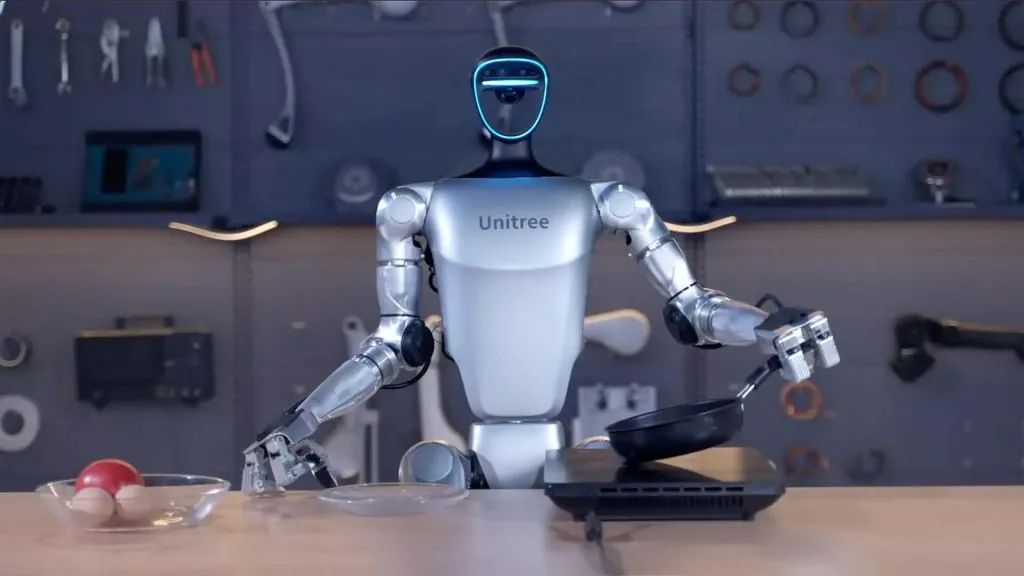
Unitree, a leading robotics firm, has filed for an Initial Public Offering (IPO), positioning itself to potentially become the first "Embodied Intelligence Stock."
The filing signals significant market ambition for the company, which develops advanced humanoid and quadruped robots. Unitree's trajectory mirrors the broader technological shift toward integrating sophisticated artificial intelligence directly into physical hardware.
IPO Strategy and Market Positioning
Unitree is leveraging its rapid growth in the robotics sector to attract substantial investment capital through the forthcoming IPO process. The company’s designation as an Embodied Intelligence Stock reflects a strategic focus on robots capable of complex, real-world interaction rather than purely digital processing.
This market classification suggests investors are looking beyond traditional software valuations and into hardware platforms that exhibit autonomous decision-making capabilities in dynamic environments. Unitree's technology addresses this intersection directly through its sophisticated robotic designs.
The company’s portfolio includes highly capable quadruped robots, which have seen significant traction in various industrial and research applications globally. These machines are engineered for robustness and adaptability, key attributes driving demand across logistics, inspection, and mobility sectors.
Sources indicate that the IPO aims to fund continued research and scaling of its advanced robotic platforms. The capital infusion will likely fuel expansion into new commercial verticals and accelerate R&D efforts in areas like sensor fusion and on-board processing power.
The market narrative surrounding Unitree is increasingly tied to automation readiness. As global industries grapple with labor shortages and the need for precision tasks, robots capable of navigating unstructured environments—a hallmark of embodied intelligence—are becoming mission-critical assets.
Technological Underpinnings Driving Valuation
Unitree’s competitive edge stems from the integration of proprietary hardware engineering with advanced AI algorithms. The company does not merely build mobile platforms; it designs systems that learn and adapt during operation, which distinguishes it from simpler automation tools.
The quadruped models demonstrate exceptional agility, allowing them to traverse uneven terrain where wheeled or tracked vehicles would fail. This capability translates directly into high utility in challenging operational settings, such as construction sites or disaster zones.
Furthermore, the underlying software architecture facilitates rapid deployment and retraining of the robots for specific tasks. This flexibility lowers the barrier to adoption for industrial clients who require versatile robotic solutions rather than single-purpose machinery.
The pursuit of becoming an "Embodied Intelligence Stock" is a deliberate attempt to capture premium valuation associated with true general-purpose robotics, moving past niche applications. It places Unitree in direct competition with established players while carving out a leading position in the humanoid and advanced quadruped segments.
Analysts watching the filing suggest that success hinges on demonstrating scalability of these sophisticated systems outside of controlled laboratory settings. The market will assess whether Unitree can translate its technological prowess into widespread, reliable commercial deployment at scale.