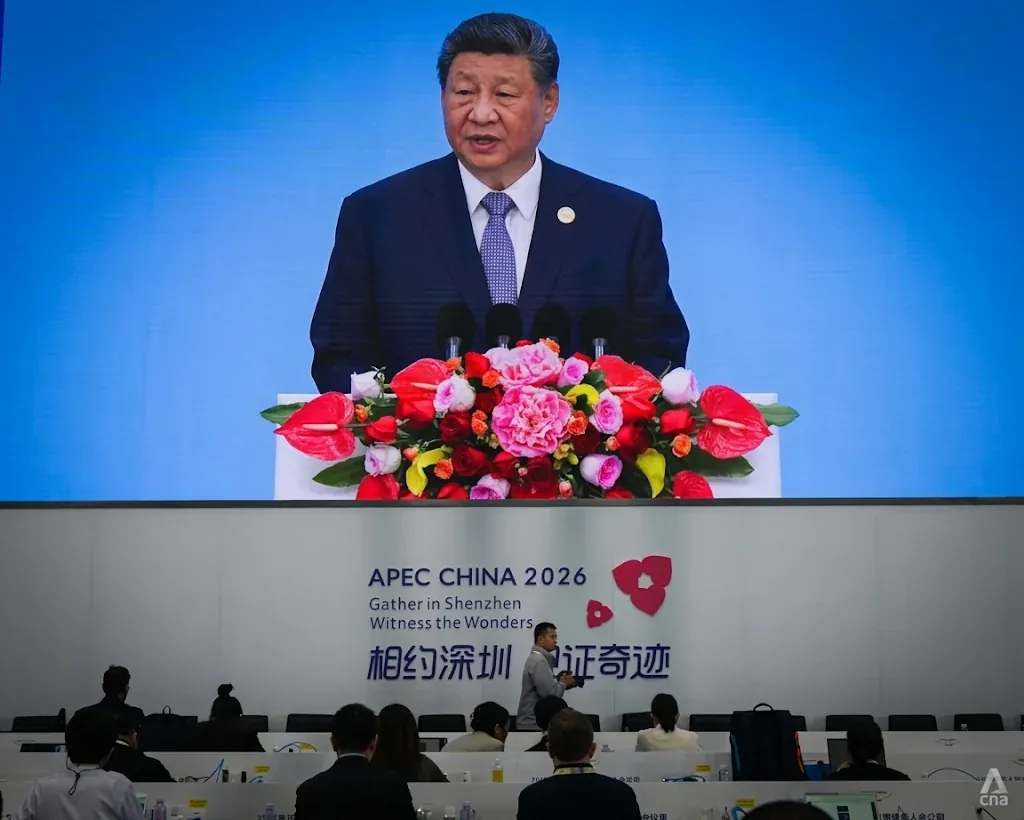
Chinese President Xi Jinping on Wednesday called for lower trade barriers and stronger economic cooperation across the Pacific, presenting China as a dependable partner for international business as renewed technology restrictions threatened its fragile trade truce with the United States.
Speaking to business leaders at the Asia-Pacific Economic Cooperation CEO Summit, Xi promised wider access to China’s markets and urged governments to protect supply chains, deepen digital commerce and advance a regional free trade area. His address came ahead of planned talks Thursday with U.S. President Donald Trump and Russian President Vladimir Putin.
The setting reinforced his message. Shenzhen, a southern Chinese manufacturing and technology powerhouse, offered a showcase of the economic transformation Beijing wants foreign investors to embrace — and the industrial strength increasingly at the center of international trade disputes.
Xi promises greater access to China’s markets
Xi urged support for the World Trade Organization and a trading system governed by agreed rules, warning that protectionism and unilateral action threatened economic progress. He called for closer cooperation in cross-border e-commerce, digital trade and customs technology, alongside efforts to keep industrial supply networks operating smoothly.
For overseas businesses, his central pledge was that China would lower tariffs, expand market access and tackle obstacles embedded in regulations and standards. He also promised greater openness in manufacturing and services and increased imports of high-quality goods.
But the address offered no timetable or details identifying which tariffs would fall, how large the reductions would be or which businesses would benefit first, according to CNA. That left companies awaiting practical measures behind Beijing’s renewed assurances of a predictable investment environment.
The trade message came as Washington’s latest restrictions on Chinese access to advanced artificial intelligence chips added pressure to relations between the world’s two largest economies. Reuters reported that Beijing had pledged retaliation, raising fresh uncertainty over a truce reached after last year’s tariff confrontation.
Xi’s proposals extended beyond goods crossing borders. He sought partnerships in artificial intelligence, scientific research and low-carbon development, arguing that technological advances should generate growth throughout the region. He also called for cooperation tailored to economies at different stages of development, including support in transport, energy and food security.
Shenzhen puts high-tech trade on display
Shenzhen’s role as host gave those proposals a concrete backdrop. Home to Huawei, Tencent, electric vehicle maker BYD and drone manufacturer DJI, the city brings together globally important businesses in telecommunications, digital services, clean transport and advanced manufacturing.
Its development illustrates how China’s export economy has evolved. Shenzhen began with processing trade and expanded into sophisticated manufacturing, with newer industries including robotics, artificial intelligence and electric vehicles. At BYD’s factories, vehicles move from production lines through Shenzhen’s port to overseas customers, the municipal government says.
The city’s commercial ties with the Pacific region are substantial. According to the summit’s Shenzhen media kit, trade with other APEC economies reached 1.98 trillion yuan in the first half of 2026, up 33% from a year earlier and accounting for nearly 70% of its foreign trade.
Those connections give Shenzhen a direct stake in whether regional commerce becomes easier or more restricted. Its exporters depend on access to customers abroad, while technology companies operate across supply chains affected by licensing decisions, investment rules and competing national security priorities.
Xi highlighted Shenzhen’s transformation from a small border town into an international metropolis in his speech. The implication was clear: Beijing wants its development presented as evidence that opening markets and investing in innovation can reinforce each other.
Trump and Putin talks test cooperation message
The diplomacy surrounding APEC will test that appeal. Xi and Trump are scheduled to hold bilateral talks Thursday before joining Putin for their first three-way leaders’ meeting. Trade and technology tensions form the economic backdrop, while nuclear weapons and international security add a separate, potentially difficult agenda.
The White House has said Trump intends to discuss reducing nuclear weapons. U.S. officials have tempered expectations, describing the gathering as the start of a conversation rather than a meeting likely to produce an agreement.
Putin, addressing the business summit Wednesday, criticized sanctions and export restrictions and emphasized Russia’s economic ties with the Asia-Pacific. His appearance underscored how disputes over security increasingly shape commercial relationships.
APEC’s commitments are voluntary, limiting its ability to resolve those disputes. For companies gathered in Shenzhen, the immediate question is whether Xi’s promises and the leaders’ diplomacy produce clearer market access and more stable trading conditions.