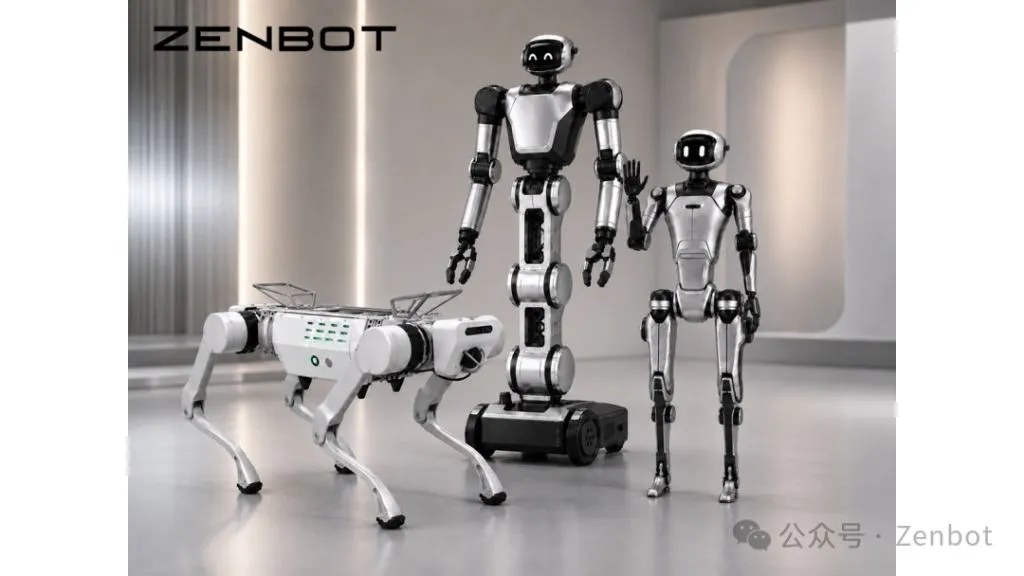
Embodied AI startup Zenbot secured nearly 100 million yuan in an angel funding round, signaling significant investor confidence in the burgeoning field of physical intelligence.
The substantial capital infusion positions Zenbot to accelerate development across its core platforms, which integrate advanced artificial intelligence with real-world robotic capabilities. The company focuses on creating embodied AI systems capable of navigating and interacting intelligently within complex environments, moving beyond purely digital applications.
This funding validates the market's appetite for solutions that bridge the gap between sophisticated computational models and tangible, autonomous action. Zenbot’s technology aims to solve intricate logistical and operational challenges where current automation methods prove insufficient or too rigid.
Strategic Focus on Embodied Intelligence
Zenbot’s technological differentiation lies in its ability to perceive, reason, and act within unstructured physical spaces. Unlike purely software-based AI solutions, Zenbot's products possess a degree of autonomy rooted in their physical form, enabling them to handle variability inherent in real-world scenarios.
The angel round funding is earmarked for scaling operations, expanding the engineering team, and furthering research into more complex environmental interaction models. Specific deployment targets reportedly include advanced manufacturing environments and intricate warehouse logistics where precision and adaptability are paramount requirements.
Industry observers suggest this investment reflects a broader shift in venture capital focus away from purely large language model (LLM) applications toward systems that can execute those LLM directives physically. The convergence of generative AI with robotics represents the next major frontier in enterprise automation, and Zenbot appears positioned at its vanguard.
The company’s approach emphasizes developing robust "world models" within its robotic agents—internal representations of how the physical world operates. This allows for proactive decision-making rather than mere reactive execution based on pre-programmed scripts, a critical leap for industrial adoption.
Market Implications and Future Trajectory
The successful closing of this angel round places Zenbot among key players vying to define the commercial standards for embodied AI in China. The near 100 million yuan injection provides the runway necessary for aggressive market penetration against established industrial automation providers.
Investors backing Zenbot are betting on a future where robots do not simply perform repetitive tasks, but actively participate in complex problem-solving processes alongside human workers or autonomously manage entire operational workflows. This shift promises substantial productivity gains across various sectors.
While the specific terms of the angel round remain proprietary, the financial backing signals strong belief in Zenbot’s scalable architecture and its potential to capture significant market share as embodied AI matures from a research concept into an industrial necessity.
Zenbot's ability to translate abstract intelligence into concrete physical action addresses a major bottleneck in current automation cycles. The company continues to refine the integration between perception stacks, planning algorithms, and low-level motor control systems, aiming for reliable deployment across diverse client infrastructures.