
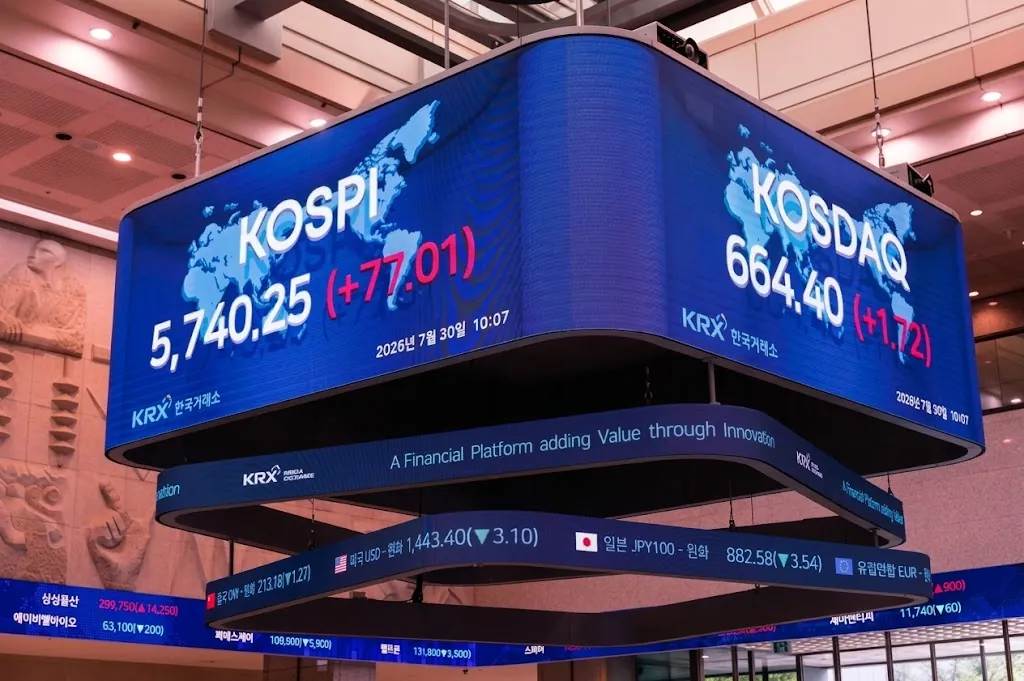
Taiwan stocks plunged to their steepest-ever decline, while South Korea suspended trading amid a severe, sector-wide rout driven by aggressive sell-offs in the AI industry.
The dramatic market contraction signals acute investor apprehension regarding the valuation and near-term growth trajectory of key technology leaders across East Asia. This synchronized downturn highlights the fragility of high-growth tech valuations when subjected to rapid, concentrated profit-taking, particularly within the semiconductor and AI hardware ecosystems.
The selling pressure was not isolated to any single national exchange; it propagated across major technology hubs, indicating a broad, systemic recalibration of risk appetite among institutional investors. The market response underscores the current sensitivity of advanced technology stocks to macroeconomic shifts and evolving investor sentiment surrounding AI adoption curves.
Market Mechanics and Sectoral Stress
The short trading halt for 20 minutes implemented in South Korea was a direct measure by regulators to stabilize the exchange following unprecedented volatility, reflecting the depth of the AI-related sell-off as the KOSPI plunged more than 8%. Taiwanese indices experienced precipitous drops as investors rapidly liquidated positions in firms heavily exposed to the global AI infrastructure build-out, including chip designers and advanced memory manufacturers.
Commercial dynamics suggest that while AI remains the dominant theme, the market is now aggressively correcting for expectations. The initial euphoria surrounding AI monetization appears to have given way to concerns over capital expenditure cycles, supply chain bottlenecks, and the sustainability of exponential growth rates across the hardware stack. Specific components, from advanced logic chips to high-bandwidth memory (HBM), saw disproportionate declines.
Analysts point to the interplay between high valuations and macroeconomic uncertainty as the primary technical driver. Investors are re-evaluating the risk-reward profile, demanding clearer, near-term revenue visibility rather than relying solely on long-term technological potential. This shift has forced a severe repricing across the entire semiconductor value chain.
Geopolitical and Industry Implications
Beyond immediate financial losses, this sharp market correction carries significant geopolitical weight, given the centrality of Taiwan and South Korea to global high-end semiconductor manufacturing. Any sustained instability in these markets immediately translates into supply chain risk for multinational technology corporations worldwide.
The rout forces a strategic reassessment of diversification. Companies reliant on the East Asian tech corridor must now navigate a more volatile environment, potentially accelerating efforts to build resilient, geographically dispersed manufacturing and R&D footprints. This recalibration moves the focus from pure expansion to defensive operational stability.
Ultimately, the depth of this sell-off serves as a crucial barometer for the next phase of the AI revolution. While the underlying technological demand for AI remains structurally sound, the market is signaling a transition from speculative investment to demonstrable, profitable execution. Investors are now demanding tangible returns commensurate with the immense technological bets placed on this sector.