🎙 Listen to a summary of this story
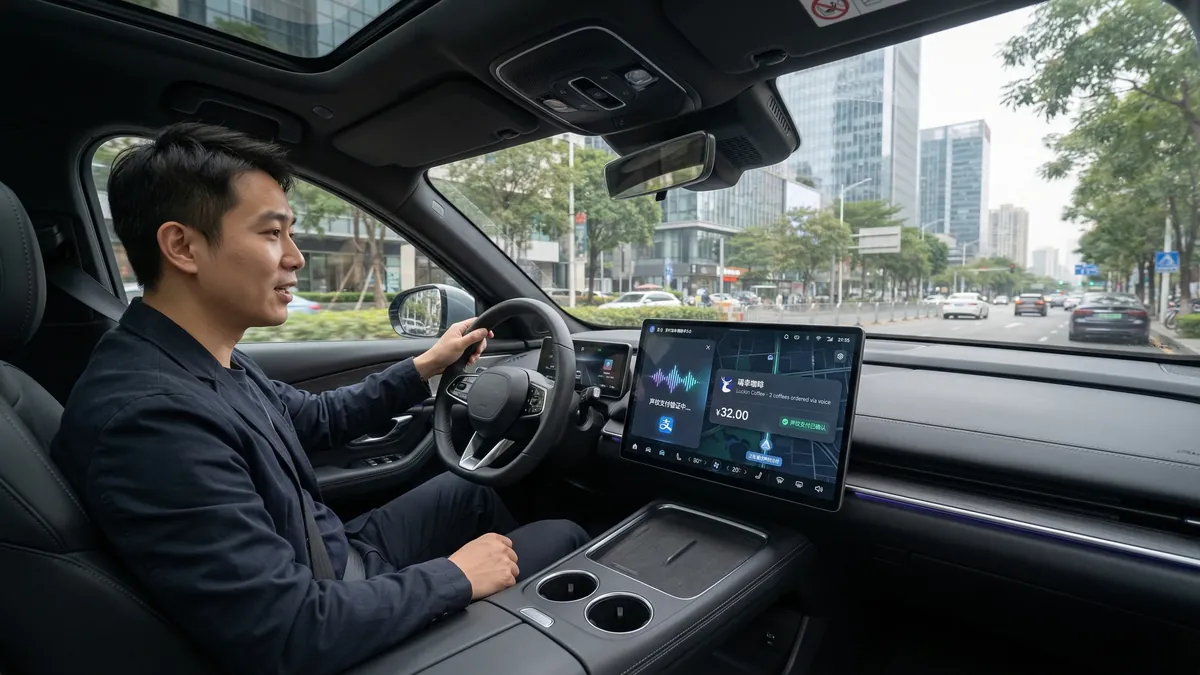
Alipay has launched In-Car Assistant 3.0, integrating advanced voice ordering and biometric voiceprint payments directly into the vehicle experience. This significant upgrade positions Alipay to deepen its penetration into the rapidly expanding automotive digital ecosystem, moving beyond simple infotainment to become a core transaction layer within the modern automobile.
The new iteration signals a strategic pivot for Alipay, leveraging its established financial infrastructure to solve friction points inherent in in-car commerce. By enabling hands-free, secure payments via unique voiceprints, the system drastically lowers the barrier to entry for users wishing to purchase goods or services while driving, directly addressing safety and convenience concerns.
This integration represents a critical step in China’s broader push toward smart, interconnected mobility, where the vehicle is evolving from a mode of transport into a mobile, personalized commerce hub. The deployment of Assistant 3.0 immediately places Alipay in direct competition with established automotive software providers vying for control over the in-vehicle user journey.
Technical Integration and Commercial Dynamics
Technically, Assistant 3.0 moves beyond simple wake-word recognition. It incorporates sophisticated natural language processing (NLP) models capable of understanding complex, contextual voice commands related to purchasing and service requests. The voiceprint payment module utilizes advanced biometric authentication, ensuring that transactions are tied specifically to the authenticated driver profile, thereby mitigating risks associated with shared vehicle usage.
Commercially, the platform is designed not only for immediate gratification—such as ordering coffee or roadside assistance—but also for recurring services. This allows Alipay to build long-term data profiles on driver behavior, spending habits, and travel patterns, providing valuable data streams that can be monetized through targeted partnerships with automakers and third-party vendors.
The rollout focuses initially on key markets within China where smartphone penetration and adoption of mobile payment ecosystems are highest. However, the architecture is built with scalability in mind, suggesting future international deployment is a calculated objective to capture global mobility market share.
Market Implications and Industry Shift
The introduction of robust voiceprint payments signifies a maturing trend in FinTech convergence with IoT. It establishes a new standard for secure, zero-touch transactions within high-mobility environments, setting a competitive benchmark for rivals in the autonomous and connected vehicle space.
From a geopolitical perspective, this reinforces the dominance of domestic Chinese tech giants in capturing the high-value data generated by next-generation transportation. As vehicle data becomes an invaluable asset, Alipay is positioning itself not merely as a payment processor, but as a data custodian within the automotive supply chain.
Ultimately, the success of Assistant 3.0 will define the next phase of automotive digitalization. If user adoption rates meet projections, the in-car experience will fundamentally shift from being a passive passenger environment to an active, seamless digital commerce platform, transforming how consumers interact with services while on the move.