🎙 Listen to a summary of this story
National Push Drives Industrial Upgrading
The Chinese government has intensified strategic support for high-end manufacturing, aiming to overcome historical reliance on imported technology and components. This concerted effort places advanced production techniques—ranging from robotics integration to precision engineering—at the forefront of national economic planning.
Policy directives emphasize moving beyond basic assembly into complex, knowledge-intensive production chains. State investment is heavily channeled into R&D consortia that bridge academic research with industrial application, ensuring technological breakthroughs translate directly into viable commercial products.
A critical area of focus involves the semiconductor and new energy vehicle supply chains. These sectors represent strategic chokepoints where reliance on foreign entities poses significant geopolitical risk to China's economic stability. Consequently, national initiatives are prioritizing vertical integration within these domains.
The government mandates that enterprises achieving certain levels of technological sophistication receive preferential financing and regulatory easing. This creates a powerful incentive structure favoring firms willing to undertake the substantial capital expenditure required for advanced machinery and process retooling.
Industry analysts suggest this push is not merely about increasing output volume, but fundamentally restructuring the quality profile of Chinese industrial output to meet global standards for innovation.
Key Technologies Under Accelerated Development
Specific technological pillars receiving concentrated governmental attention include intelligent manufacturing systems and materials science. Intelligent manufacturing, often termed "Smart Manufacturing," involves embedding IoT sensors, AI algorithms, and automated control systems directly into production lines.
This digitization allows for real-time process optimization, predictive maintenance, and hyper-customization of products at scale—capabilities previously exclusive to leading Western industrial complexes. Factories are being reconfigured from static assembly points into dynamic, data-driven ecosystems.
Furthermore, the development of advanced materials is accelerating to support next-generation applications, particularly in aerospace and high-efficiency energy storage devices. The ability to design and produce novel alloys or composite structures domestically is seen as essential for maintaining technological parity with international rivals.
The integration of these manufacturing advancements directly feeds into China’s broader goals outlined in its industrial policy documents. Success in advanced production serves as a direct metric of national technological sovereignty.
Companies benefiting from these policies are increasingly becoming global exporters, not just of finished goods, but of proprietary manufacturing know-how itself. This shift signals an evolution from being a low-cost manufacturer to becoming a high-value technological producer within the global economy, according to reports detailed in The China Daily .
…BEIJING — At a limestone mine in eastern China, a driverless truck follows a route set by satellite navigation, 5G and laser radar. One worker can supervise five vehicles from a control room, according to China Daily’s account of the operation. The scene captures a shift in China’s industrial ambitions: Advanced manufacturing now means changing how established industries work, as well as building electric cars, chips and robots.
Beijing wants factories to use more automation and artificial intelligence while relying less on imported components and equipment. Its goal is to make supply chains more resilient and help Chinese companies compete for higher-value business overseas. The strategy is gaining force as China’s manufacturers face a slower domestic economy and growing competition abroad.
Upgrading the factory floor
China’s 2026–2030 development plan calls for advanced manufacturing to form the backbone of a modern industrial system. It pairs support for emerging fields, including robotics, aerospace and new materials, with upgrades to steel, shipbuilding and machinery. The plan also calls for stronger domestic capabilities in critical components and specialised materials.
The government is turning those ambitions into factory programmes. Under a 2026 initiative, six government bodies are assessing and promoting “smart factories” at different levels of sophistication. A separate AI and manufacturing programme seeks to bring the technology into industrial production. In practice, that can mean systems that inspect products for defects, adjust equipment or flag a machine before it fails.
Recent figures show how quickly parts of the sector are expanding. Output from China’s high-technology manufacturers rose 16.7% in August from a year earlier, compared with 6.1% growth for manufacturing overall, according to the National Bureau of Statistics. Production of new energy vehicles rose 21.9%. Those figures measure output, however, and do not establish that factories have solved every technical weakness or are earning strong profits.
Robots reveal both progress and gaps
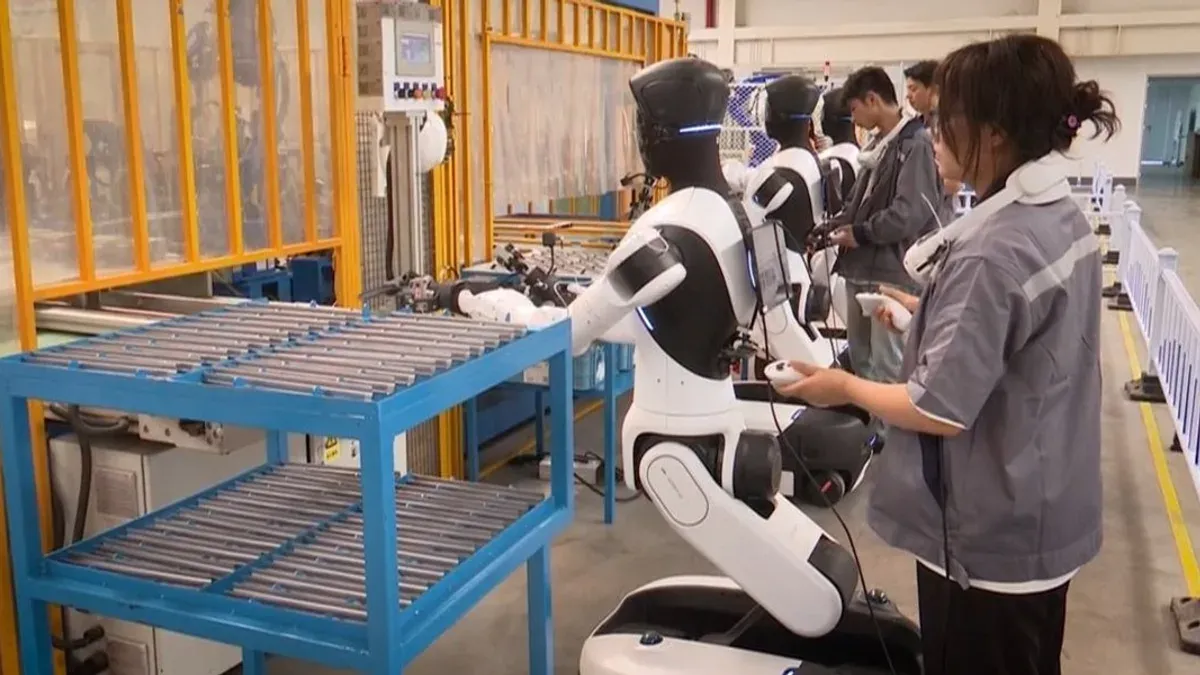
China’s scale is particularly visible in industrial robotics. Factories installed 354,000 robots in 2025, accounting for 59% of installations worldwide, the International Federation of Robotics reported this month. Chinese robot makers also sold more units than foreign suppliers in their home market, a sign that local companies are winning ground in equipment used to build other products.
Yet installing robots is only part of the challenge. A production line also depends on sensors, control software, precision components and the ability to keep equipment running reliably. China Daily reported that specialists still see significant import dependence in some of those areas. For Beijing, closing those gaps matters as much as producing more finished goods: A factory cannot be fully insulated from a disrupted supply chain if a crucial part remains hard to replace.
The same tension runs through semiconductors and electric vehicles. China has built extensive vehicle and battery supply chains, but more advanced production depends on a wide range of tools, materials and expertise. Developing substitutes takes time and testing. A component made domestically must also meet the cost, performance and reliability requirements of companies that use it.
Global success brings new pressure
China’s progress is changing markets beyond its borders. Its electric car exports doubled in 2025, according to the International Energy Agency. The agency linked that surge partly to an intense domestic price war that squeezed automakers’ margins and encouraged them to seek sales overseas. It also warned that rising inventories and changing trade rules could constrain exports in 2026.
European manufacturers are feeling the shift. A European Central Bank analysis published this month found that China’s exports increasingly resemble those of European countries in machinery and transport equipment, particularly Germany. It also found that China’s reduced reliance on some European industrial goods has coincided with European losses of export market share where competition has intensified.
For China, the question is whether industrial upgrading can deliver durable returns alongside technological independence. More sophisticated factories may make better products with fewer defects and less waste. They can also add capacity to markets where companies already struggle to make money. Beijing’s manufacturing push has made China a more formidable competitor; its next test is turning that capability into profitable, dependable production.