China’s rise to second place in global intelligent computing power marks a turning point in the country’s technology strategy. The expansion is not simply the product of companies purchasing more servers. It reflects an increasingly coordinated system in which state capital, industrial policy and private-sector demand are directing resources towards artificial intelligence, advanced semiconductors and the infrastructure needed to support them.
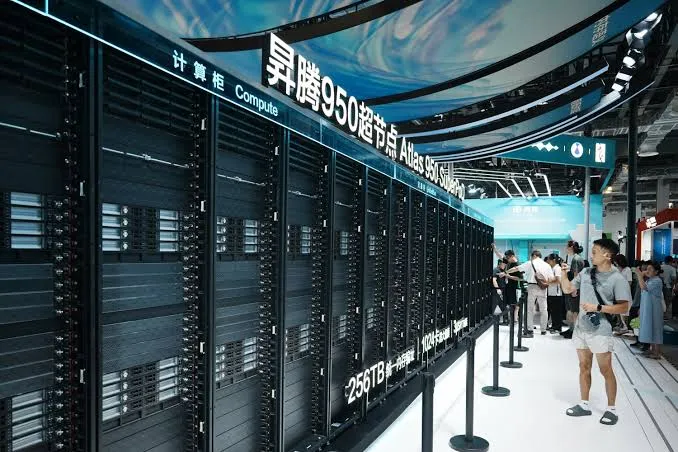
According to China’s Digital China Development Report 2025, the country’s intelligent computing capacity reached 1.59 million PFLOPS by the end of 2025, ranking second globally. More recent government data indicated that capacity continued to expand rapidly during the first half of 2026. The growth has been driven by demand for training large language models, operating generative-AI services and deploying intelligent systems across manufacturing, transport, healthcare and scientific research.
The most significant change is qualitative rather than numerical. Sales of dedicated AI servers have reportedly overtaken those of conventional general-purpose servers in China for the first time. Central processing units remain essential to everyday business computing, but the fastest-growing workloads increasingly depend on graphics processors, neural-processing units and other accelerators designed to perform enormous numbers of calculations in parallel.
AI Infrastructure Becomes a Strategic Industry
This transition is reshaping Chinese data centres. Facilities originally designed to host websites, databases and enterprise software are being reorganised around dense clusters of AI accelerators, high-speed networking and advanced cooling systems. Cloud providers are simultaneously developing platforms through which companies can rent specialised computing capacity rather than build costly clusters themselves.
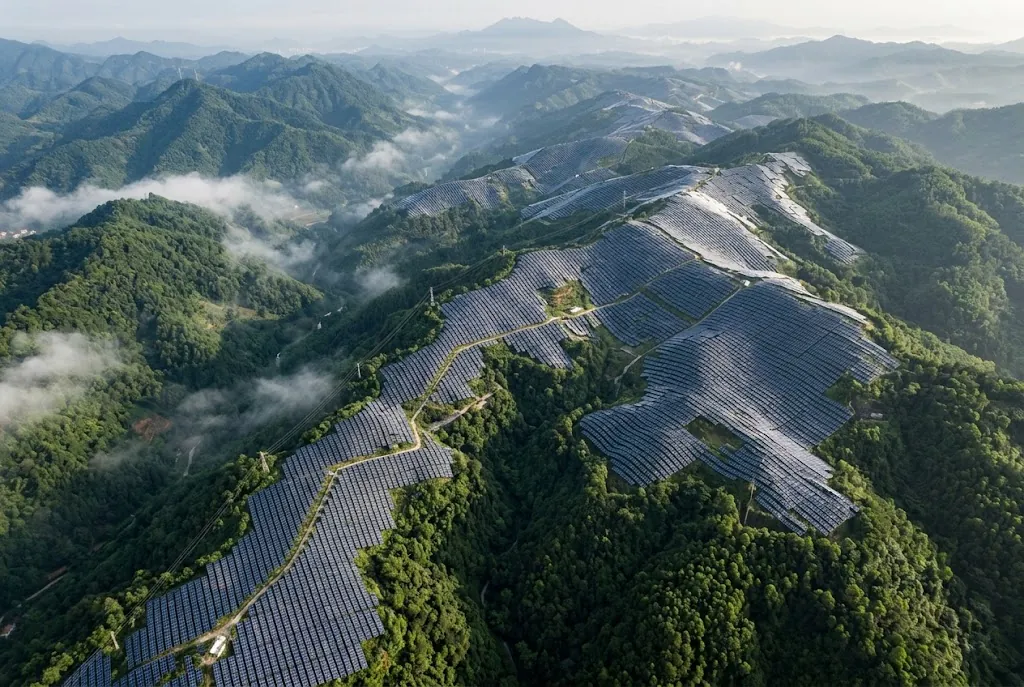
Beijing is also attempting to connect computing centres across the country. A Ministry of Industry and Information Technology plan calls for greater interoperability between facilities, standardised access to computing resources and more efficient allocation of workloads. This supports the broader “East Data, West Computing” programme, under which data-intensive tasks can be transferred from crowded coastal regions to western provinces with cheaper land and greater access to renewable energy.
Five areas are emerging as particularly important: high-end computing equipment, energy-efficient data centres, domestic replacement of imported technology, overseas expansion by Chinese suppliers and computing services delivered through the cloud. Together, they show that computing power is becoming an industrial ecosystem rather than a stand-alone technology market.
The growth nevertheless exposes China’s continuing weaknesses. Export restrictions have limited access to the most advanced American-designed AI chips and the manufacturing equipment required to reproduce them domestically. Chinese companies are responding by redesigning models, improving software efficiency and adopting processors supplied by firms such as Huawei. These substitutes are developing quickly, although they do not consistently match the performance or software support offered by the leading international products.
State Capital Reshapes Technology Investment
The infrastructure build-out is being financed through a distinctive combination of corporate spending, bank lending, local-government investment vehicles and national guidance funds. Beijing increasingly treats computing capacity in much the same way that earlier governments treated railways, electricity grids and telecommunications networks: as foundational infrastructure whose strategic value may justify investment long before commercial returns become certain.
China’s national venture-capital guidance fund illustrates this approach. Established to attract private investment into early-stage technology companies, it emphasises long investment horizons and a greater tolerance for failure than conventional venture capital. Its priorities include artificial intelligence, semiconductors, quantum technologies, biotechnology and other industries associated with technological self-reliance.
Provincial and municipal governments are pursuing similar strategies. Rather than distributing subsidies indiscriminately, some local authorities are building clusters around selected companies, laboratories and manufacturing facilities. The city of Hefei’s long-term backing of memory-chip producer ChangXin Memory Technologies has become a prominent example of how local capital, infrastructure and industrial policy can be combined to cultivate a domestic technology champion.
This model helps companies survive the costly period between laboratory research and commercial production. Semiconductor fabrication plants, advanced computing centres and biotechnology platforms require substantial upfront expenditure, while returns may take years to materialise. State-supported funds can absorb some of that risk and encourage banks and private investors to participate.
However, government involvement can also distort competition. Local officials may duplicate projects, support politically favoured businesses or preserve companies that would otherwise fail. The allocation of funding can therefore reward alignment with national policy as much as technical excellence or customer demand. China’s challenge is to use public capital to address genuine market failures without suppressing the experimentation that produces breakthrough innovation.
A Self-Reinforcing Technology System
Computing infrastructure and state investment are increasingly reinforcing one another. Public capital supports chipmakers, server manufacturers and data-centre operators; those companies expand the computing resources available to AI developers; and successful AI applications generate new demand for domestic hardware and cloud services. Greater computing power also accelerates semiconductor design, drug discovery, autonomous-driving research and industrial simulation, potentially strengthening several strategic sectors simultaneously.
The system is already influencing China’s AI market. State-linked investors have become prominent backers of leading model developers, helping transform what began as a private-sector race into a national effort to establish a resilient domestic AI ecosystem. Cloud groups, telecommunications operators and local governments are also creating subsidised computing platforms through which smaller companies can gain access to expensive accelerators.
Yet computing capacity alone will not determine leadership. China must still improve chip performance, software compatibility, data-centre utilisation and access to reliable electricity. AI clusters consume immense amounts of power, making energy efficiency and grid planning critical constraints. Building redundant facilities to satisfy local investment targets would increase headline capacity without necessarily producing corresponding economic value.
China’s second-place ranking should therefore be understood as evidence of both technological progress and institutional mobilisation. Beijing is constructing an integrated system in which capital, computing infrastructure and industrial policy are directed towards the same strategic goals. Whether that system produces durable innovation will depend on its ability to combine state coordination with competition, technical discipline and commercially useful applications. What is already clear is that AI computing has moved from the margins of China’s digital economy to the centre of its development strategy.