China’s technology companies are facing a tougher test of their artificial intelligence ambitions as a global stock-market retreat exposes investor anxiety over the industry’s mounting bills: whether spending on computing power can produce enough cash to justify it.
The pressure extends beyond Wall Street. Chinese chipmakers, communications-equipment suppliers and internet groups have suffered losses as investors reassess businesses whose valuations depend on sustained AI investment. For China, the implications reach from financing new infrastructure to the commercial prospects of companies supplying the global expansion.
The sell-off does not establish that demand for AI is collapsing. It does suggest that technological progress and rising sales are becoming insufficient reassurance for shareholders watching cash leave corporate balance sheets.
A global retreat reaches Chinese technology
By October 30, the Nasdaq 100 had fallen more than 5.8% during the month, with over $2 trillion in market value at risk of being erased, according to Reuters. Earnings from major American technology companies intensified concerns about rising infrastructure spending and the time needed to recover those investments. Increasing dependence on borrowing has added another financial vulnerability. :chatgpt-content-reference{index="0"}
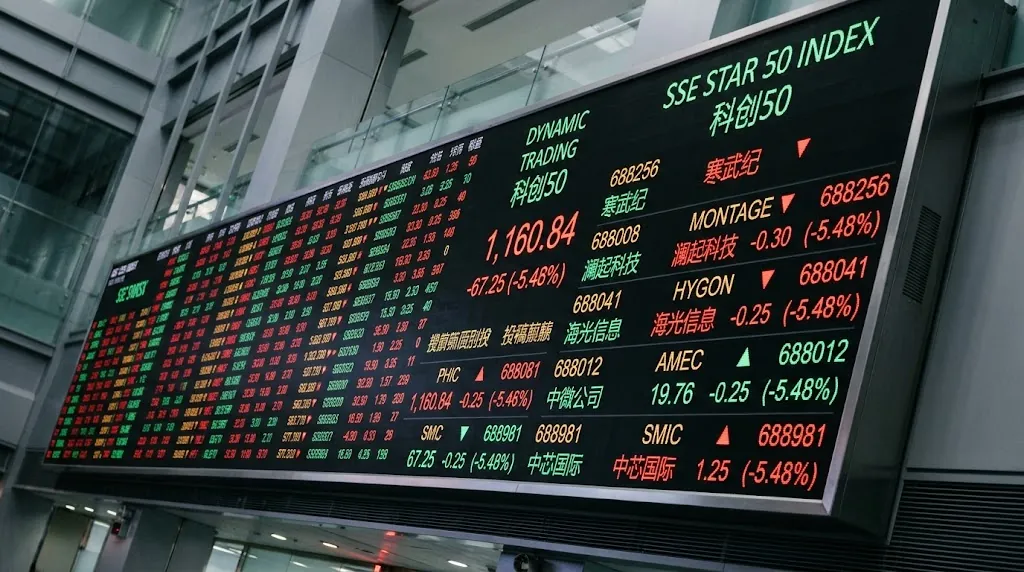
China’s losses show how widely those concerns have spread. The mainland’s blue-chip CSI 300 index fell 8.5% in October, its worst monthly performance since early 2016. On October 30 alone, Shanghai’s technology-focused STAR 50 dropped 5.5%, while a gauge of 5G communications companies slumped 6.2%, Reuters reported. :chatgpt-content-reference{index="1"}
Eoptolink Technology, a Chinese optical-module producer supplying equipment used in high-speed data connections, tumbled 14% that day and lost half its value during October. Its decline illustrates how doubts about infrastructure budgets can punish suppliers alongside the companies purchasing their products. :chatgpt-content-reference{index="2"}
Hong Kong offered a qualification to the picture of indiscriminate selling. The Hang Seng Index rebounded 1.5% on October 30 and its technology gauge edged up 0.3%, although the latter remained near a two-year low. Chinese markets are responding to overlapping pressures, rather than simply reproducing each American trading session. :chatgpt-content-reference{index="3"}
China’s AI leaders face their own cash-flow squeeze
Chinese corporate disclosures provide reasons for scrutiny independent of American sentiment.
Alibaba reported capital expenditure of almost $10 billion in the quarter ended June 30, up 75% from a year earlier. Free cash flow was negative $6.6 billion, with the company attributing the deterioration principally to increased cloud-infrastructure expenditure. Alibaba nevertheless held nearly $70 billion in cash and other liquid investments. :chatgpt-content-reference{index="4"}
There was substantial growth alongside that spending. Alibaba said its AI Cloud and Compute Services revenue increased 45% to $7.1 billion, while the segment’s adjusted earnings margin reached approximately 12%. Those figures demonstrate commercial demand, but segment earnings do not by themselves show that the group’s infrastructure investments have generated an adequate cash return. :chatgpt-content-reference{index="5"}
Tencent presents a similar tension. Its second-quarter capital expenditure rose 176% to 52.8 billion yuan. Free cash flow turned negative by 13.8 billion yuan, although Tencent said substantial computing prepayments explained the pressure: excluding those payments, free cash flow would have been positive 37.6 billion yuan. :chatgpt-content-reference{index="6"}
The distinction matters. A payment securing future computing capacity has different implications from persistent losses on services already being sold. Investors assessing Chinese AI companies therefore need to distinguish expenditure timing, infrastructure construction and the continuing cost of operating models. Headline cash burn alone cannot resolve whether an investment is sound.
A harder commercial test for Chinese tech
The disclosures point towards a more demanding investment environment for China’s sector. Large platforms with established businesses and substantial reserves have room to finance development internally. Smaller companies dependent on fresh capital could face harder choices if falling valuations make share issuance more costly or investors demand clearer evidence of revenue.
For equipment suppliers, the central risk is customer behaviour. Slower infrastructure expansion, delayed purchases or tougher price negotiations could weaken orders even where long-term demand remains substantial. Eoptolink’s losses demonstrate the market’s sensitivity to that possibility; they do not establish that an equivalent decline in sales has occurred.
There are also reasons to resist treating every Chinese technology company as equally exposed. Tencent said in October that its overseas cloud customer base had doubled over the preceding year and international demand for AI products and services had grown by triple digits. Such company-reported measures indicate expansion, although they leave questions about profitability unanswered. :chatgpt-content-reference{index="7"}
The likely competitive test is increasingly practical: which companies can turn computing expenditure into repeat purchases, stronger margins and sustainable cash generation? For Chinese tech, the market retreat raises the stakes of that transition. Building capable models remains essential. Proving that customers will pay enough to support them is becoming equally consequential.