
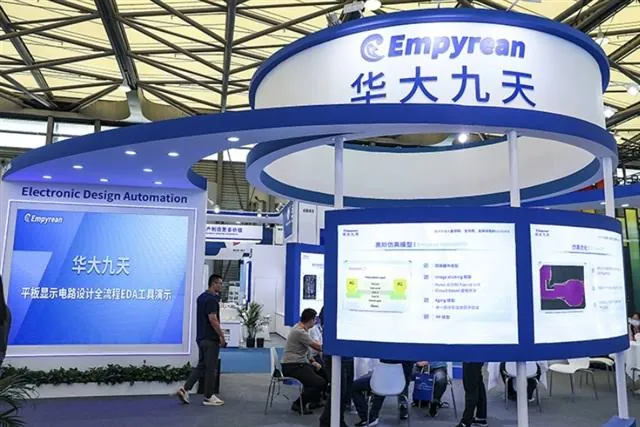
China’s leading Electronic Design Automation (EDA) firm, Empyrean Technology, has executed a strategic acquisition of a specialized technology startup, marking a critical acceleration in the nation’s push for semiconductor self-sufficiency. This move directly addresses a persistent technical vulnerability within the domestic design ecosystem, specifically fortifying the capabilities required to implement Huawei’s advanced Tau Scaling Law.
The acquisition signals a calculated maneuver by the Chinese technology sector to bypass reliance on established Western EDA giants, whose control over fundamental design software poses a significant geopolitical risk. By integrating the startup’s expertise, the acquiring company aims to close a crucial functional gap, enabling the design of next-generation, high-performance chips domestically without external constraints.
This development is not merely a corporate transaction; it represents a tangible milestone in China's broader national strategy to achieve technological decoupling from the American and European supply chains, directly impacting the competitiveness of Chinese hardware manufacturing globally.
Technical Imperatives and Commercial Integration
The acquisition targets a specific technical bottleneck in the chip design lifecycle. EDA tools are the software backbone of modern semiconductor fabrication, translating abstract architectural designs into physical, manufacturable transistor layouts. The acquired startup specializes in solving complex simulation or optimization problems that are currently limiting the efficiency and scale of domestic chip development.
The focus on supporting Huawei’s Tau Scaling Law highlights the technical gravity of this purchase. This scaling law dictates how transistor density and performance can be increased as process nodes shrink. To fully exploit these scaling gains—a prerequisite for leading-edge AI and mobile processors—chip designers require highly sophisticated, proprietary simulation environments. The integration of the startup’s technology provides the necessary tools to validate these complex, scaled designs accurately.
Commercially, this strengthens the Chinese EDA firm’s market position against global incumbents. It transforms the company from a domestic player capable of basic design flow management into a comprehensive solution provider capable of handling the most advanced computational requirements demanded by national champions like Huawei.
Geopolitical Ramifications and Industry Trajectory
The strategic significance extends far beyond the balance sheet. This acquisition underscores the intense technological competition characterizing the global semiconductor landscape. As geopolitical tensions heighten, the ability of a nation to design and simulate its own advanced silicon becomes a matter of national security, not just commercial advantage.
This move is a direct response to export controls and technology restrictions imposed by Western nations. By internalizing the necessary design capabilities, the Chinese firm mitigates the risk of sudden software embargoes, ensuring a more resilient pathway for its domestic hardware industry to continue innovating at the cutting edge.
Analysts view this trend as evidence of a maturing, self-reinforcing domestic tech ecosystem. The continuous cycle of acquiring specialized startups and integrating their IP demonstrates a sophisticated, state-supported industrial policy aimed at achieving true technological sovereignty in one of the world's most critical industrial sectors.