
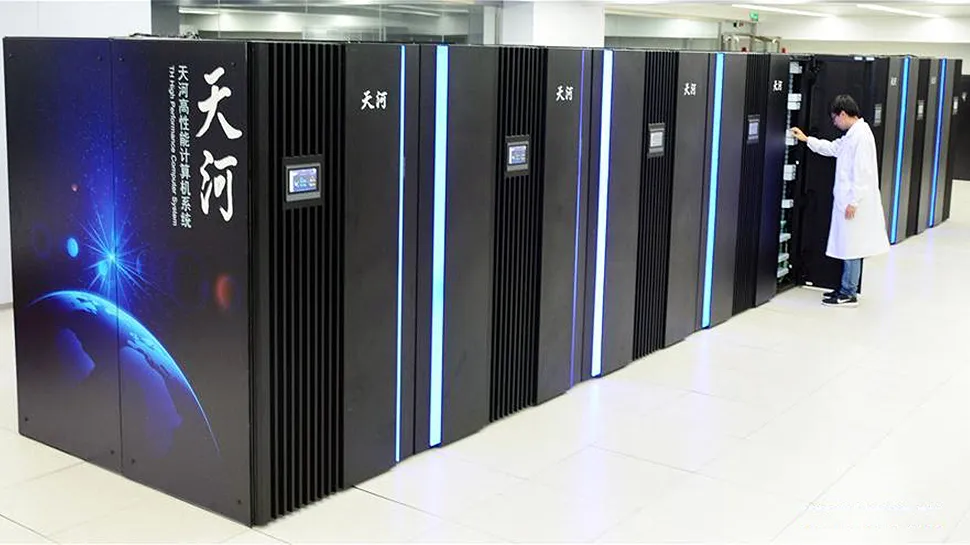
China's intelligent computing capacity has officially surpassed 2,185 ExaFLOPS, marking a significant escalation in the nation's high-performance computing capabilities.
National Computing Milestone Achieved
Official data confirms that China's aggregate intelligent computing power now registers at 2,185 EFLOPS. This figure represents a substantial increase in the computational throughput available across various national scientific and technological infrastructure projects. The advancement underscores Beijing’s aggressive pursuit of self-sufficiency and leadership within the global high-performance computing (HPC) landscape.
The reported capacity is derived from aggregated data encompassing multiple large-scale supercomputing centers operating within mainland China. Such milestones are critical indicators for national strategic planning, directly impacting sectors ranging from advanced materials science to climate modeling and artificial intelligence development.
These massive computational resources enable researchers to tackle problems previously deemed intractable due to sheer processing demands. For instance, complex simulations required for next-generation semiconductor design or large-scale epidemiological studies necessitate this level of parallel processing power available in the national network.
The consistent elevation of these metrics signals a concerted state investment strategy aimed at closing the technological gap with leading global powers. The focus remains on integrating advanced AI accelerators alongside traditional CPU/GPU clusters to maximize efficiency within the EFLOPS metric framework.
Strategic Implications for Technological Sovereignty
Achieving over 2,185 EFLOPS provides a robust platform for accelerating domestic innovation cycles across critical industries. This surge in capacity is not merely an academic benchmark; it directly supports industrial competitiveness and technological sovereignty goals.
The data release suggests that the modernization of China's supercomputing clusters is progressing rapidly. These systems are increasingly incorporating cutting-edge architectures designed to handle the exponentially growing datasets generated by modern scientific endeavors. The shift toward more intelligent computing implies a greater emphasis on algorithm optimization alongside raw hardware power.
Experts view this sustained growth as crucial for realizing China's long-term technological ambitions, particularly in fields where computational intensity is highest. Access to such immense processing capability allows domestic entities to participate meaningfully in global research consortia and drive proprietary breakthroughs.
The government’s focus appears calibrated toward ensuring that these massive computing resources are utilized not only for fundamental scientific exploration but also for solving immediate national economic challenges. The successful scaling of the infrastructure reflects a mature execution of long-term digital transformation policies.