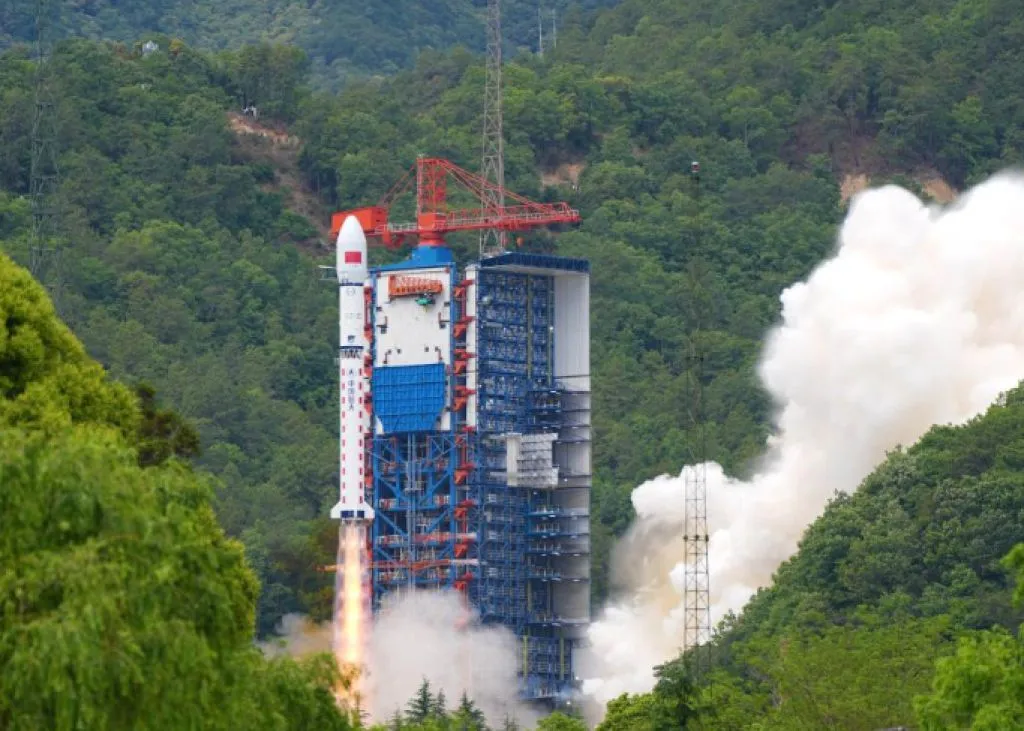
XICHANG, China — China successfully launched a new test satellite for internet technology from the Xichang Satellite Launch Center in the southwestern Sichuan province on Sunday, marking another step in the nation’s push to build its own space-based communication infrastructure. The satellite was carried into space aboard a Long March-2D carrier rocket, lifting off at 2:07 a.m. Beijing Time and entering its preset orbit successfully. According to space authorities, the primary objective of this mission is to carry out technical tests and verifications for direct broadband connectivity of mobile phones with satellites, alongside testing integrated space-ground network technologies.
The mission represents a significant milestone in China's rapidly expanding space program, representing the 646th flight mission of the Long March carrier rocket series. As global competition intensifies to establish mega-constellations in low-Earth orbit, Chinese engineers are actively testing systems that will allow standard consumer mobile devices to communicate directly with orbiting platforms, bypassing the need for specialized ground terminals. This capability is expected to form the backbone of a future integrated aerospace-ground network, delivering high-speed internet to remote regions, maritime environments, and disaster-stricken areas.
Advanced Launch Vehicle Developments and Recovery Attempts
The successful deployment of the internet test satellite highlights the reliability of China’s established launch fleet, particularly the workhorse Long March-2D rocket. This mission follows a series of ambitious aerospace developments, including the high-profile debut flight of the Long March 12A carrier rocket from the Jiuquan Satellite Launch Center in late 2025. The Long March 12A, standing at 70.4 meters tall as the tallest space vehicle China has ever built, succeeded in carrying its second-stage booster into the preset orbital position, though its first-stage booster failed to land at its designated recovery site. Developed by the Shanghai Academy of Spaceflight Technology under the state-owned China Aerospace Science and Technology Corporation, the 437-ton rocket is capable of transporting at least 6 tons of payload to low-Earth orbit and serves as a key pillar in the country's plans to develop reusable space vehicles.
China's drive to perfect reusable rocket technology is intended to significantly reduce launch costs while increasing the frequency of space missions. This strategic effort has seen active participation from both state-backed agencies and commercial space entities. For instance, commercial aerospace company LandSpace recently launched its ZQ-3 reusable rocket from the Jiuquan spaceport, achieving orbital insertion but encountering similar challenges in recovering its first-stage booster. These experimental flights, even when recovery fails, provide engineers with critical telemetry and structural data required to refine landing algorithms and thermal protection systems. Such iterative testing mirrors the early development cycles of international reusable launch vehicles, such as SpaceX's Falcon 9 and Blue Origin's New Glenn, both of which faced multiple landing failures before achieving operational reliability.
By conducting these frequent launches and testing novel integrated communication technologies, China is laying the groundwork for a robust, independent space-ground infrastructure. Sunday’s successful insertion of the broadband test satellite, combined with ongoing research into high-payload reusable launchers like the Long March 12A, underscores the rapid pacing of the Chinese space sector. As state agencies and commercial firms continue to share data and refine launch technologies, the dream of a seamless, globally accessible satellite internet network is moving closer to reality.