China’s Energy Transition Moves From Capacity Race to Grid Test
China entered 2025 with the world’s largest clean-energy build-out and a harder question: whether its power system can absorb what its factories, utilities and local governments are installing.
Renewable energy accounted for 56% of China’s total installed power capacity at the end of 2024, according to data from the National Energy Administration carried by the Chinese government’s English portal. New renewable capacity made up 86% of all power capacity added during the year, while renewable generation rose to 3.46 trillion kilowatt-hours, about 35% of total electricity output.
The scale is unmatched. Wind and solar capacity together surpassed 1.4 billion kilowatts in 2024. Solar capacity reached about 887 gigawatts after a record annual increase, while wind capacity rose to roughly 521 gigawatts. China also crossed a manufacturing threshold in transport, with new energy vehicle production exceeding 10 million units in a single year for the first time.
The expansion is central to Beijing’s industrial and climate strategy. In a Jan. 9 People’s Daily article, Zheng Shanjie, chairman of the National Development and Reform Commission, said China would “actively and prudently” advance carbon peaking and carbon neutrality, accelerate the shift from energy-consumption controls to carbon-emission controls, expand energy-saving and carbon-reduction upgrades, and deepen reforms in new-energy power pricing.
Policy Emphasis Shifts to Flexibility and Markets
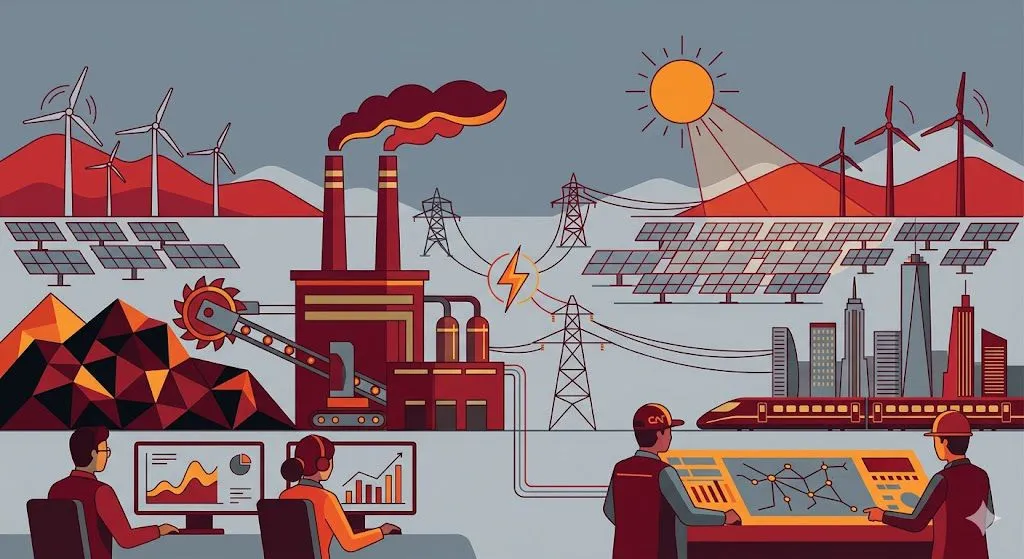
The transformation is no longer only about building more wind farms, solar bases, batteries and transmission lines. It is about dispatch rules, price signals, storage, demand response and the ability to move electricity across provinces when weather and demand change.
An International Energy Agency report on China’s power system transformation said increasing system flexibility is essential for integrating high shares of renewable energy. The report said well-functioning spot markets, greater interprovincial power trading and targeted transmission investment could lower annual system operating costs by about 420 billion yuan and reduce annual carbon dioxide emissions by about 750 million tons in a 2035 scenario.
The IEA analysis also found that China could integrate much higher shares of variable renewable generation if it improved dispatch and expanded flexible resources. In one sustainable development scenario for 2035, variable renewables would account for 35% of generation nationwide and as much as 73% in the northwest, a level requiring advanced grid management and digital tools.
That finding points to the core challenge. Much of China’s best wind and solar resource is in the north and west, while demand is concentrated along the coast and in inland manufacturing centers. Long-distance transmission has expanded, but provincial planning, legacy coal contracts and local reliability concerns can limit the flow of low-cost renewable power.
China’s power market reforms are intended to address that mismatch. Spot power markets can show the value of electricity at different times and locations, rewarding plants and consumers that respond quickly when supply changes. Demand response, smart electric-vehicle charging, pumped hydro, grid-scale batteries and flexible industrial loads are increasingly treated as resources rather than side issues.
Coal Remains the Backstop as the Economy Electrifies
The transition is advancing inside a system that still depends heavily on coal. Thermal power capacity continued to grow in 2024, and coal plants remain the main backstop during heat waves, droughts, winter peaks and periods of low wind or solar output. Beijing’s official planning continues to describe coal as a safeguard for energy security, even as it raises the priority of renewable generation and carbon controls.
Zheng’s article underscored that dual approach. It called for strengthening coal’s bottom-line guarantee role, deepening market-oriented reform of new-energy grid pricing, increasing domestic oil and gas exploration and improving energy-resource security. The same article placed those measures within a broader 2025 agenda of economic stabilization, industrial upgrading and completion of the 14th Five-Year Plan.
The result is a transition marked by speed and contradiction. China is installing clean power faster than any other country and has become the dominant global manufacturer of solar panels, batteries, wind equipment and electric vehicles. At the same time, its industrial base, data centers, electrified transport and advanced manufacturing are raising electricity demand, making absolute emissions harder to reduce quickly.
The next phase will be measured less by headline capacity totals than by utilization, curtailment, market design and emissions. If China can use more of the renewable power it already has, coordinate provincial grids and make demand more flexible, the country’s clean-energy surge could begin to displace coal generation more decisively. If not, the build-out may continue to coexist with high fossil-fuel use.
The direction of policy is clear, but the engineering and institutional work is unfinished. China has built the hardware for a new energy system at extraordinary scale. The test now is whether it can operate that system efficiently enough to change the country’s emissions trajectory while maintaining the reliability that its economy requires.