
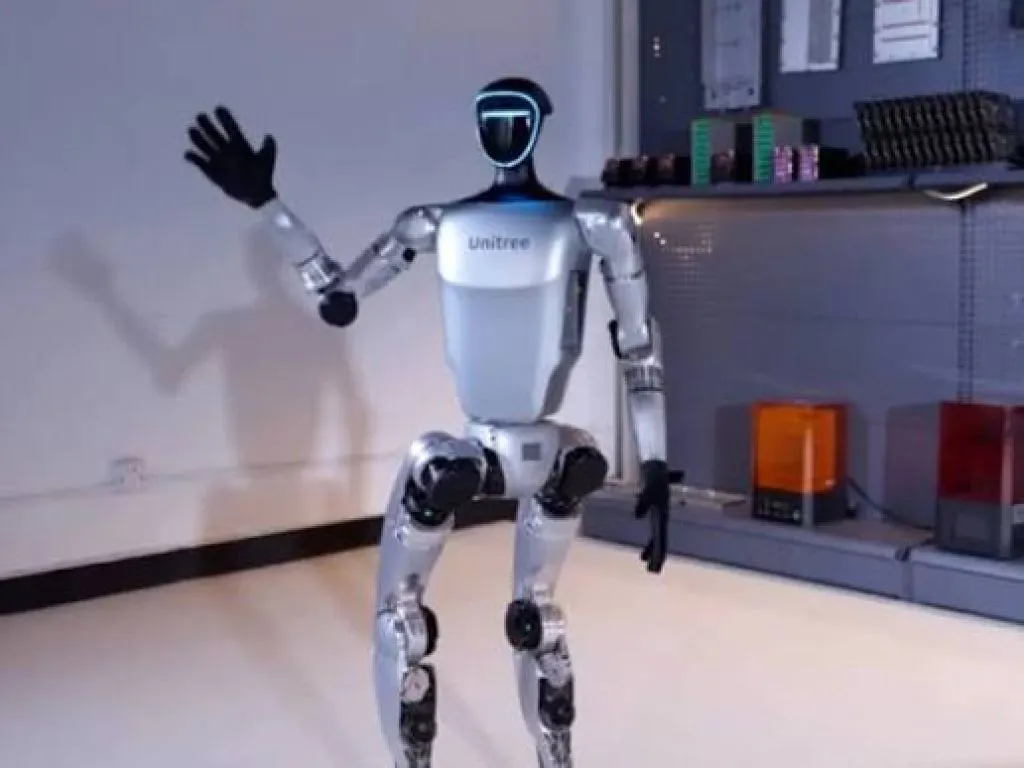
China pushes humanoid robots from demos to real work
China wants to put more than 10,000 humanoid robots into commercial use by the end of 2026, a national goal aimed at moving the machines from staged demonstrations into factories, warehouses, hospitals, restaurants and emergency-response sites.
The target was outlined in a June notice from the Ministry of Industry and Information Technology and the state asset regulator, and reported by Caixin Global. The plan calls for humanoid robots and other “embodied intelligence” products to complete application testing and begin regular deployment in a first group of representative settings by year’s end.
Officials said the program will focus on more than 100 high-value use cases, including manufacturing, inspection, maintenance, logistics, retail, medical care, elderly care, workplace safety, emergency rescue and disaster prevention. Provinces and major state-owned companies are being asked to identify real operating sites where robots can be trained, tested and judged against practical measures such as task success, efficiency, safety and cost.
The initiative reflects Beijing’s effort to turn humanoid robotics into another pillar of advanced manufacturing. China already dominates the broader industrial robotics market. The International Federation of Robotics said China had more than 2 million industrial robots operating in factories in 2024 and installed 295,000 units that year, accounting for 54% of global demand.
Deployment drive tests cost, safety and reliability
Humanoid robots have attracted heavy investment because their humanlike shape could allow them to work in spaces designed for people, from assembly lines and stockrooms to service counters. But the technology remains difficult to commercialize. Robots must handle varied objects, move safely around people, operate for long shifts and prove cheaper or more useful than existing automation.
China’s plan is designed to confront those limits by creating real-world training environments. The government notice calls for companies, research institutes, component suppliers and users to form joint groups for each scenario. Those groups are expected to develop task-specific skills, gather machine data, improve motion-control algorithms and refine hardware such as actuators, sensors and batteries.
The program also encourages “humanoid robot as a service” models, including leasing and pay-per-use arrangements, to reduce upfront costs for customers. Officials said qualified projects could receive support through policy, standards work, financing, insurance and government incentives.
Several Chinese companies are already racing to claim early markets. Startups and established manufacturers, including robotics firms backed by automakers and logistics companies, have shown humanoids carrying boxes, sorting goods and performing basic factory tasks. State media has reported deployments in logistics centers, while automakers have tested humanoids for industrial-assistant roles.
The push carries political and economic stakes. China is trying to offset a shrinking workforce, raise factory productivity and strengthen domestic supply chains in artificial intelligence, advanced components and robotics. It also wants to generate the large volumes of real operating data needed to improve embodied AI systems.
Still, the 10,000-unit goal will be a test of whether humanoid robots can move beyond eye-catching videos. Analysts say early deployments are likely to be narrow, repetitive and closely supervised. The broader question is whether China can make the machines reliable enough, and cheap enough, for routine work at scale.