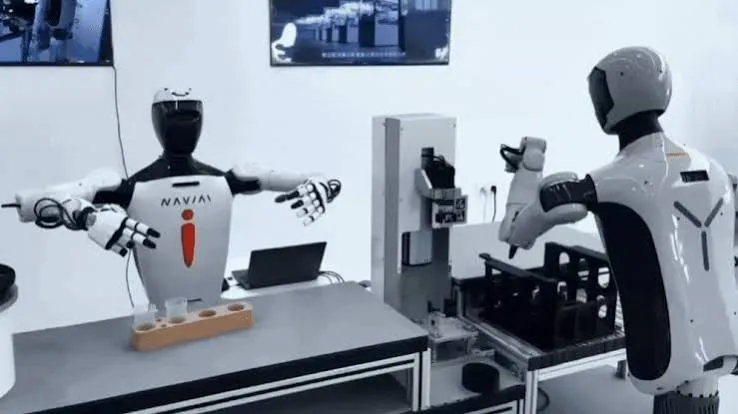
Humanoid robots have achieved unprecedented levels of dexterity, completing complex daily tasks that previously required human intervention.
Recent breakthroughs at Zhejiang Humanoid Robot Innovation Center in Ningbo, Zhejiang, demonstrate robotic systems mastering sophisticated manipulation and dynamic movement, signaling a fundamental shift in automation capabilities. These advancements integrate advanced AI with novel actuator technologies, allowing bipedal machines to navigate irregular environments and perform intricate labor functions previously confined to human expertise. Researchers have successfully engineered robots capable of fluidly handling objects of varied weights and shapes while maintaining perfect balance across unstable terrain.
The core leap lies in the synergy between artificial intelligence models and electromechanical hardware. Previous generations of humanoid robots excelled at repetitive, controlled tasks; however, current prototypes utilize sophisticated neural networks trained on massive datasets of human interaction. This allows them to interpret unstructured environments—such as cluttered homes or dynamic factory floors—and make real-time, predictive adjustments to their movement kinematics.
Technological Pillars Driving the Robotic Leap
The hardware architecture is undergoing a revolution driven by high-density actuator arrays. These systems move beyond simple motors, incorporating materials that mimic biological muscle elasticity and power density. This dramatically reduces the energy consumption required for complex motions while significantly increasing torque output. Furthermore, improvements in sensor fusion—combining data from LiDAR, depth cameras, and tactile sensors—provide the robot with a comprehensive understanding of its spatial relationships with the environment.
Xiong Rong is chief scientist and general manager at The research is being undertaken at Zhejiang Humanoid Robot Innovation Center Co Ltd. The company was founded in late 2023 by Xiong Rong, its general manager, and eight doctoral graduates from Zhejiang University.
Experts point to the enhanced processing power as critical. The robots now operate on localized edge computing units, enabling immediate decision-making without relying solely on cloud connectivity. This autonomy is crucial for safety applications and operations in remote industrial settings. These systems can process visual data streams at rates exceeding 100 frames per second, allowing them to predict the trajectories of moving objects—be they people or machinery—with millisecond precision.
Academic and corporate research facilities are collaborating intensely on optimizing these physical platforms. The focus remains on creating modularity, ensuring that components can be rapidly upgraded or swapped out to suit different operational environments. This adaptability is key to realizing the full commercial potential of general-purpose robotic agents.
Sectoral Impact and Commercial Trajectory
The immediate implications span multiple high-cost, labor-intensive sectors, including elder care, logistics, and manufacturing. In healthcare settings, humanoids are being tested for patient assistance, capable of lifting patients or retrieving supplies with minimal risk to both the user and the robot. Industrial applications benefit from robots that can manage complex supply chain tasks—such as sorting diverse packages in a warehouse—without needing fixed conveyor belts.
Analysts forecast that this technological wave will redefine job roles rather than simply eliminating them, shifting human labor toward supervision, strategic planning, and maintenance of the advanced robotic infrastructure. The initial deployments are expected to focus on environments where safety regulations are stringent or where physical demands exceed sustainable human limits over time.
The commercialization timeline suggests a phased rollout. Initial adoption will target controlled industrial settings (e.g., semiconductor fabrication plants) before expanding into unpredictable public spaces. Concerns regarding regulatory frameworks, ethical guidelines for autonomy, and energy efficiency remain central to the industry's next phase of development.
Overall, these advancements solidify the shift from specialized automation tools to general-purpose robotic assistants, marking a watershed moment for the integration of advanced artificial intelligence and physical machinery into daily human life.