
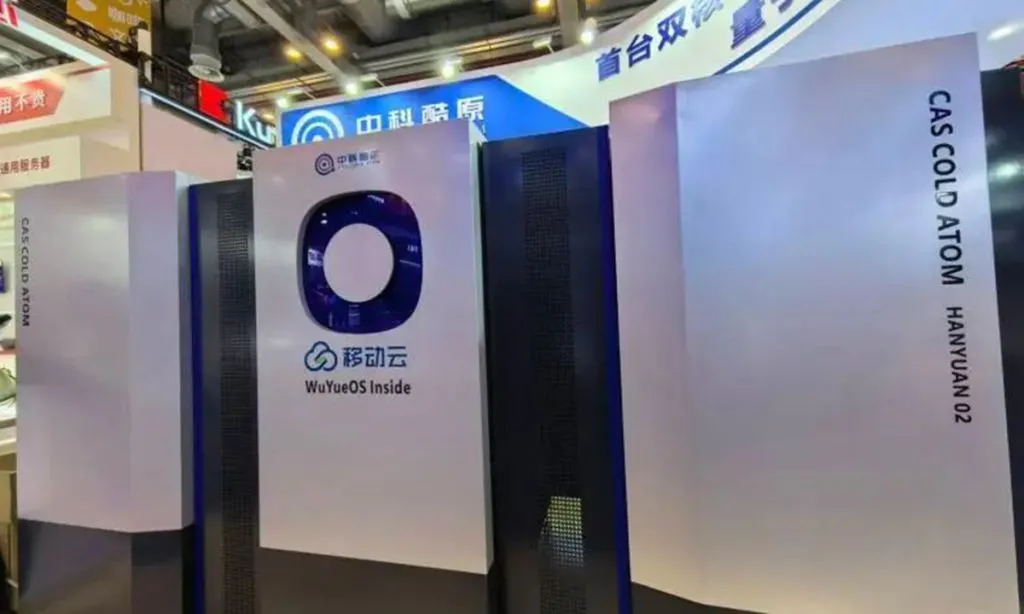
China has unveiled Hanyuan-2, the world’s first dual-core neutral-atom quantum computer, marking a leap in computational scaling.
The breakthrough, announced by Chinese startup CAS Cold Atom Technology, uses a dual-core architecture that allows unprecedented connectivity between quantum processing units. Unlike traditional single-core systems, which face physical limitations related to qubit counts and error rates, the Hanyuan-2 design distributes complex operations across two distinct but integrated neutral-atom arrays. This architectural shift is designed to address the scalability challenges currently hindering the transition from experimental prototypes to commercially viable quantum machines.
The system employs neutral atoms trapped by optical tweezers, a method that offers advantages in coherence times and gate fidelity compared with superconducting circuits. By using lasers to manipulate individual atoms, researchers can create highly controlled environments for quantum information processing. The dual-core configuration facilitates the execution of large-scale algorithms by enabling communication between the two separate cores, effectively doubling the computational workspace available for complex simulations.
The strategic implications for global technology competition are substantial. As nations race to achieve quantum advantage, China’s move toward modular and multi-core architectures signals a shift from proving basic quantum mechanics to engineering practical, high-capacity hardware. This development places pressure on Western research efforts, many of which remain focused on error correction and scaling within single-module systems.
Technical Specifications and Scaling Capabilities
The technical foundation of the Hanyuan-2 relies on the precision of laser-based atom manipulation. By using optical lattices, the system can maintain stable quantum states for longer durations, reducing the noise that typically leads to computational errors. The integration of two cores represents a modular approach to quantum computing. Rather than attempting to build a single, massive processor, researchers can link smaller, high-fidelity units to achieve greater computational power.
This modularity is critical for implementing fault-tolerant quantum computing. Current industry standards struggle with the high qubit overhead required for error correction, which often consumes more qubits than are available for actual calculation. The dual-core architecture provides a pathway to distribute these error-correction tasks across hardware segments, optimizing resource allocation and increasing the overall reliability of the system.
Industry analysts suggest that this milestone could accelerate advancements in materials science, cryptography and complex molecular modeling. These fields require the massive parallel capabilities that only large-scale quantum systems can provide. The ability to simulate chemical reactions at an atomic level with high precision could revolutionize drug discovery and battery technology, areas where China has already invested heavily in strategic research initiatives.
While specific details regarding the total qubit count and exact error rates remain closely guarded by state-affiliated research institutions, the successful demonstration of dual-core entanglement confirms that the neutral-atom approach is a viable contender for long-term quantum development. The global scientific community will now look to see whether the architecture can be scaled beyond two cores into larger, networked clusters.