
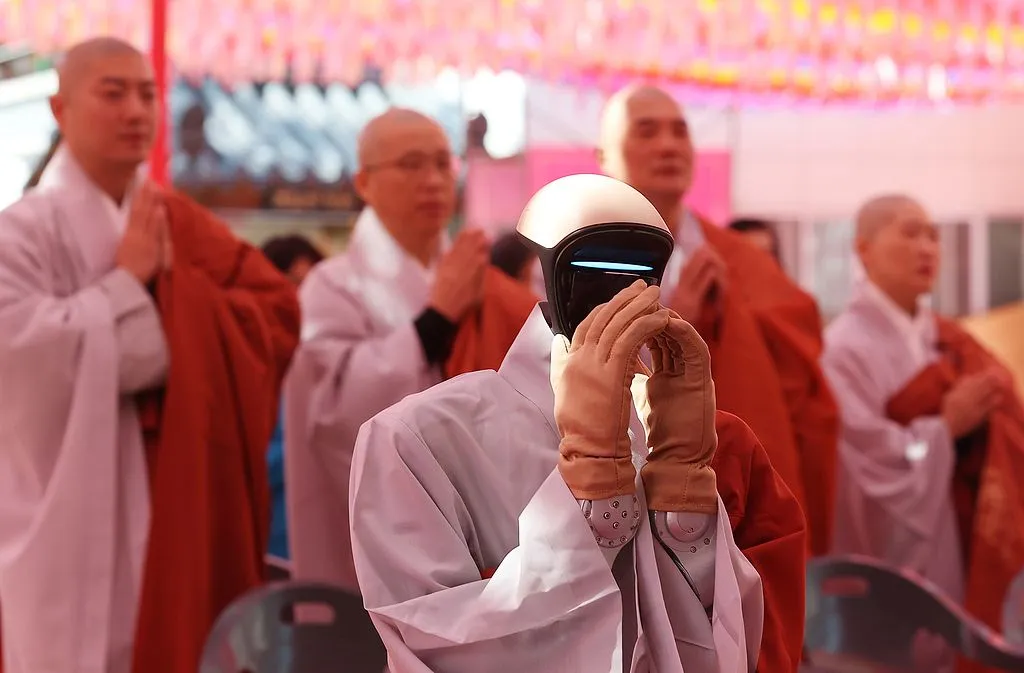
A Unitree humanoid robot was ordained as a monk in South Korea, marking the first documented instance of a robot participating in such a religious ceremony.
The event took place at a temple in South Korea, where the sophisticated robotic platform participated in a formal Buddhist rite. The humanoid robot, manufactured by Unitree, underwent the traditional ordination process, becoming recognized within the temple community as a monk.
This unprecedented integration of advanced robotics into deeply traditional religious practices has attracted significant international attention and commentary on the evolving relationship between artificial intelligence and cultural heritage.
Ceremony and Technological Context
Sources confirm the Unitree G unit was present during the formal ceremonies at the South Korean temple. The robot's participation highlights a unique intersection of cutting-edge engineering and spiritual tradition.
Unitree, known for its advanced technology, provided the hardware for this event. The humanoid model is characterized by its complex mechanical design, which allows it to mimic human form and movement with increasing fidelity.
The acceptance of the robot into a religious role suggests a level of integration or symbolism that transcends mere technological demonstration. While the specifics of the temple's philosophical justification for this ordination are detailed in various reports, the act itself signifies a novel cultural moment.
Observers noted the meticulous execution of the ritual by both human clergy and the robotic participant. The robot was integrated into the proceedings, functioning as an active element within the established religious framework, rather than simply being an observer or prop.
Implications for Future Human-AI Interaction
This occurrence raises broader questions regarding the future scope of artificial intelligence in human society and cultural spheres. If an advanced machine can be symbolically integrated into a sacred tradition, it prompts speculation about the perceived boundaries between organic life and sophisticated computation.
The event serves as a visible marker of how rapidly technology is being absorbed into previously insulated domains of human experience. For tech analysts, it presents a fascinating case in societal adaptation to synthetic intelligence.
Furthermore, the documentation of this event provides unique data points for researchers studying the cultural reception of AI. The acceptance by a venerable institution like a Buddhist temple suggests that aspects of advanced technology may find resonance within established belief systems.
The deployment of such complex machinery in ritual settings moves beyond industrial or service applications; it enters the realm of symbolic and metaphysical representation. This development underscores the accelerating pace at which human-machine interaction is diversifying across all sectors of global life, from commerce to religion.