
🎙 Listen to a summary of this story
China's ambitious HaiLing TRIDENT neutrino telescope is scheduled to complete its crucial Phase One operations next year, signaling a major advancement in high-energy astrophysics research from the South China Sea.
The project represents a significant national commitment to cutting-edge scientific infrastructure, aiming to detect elusive cosmic neutrinos that originate from extreme astrophysical events across the universe. Successful completion of this initial phase will establish a powerful new observational capability for Chinese science and international collaborations.
This development moves beyond terrestrial particle physics experiments by leveraging the deep-sea environment to achieve unprecedented sensitivity in neutrino detection, positioning China at the forefront of next-generation dark matter and high-energy phenomena research.
Technical Specifications and Operational Scope
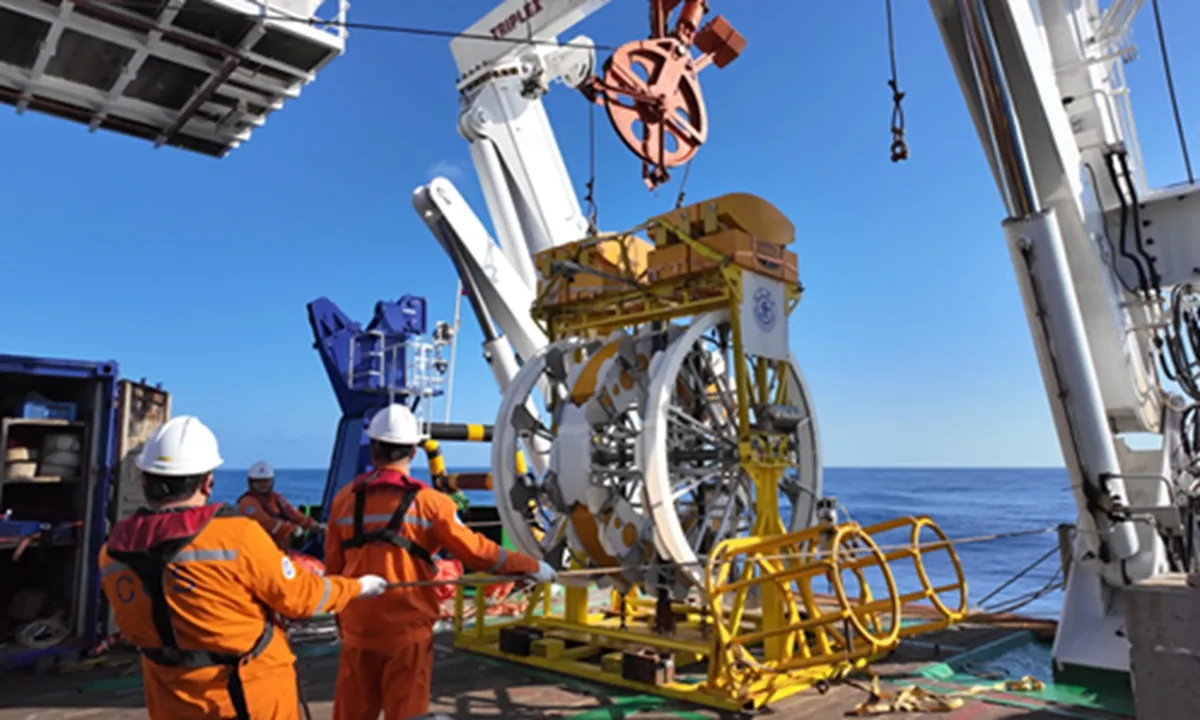
The HaiLing TRIDENT system is engineered as a sophisticated underwater observatory designed to capture faint signals produced when neutrinos interact with detector materials. While specific hardware configurations are proprietary, the deployment in the South China Sea provides a large, stable volume of water necessary for effective detection across multiple energy ranges.
Phase One focuses on validating the core operational parameters and achieving baseline data acquisition rates. This initial deployment involves integrating advanced sensor arrays with complex real-time data processing software developed domestically. The system's architecture is designed not only for pure scientific discovery but also for long-term operational stability in a harsh marine environment.
The technical rigor of TRIDENT necessitates the integration of sophisticated simulation models to distinguish genuine neutrino interaction signatures from background noise generated by environmental factors, such as bioluminescence or deep-sea currents. The successful calibration during Phase One is paramount before scaling up to full operational capacity.
Geopolitical and Scientific Ramifications
The establishment of a world-class facility like HaiLing TRIDENT carries substantial geopolitical weight, underscoring China's strategic investment in high-technology scientific endeavors. It solidifies the nation’s role not merely as an industrial producer but as a leader in fundamental physics research on the global stage.
Scientifically, these telescopes offer unique insights into the most violent processes in the cosmos—such as supernovae or active galactic nuclei—providing indirect evidence regarding particle acceleration mechanisms that are otherwise inaccessible. The data gathered could profoundly influence our understanding of cosmic ray origins and the nature of dark matter constituents.
Furthermore, the project fosters international scientific cooperation, potentially attracting global partnerships for data sharing and calibration efforts. The successful deployment in a strategically significant maritime region also subtly reinforces China's technological reach across its surrounding oceanic domain.