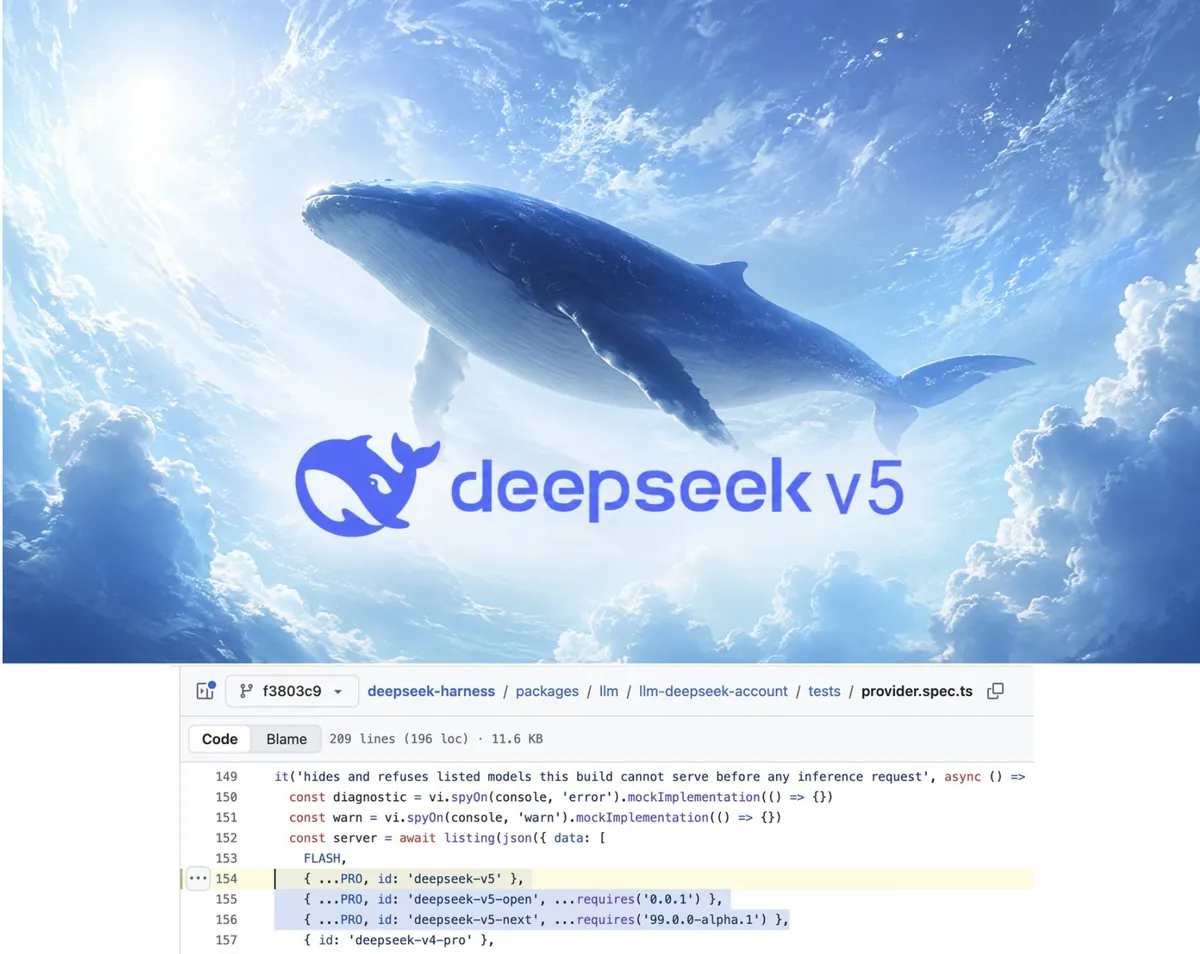
Identifiers for the advanced DeepSeek V5 large language model were discovered within the official Harness code repository, signaling a significant push toward enterprise-grade integration of cutting-edge Chinese AI. This discovery suggests that major DevOps and cloud infrastructure platforms are actively baking advanced proprietary models into their core operational frameworks, moving beyond simple API consumption.
The presence of these specific V5 identifiers within Harness—a platform renowned for its continuous delivery and workflow orchestration—indicates a strategic partnership or an internal roadmap commitment to leverage DeepSeek’s capabilities for complex, high-stakes automation tasks. This integration transcends mere feature addition; it points to a fundamental shift in how enterprise software manages AI-driven workflows.
The implications are immediate for the competitive landscape of MLOps tooling, forcing competitors to rapidly assess their own roadmap against the demonstrated integration capacity of platforms like Harness.
Technical Integration and Model Deployment Dynamics
The technical significance lies not just in the model's existence, but in its placement within the Harness ecosystem. Harness is designed to manage the entire software delivery lifecycle, from commit to production deployment. Embedding DeepSeek V5 identifiers implies that the model is being utilized for functions requiring deep contextual understanding, such as automated pipeline optimization, intelligent error detection in CI/CD flows, or sophisticated resource allocation planning.
DeepSeek V5 itself represents a substantial advancement in model architecture, boasting high performance across various benchmarks while maintaining efficiency suitable for enterprise deployment. Its integration into Harness suggests a focus on operationalizing AI—moving it from a research curiosity to a reliable, production-grade component capable of handling mission-critical infrastructure decisions.
While specific details regarding the fine-tuning datasets or the exact deployment architecture remain proprietary to both parties, the visibility of the identifiers confirms that the integration is moving past proof-of-concept stages and into active development cycles within a major commercial entity.
Broader Market and Geopolitical Ramifications
This corporate adoption serves as a powerful market validation point for DeepSeek’s technological prowess outside of purely academic or Chinese domestic markets. It signals increasing global confidence in the performance and robustness of models developed within the Chinese AI sphere.
From a geopolitical standpoint, this integration accelerates the trend of technology decoupling and diversification. As Western enterprises seek resilient, high-performing alternatives to incumbent models, the visibility of DeepSeek V5 within a global tooling suite like Harness positions it as a serious challenger to established LLM providers.
The long-term market implication is a likely acceleration in the "AI-Native Infrastructure" trend. Future DevOps tools will not merely orchestrate code; they will orchestrate cognitive functions, using powerful models like DeepSeek V5 to achieve levels of self-optimization previously unattainable, fundamentally redefining the role of the DevOps engineer.