🎙 Listen to a summary of this story
Huawei has unveiled openJiuwen's X-Router, a self-evolving model router designed to intelligently route agent requests to the most appropriate specialized AI models. This development marks a significant step toward optimizing large-scale multi-agent systems by dynamically matching complex tasks to highly tuned computational resources.
The core innovation lies in the router's ability to learn and adapt its routing decisions autonomously, moving beyond static or rule-based dispatching mechanisms common in current AI orchestration frameworks. By employing a self-evolving paradigm, X-Router minimizes latency and maximizes efficiency across diverse workloads handled by an ensemble of specialized agents.
This capability directly addresses scalability bottlenecks inherent in monolithic AI architectures, offering a pathway for enterprises to deploy sophisticated, modular AI ecosystems capable of handling nuanced, heterogeneous requests with high precision.
Technical Architecture and Operational Mechanics
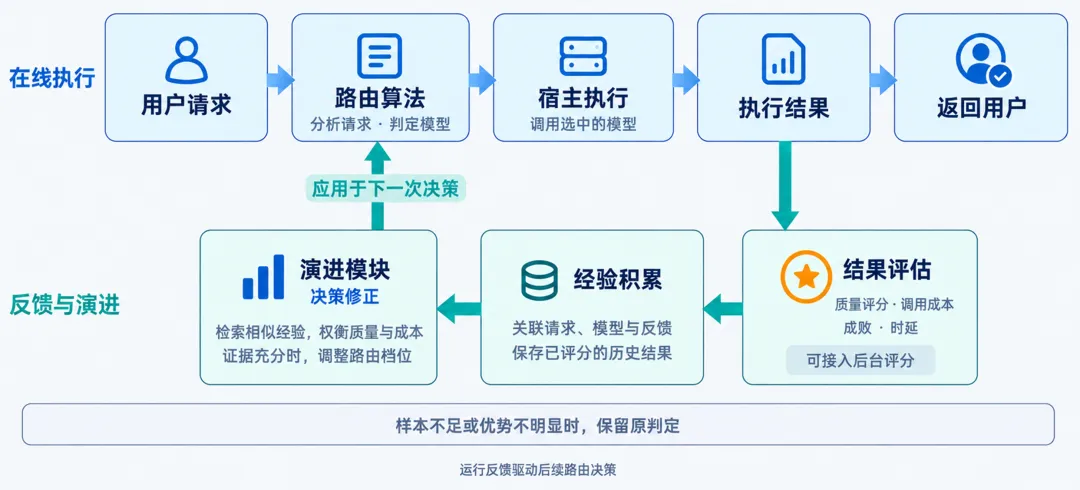
The X-Router functions as an intelligent traffic controller within the broader agent network. It ingests incoming requests—which can range from simple queries to complex multi-step reasoning tasks—and assesses their intrinsic characteristics against the capabilities profile of each available specialized model.
Technically, this involves a sophisticated internal mechanism that evaluates request semantics and computational demands. Rather than relying on pre-defined thresholds, the system iteratively refines its routing weights based on historical performance data associated with specific agent types, enabling true self-evolution over time.
The architecture supports integrating various models, each potentially optimized for distinct functions—such as vision processing, natural language understanding, or mathematical computation. This modularity allows organizations to incrementally scale their intelligence without rebuilding the entire system stack around a single foundational model.
Industry Trajectory and Market Impact
The introduction of X-Router positions Huawei within the escalating global competition for efficient AI infrastructure, particularly in enterprise deployment scenarios where operational cost and response time are paramount. The ability to manage heterogeneous workloads efficiently translates directly into tangible economic advantages for adopting organizations.
Geopolitically, this focus on foundational, adaptable routing technology underscores a strategic emphasis on building robust, domestic AI ecosystems less susceptible to reliance on singular, proprietary architectures from international competitors. It promotes architectural sovereignty in the deployment of advanced cognitive services.
For the wider market, X-Router signals a definitive shift away from 'one-size-fits-all' LLM deployment toward finely tuned, specialized agent collectives managed by intelligent meta-layers. This move accelerates the practical realization of complex AI applications across industries like finance, manufacturing, and healthcare.