🎙 Listen to a summary of this story
Humanoid robots are rapidly moving beyond mere novelty, demonstrating physical capabilities that challenge elite human athletes in increasingly complex real-world scenarios.
The Ascent of Robotic Runners
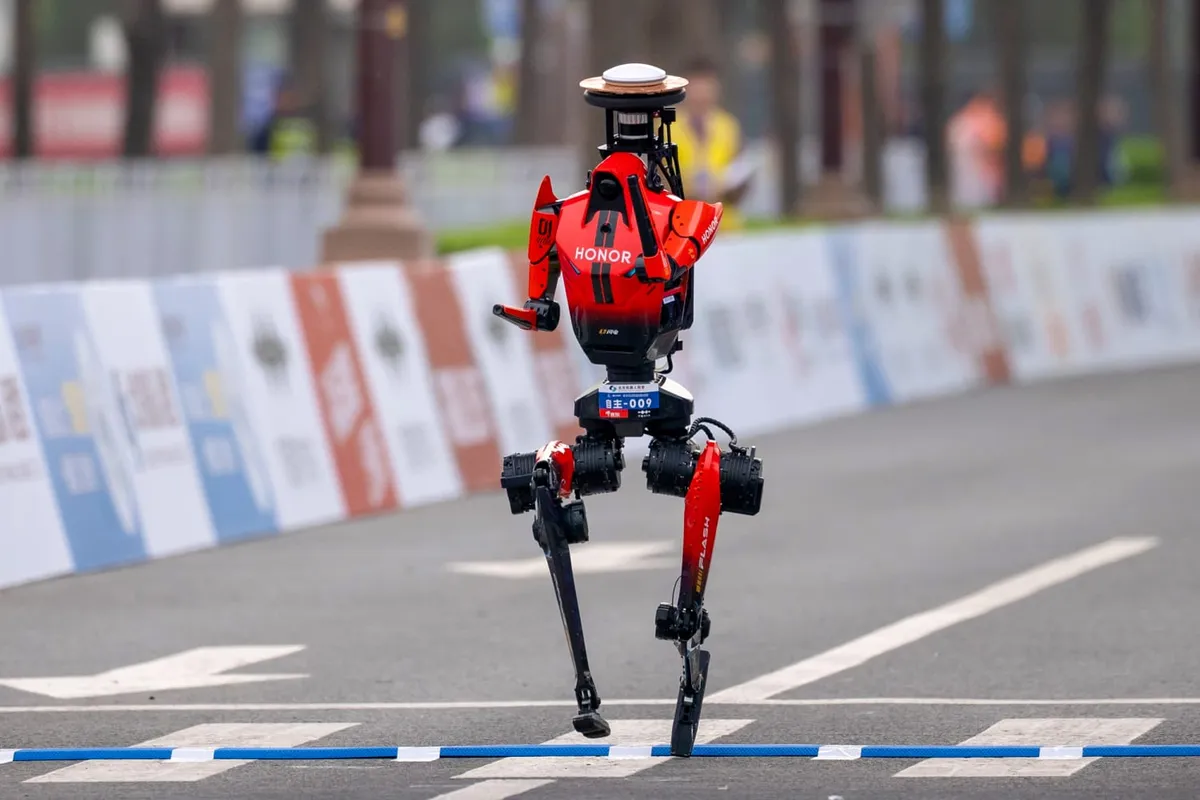
At the World Humanoid Robot Games, which began in Beijing on Saturday, a robot named Lightning ran the 100m race in 9.32 seconds, beating the human world record of 9.58 seconds set by Usain Bolt at the Berlin World Athletics Championship in 2009.
Spectators witnessed Lightning and other robots achieving speed and stability metrics that surpass human benchmarks in specific tasks, suggesting a convergence point where machine precision overtakes biological variance. This progression is fueled by sophisticated algorithms governing motor control and enhanced actuator design capable of handling extreme loads and rapid shifts in balance.
The strategic implication of this capability leap extends far beyond athletic competition. Industries reliant on high-precision physical labor—such as advanced manufacturing, logistics in unpredictable environments, and even elder care requiring swift mobility—are prime candidates for immediate robotic integration. The ability to perform tasks consistently at or above peak human performance levels represents a fundamental economic disruptor.
Investment capital is aggressively flowing into firms specializing in dexterous manipulation and bipedal locomotion systems. These companies are focusing intensely on reducing the computational latency between sensory input and motor response, which remains a critical bottleneck preventing true seamless integration into unstructured human environments. The goal is not just to match Olympian performance but to exceed it under conditions of variability.
This technological acceleration forces reassessments across several sectors. Labor markets must prepare for a redefinition of what constitutes 'skilled physical work.' Furthermore, the energy consumption efficiency of these advanced systems is becoming a key metric, as deploying powerful humanoid forms requires significant power management innovations to achieve practical, sustained operation.
Defining the Next Frontier
The next evolutionary step for humanoid robotics involves moving from demonstrating superior *physical* metrics to achieving genuine *contextual intelligence*. Superior speed is valuable, but autonomous decision-making in novel situations holds greater strategic weight.
Current research trajectories indicate a strong focus on integrating advanced sensor fusion—combining LiDAR, high-resolution cameras, and tactile feedback—to create a robust, real-time model of the surrounding environment. This allows the robot to anticipate changes rather than merely reacting to them.
The transition from programmed routines to emergent behavior is the core challenge researchers are tackling. A system that can navigate an unfamiliar disaster zone, identify hazards, prioritize objectives based on abstract parameters (like human safety), and execute a multi-step plan without explicit pre-programming represents true artificial general mobility.
Furthermore, the interoperability between different robotic units is gaining prominence. Future industrial deployments will likely involve swarms of specialized humanoids coordinating complex operations—a distributed intelligence network where individual machine prowess contributes to a collective, optimized outcome far beyond the capability of any single unit. This networked autonomy represents the ultimate goal.