
🎙 Listen to a summary of this story
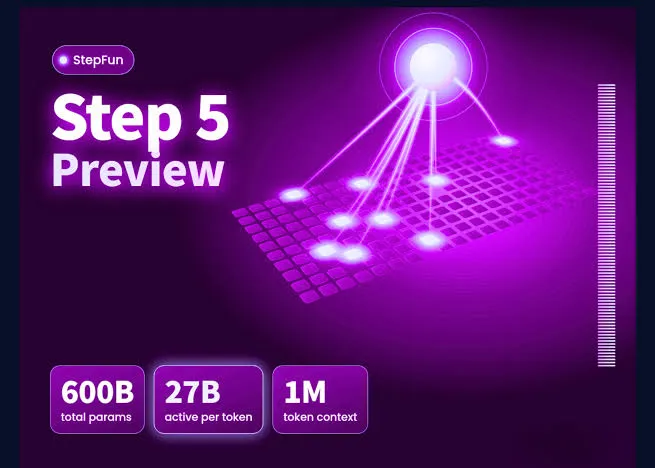
StepFun is previewing Step 5, a massive open-weights agent featuring a 600 billion parameter Mixture-of-Experts (MoE) architecture capable of handling one million tokens in its context window.
Technical Specifications and Release Timeline
This significant development positions StepFun directly within the competitive landscape of frontier Large Language Models, offering substantial scale combined with an open-weights accessibility that encourages broad community adoption and scrutiny. The model's architecture utilizes a 600B MoE structure, which allows for increased parameter count without proportionally increasing computational load during inference compared to dense models of similar size.
Crucially, the preview demonstrates capabilities supporting long-horizon tasks, evidenced by the 1M token context window. This expansive memory capacity enables the agent to maintain coherence and track complex dependencies across extremely lengthy inputs, a feature highly valued in advanced reasoning, code generation over large repositories, and deep document analysis.
The official open-weights release of Step 5 is scheduled for October 15th. This timeline suggests an active development cycle leading up to the public availability, allowing researchers and developers time to test the preview versions against established benchmarks before the final deployment. The model's structure implies a focus not just on raw parameter count but on efficient utilization via the MoE routing mechanism.
The ability to deploy large-scale models with open weights lowers the barrier to entry for enterprises and academic institutions wishing to fine-tune or run these powerful agents locally, reducing reliance on proprietary API access. This democratization of advanced AI capabilities is a major strategic component of the StepFun release strategy.
Implications for Agentic Systems
The introduction of such a large, context-aware agent directly impacts the trajectory of autonomous and agentic systems. Long-horizon planning requires models that do not suffer from 'context drift'—the degradation of performance as input length increases. Step 5’s million-token window addresses this fundamental limitation in many current state-of-the-art LLMs.
The Mixture-of-Experts design is particularly relevant for complex reasoning tasks because it allows the model to activate only the most specialized subnetworks for any given input token. This specialization, when combined with massive scale, enhances both performance fidelity and inference efficiency relative to monolithic models of comparable capacity.
Industry observers suggest that Step 5 will serve as a critical benchmark against which other emerging open-source foundation models will be measured. The combination of scale (600B), architecture (MoE), and memory (1M context) creates a high bar for next-generation LLM performance.
Access to the preview allows early adopters to stress-test these capabilities, providing crucial feedback before the official October 15th launch.