🎙 Listen to a summary of this story
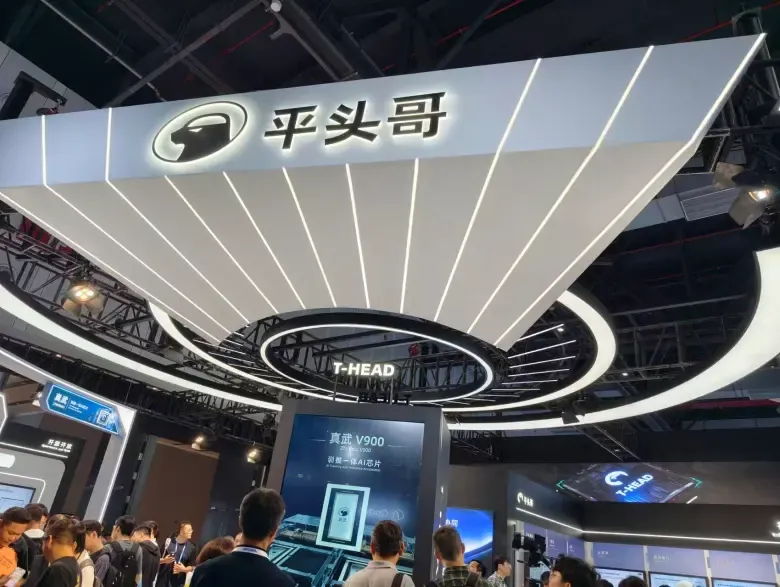
T-Head unveiled the Zhenwu V900 AI chip, a strategic advancement directly bolstering Alibaba's vertical integration across its expanding AI infrastructure stack.
The introduction of the Zhenwu V900 marks a significant milestone in China's domestic semiconductor ambitions, allowing Alibaba to reduce dependency on international high-performance computing hardware for its massive cloud and e-commerce operations.
The new processor is engineered specifically for large-scale deep learning workloads, designed to handle the computational demands of Alibaba’s proprietary AI models used in everything from recommendation engines to logistics optimization.
According to technical briefings provided by T-Head, the Zhenwu V900 achieves substantial performance gains over previous generations of domestic AI accelerators while maintaining optimized power efficiency crucial for hyperscale data center deployment.
This move signals a clear pivot by Alibaba toward complete control over its core technological pipeline, moving beyond merely utilizing third-party silicon to actively developing foundational compute power.
The chip's architecture reportedly incorporates next-generation tensor processing units (TPUs) tailored for inference and training tasks, features that are becoming increasingly critical as AI models grow exponentially in size and complexity.
Accelerating Domestic AI Sovereignty
The rollout of the Zhenwu V900 aligns with a broader national push toward technological self-sufficiency, particularly in critical hardware components where geopolitical pressures have historically constrained Chinese tech giants.
By internalizing the chip design and manufacturing process, Alibaba gains not only operational stability but also granular control over the hardware-software co-design process, allowing for tighter optimization between the chip and the software frameworks running on it.
Industry analysts suggest that this level of in-house silicon development is a necessary evolution for any company aiming to maintain a competitive edge in the global AI race against American and European counterparts.
The strategic significance extends beyond mere cost reduction; it represents a vital layer of resilience against potential supply chain disruptions affecting imports of advanced GPUs and specialized accelerators.
This chip development reinforces Alibaba's strategy of building an entire technology ecosystem—from the application layer down to the foundational compute layer—a model increasingly favored by major technology players seeking end-to-end control.
Implications for Cloud and Enterprise Adoption
The immediate impact will be felt across Alibaba Cloud's enterprise offerings, where clients are increasingly demanding customized, high-performance AI solutions that do not rely on generalized global hardware platforms.
The Zhenwu V900 enables Alibaba to offer tailored service levels, promising lower latency and potentially superior throughput for specific, high-demand use cases within its massive client base.
Furthermore, the chip’s integration into Alibaba’s internal infrastructure allows for accelerated experimentation with cutting-edge machine learning paradigms without the overhead associated with managing heterogeneous hardware fleets.
This sustained commitment to developing proprietary silicon suggests that Alibaba views AI infrastructure not merely as a utility to be purchased, but as a core, defensible competitive asset that requires deep, continuous engineering investment.
The unveiling of the Zhenwu V900 solidifies Alibaba's position not just as a massive cloud service provider, but as a significant domestic player driving the next wave of Chinese AI hardware innovation, a development that will continue to reshape the regional tech landscape.