
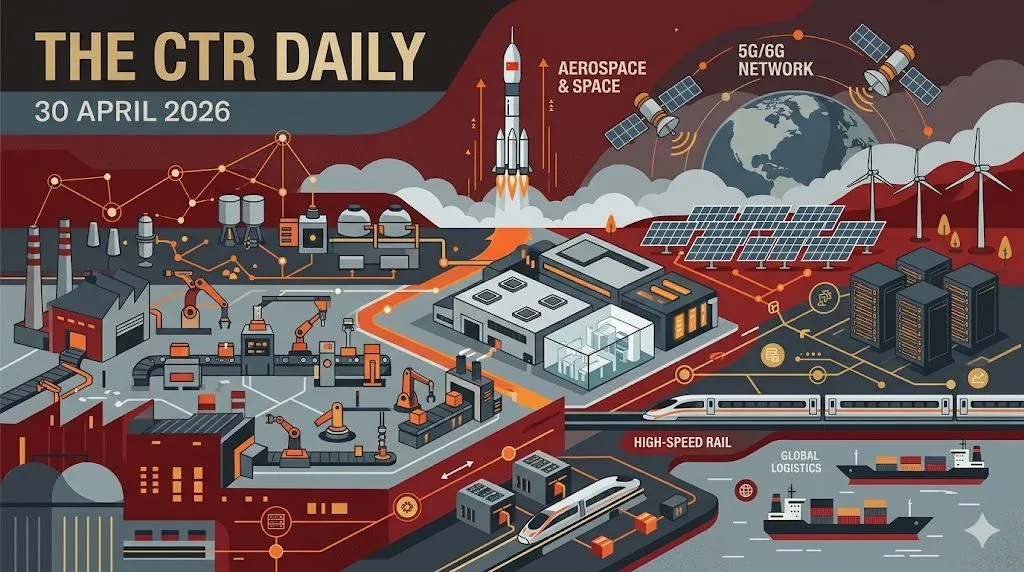
Cambrico Technologies Reclaims Crown as China's Most Expensive Stock
Propelled by a 200% surge in first-quarter net profit, reaching 1.01 billion yuan, the AI chip designer saw its shares climb 18% on April 30. This rally reflects intense investor confidence in domestic AI infrastructure as the demand for alternatives to Nvidia computing power reaches record highs.
The surge underscores a critical pivot in the Chinese capital markets: investors are increasingly willing to pay a premium for companies that can bridge the gap left by Western hardware restrictions. As the "non-Nvidia" ecosystem matures, Cambrico is positioned as a primary beneficiary of the nation's push for computational sovereignty.
The market is betting heavily on the success of local silicon.
Vice Premier Ding Xuexiang Issues "Self-Reliance" Mandate
Opening the 9th Digital China Summit on April 29, Vice Premier Ding Xuexiang emphasized that China must forge an independent AI path to withstand "external suppression." He called for deeper integration of AI into the real economy through "safe and controllable" development.
This directive provides a clear signal to tech executives: the priority is no longer just innovation for innovation's sake, but innovation that serves national security and industrial stability. The emphasis on "controllable" development suggests that while the state wants rapid AI adoption, it will strictly oversee the guardrails.
State policy is tightening its focus on technological autonomy.
Banxin Technology Unveils AI-Driven "Super Factory" for Chip Design
At a forum in Hefei on April 29, Banxin Technology unveiled its "Super Factory," a platform using Large Language Models (LLMs) to automate Electronic Design Automation (EDA) flows. The company claims the system eliminates "hallucinations" in Power, Performance, and Area (PPA) optimization.
This development is a vital tactical move for domestic semiconductor manufacturing, particularly as China seeks to accelerate its 7nm-class chip production. By automating the most complex parts of the design process, Banxin aims to reduce human error and shorten the development cycles that have historically hindered domestic progress.
Automation may be the key to overcoming hardware bottlenecks.
Amazon Joins the Satellite Race via China-U.S. Coordination
In a rare cross-border logistics milestone, 29 Amazon Project Kuiper satellites were successfully launched via a United Launch Alliance rocket on April 28. This move intensifies the global competition for "Space Internet" against China's own G60 Starlink constellation currently scaling in the Yangtze River Delta.
The launch highlights the ongoing geopolitical tension in Low Earth Orbit (LEO). While logistics coordination is possible, the race between Amazon's Kuiper and China's G60 project represents a fundamental struggle for dominance over the next generation of global connectivity infrastructure.
The battle for orbital dominance is entering a new phase.
China Pauses L4 Autonomous Driving Permits Following Network Disruption
Regulators have frozen new licenses for Level 4 (L4) autonomous vehicles following a significant system-wide malfunction involving over 100 robotaxis in Wuhan. The Ministry of Industry and Information Technology (MIIT) has called for a nationwide safety review of remote fleet management hardware.
This regulatory pause serves as a sobering reminder of the fragility of large-scale autonomous deployments. The focus on "remote fleet management" suggests that authorities are less concerned with individual vehicle sensors and more with the centralized software architectures that control entire fleets.
Safety concerns have momentarily stalled the momentum of robotaxis.
Sugon Announces Operational "Super-Intelligence Fusion Cluster"
At the 9th Digital China Summit, Sugon announced that its "Super-Intelligence Fusion Cluster" is now operational within the national grid. The cluster utilizes a proprietary interconnect fabric to manage 60,000 domestic Graphics Processing Unit (GPU) and Neural Processing Unit (NPU) units.
Unlike traditional supercomputers built for scientific simulation, this cluster is designed for industrial design through massive parallel processing. This represents a significant step in deploying high-performance computing (HPC) directly into the industrial sector to drive domestic manufacturing efficiency.
Domestic hardware is finally scaling toward massive, integrated clusters.
Ushiwu Pivots L4 Hardware Toward Humanoid Robotics
L4 low-speed autonomous driving firm Ushiwu announced a multi-hundred million RMB Series B (B2) funding round on April 30. The company is pivoting its vision-based hardware from simple delivery bots to a "general-purpose mobile chassis" for industrial humanoid robots.
This strategic pivot reflects a broader trend in the Chinese tech ecosystem: repurposing autonomous driving technology for the burgeoning humanoid robotics market. By transitioning from niche delivery applications to general-purpose robotic movement, Ushiwu is positioning itself at the intersection of two high-growth sectors.
The future of autonomy may lie in more than just moving goods.