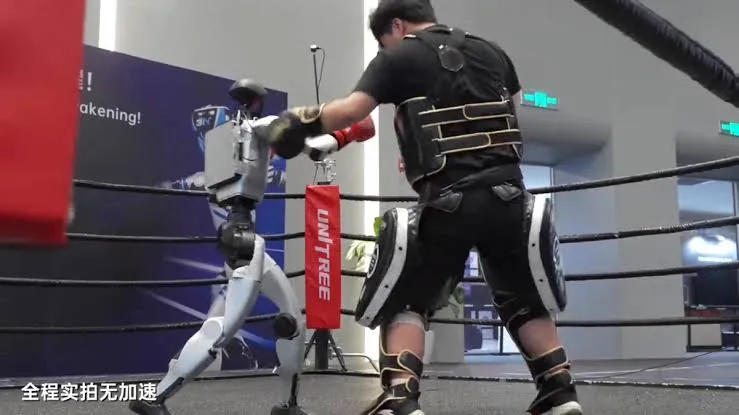
Unitree Robotics secured the highly coveted Xiongan Boxing Belt after decisively defeating EngineAI in a high-stakes robotic boxing match, marking a significant milestone in commercial humanoid combat demonstrations.
The victory underscores the rapid maturation of bipedal robotics, moving these advanced machines from purely research platforms into competitive, real-world performance showcases. This bout serves as a public validation of Unitree’s engineering capabilities against a formidable competitor in the burgeoning field of artificial athletic performance.
The competition, which utilized highly advanced humanoid platforms, was designed to benchmark critical metrics including agility, power output, and strategic decision-making under duress. The outcome signals a competitive inflection point where engineering excellence translates directly into verifiable, marketable superiority in the domestic Chinese robotics sector.
Technical Specifications and Performance Metrics
The performance disparity observed in the match was rooted in the underlying hardware and algorithmic sophistication of the respective units. Unitree’s platform demonstrates optimized kinematic design, allowing for superior energy management during high-impact exchanges.
While the specific proprietary algorithms remain closely guarded, the visible effectiveness of Unitree’s response time suggests advanced sensor fusion capabilities. These systems process complex visual and inertial data instantaneously, enabling the robot to execute evasive maneuvers and counter-attacks with minimal latency, a critical advantage in fast-paced combat scenarios.
Furthermore, the commercial dynamic surrounding this competition is telling. These demonstrations are not mere entertainment; they are high-visibility proofs-of-concept for potential industrial and service applications, directly influencing investor confidence and adoption rates across manufacturing and logistics sectors.
Industry Trajectory and Wider Implications
This success places Unitree firmly at the vanguard of China's strategic push toward technological self-sufficiency in advanced robotics. The ability to produce highly capable, commercially viable humanoid robots domestically reduces reliance on established Western or Japanese hardware incumbents.
The Xiongan Boxing Belt itself represents a form of non-traditional technological validation, functioning as a public barometer of industrial strength. As humanoid robots transition from novelty items to essential infrastructure components, the competitive landscape shifts from academic papers to arena performance, demanding robustness and operational excellence.
The implications extend beyond mere market share. These demonstrations solidify China’s position as a global powerhouse in embodied AI. The continued refinement of these platforms suggests a near-term trajectory toward widespread deployment in complex, human-centric environments, accelerating the integration of automation into daily commerce and industry globally.