China gains ground as perceptions shift
The contest between the United States and China for artificial intelligence leadership is no longer measured only by chips, patents or benchmark tests. In a week when the US government banned Anrhropic's latest AI models to foreign users, it is increasingly being fought in the realm of public confidence, where a new global survey suggests China is gaining an edge in perceived capability even as it continues to struggle with trust.
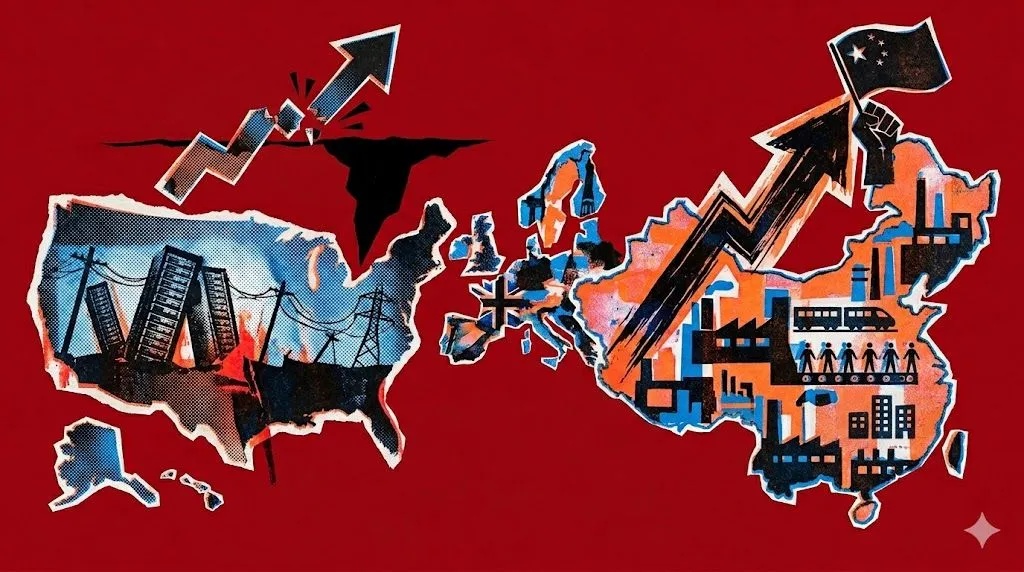
Polling by the British firm Public First, based on more than 18,000 respondents in 15 countries, found that people in 11 of those countries believe China now leads the United States in AI capability and innovation. The exceptions were the United States, Japan, India and Vietnam. In the U.S., 51% of respondents said America led the race, while 24% said China and 25% said they did not know. In the United Kingdom, 44% picked China and 26% chose the U.S.; in France and Canada, 40% chose China and 27% chose the U.S. :
The findings point to a striking reversal in the global narrative around AI. For much of the generative AI boom, American companies including OpenAI, Google, Anthropic and Meta appeared to define the frontier. But Chinese companies have narrowed the gap with lower-cost, high-performing systems, especially open models that developers can download, adapt and deploy without relying on the most expensive proprietary services.
America still leads in money and infrastructure
The perception shift does not mean China has overtaken the U.S. across the board. Stanford University’s 2026 AI Index says the U.S.-China model performance gap has “effectively closed,” with U.S. and Chinese models trading the lead multiple times since early 2025. As of March 2026, Stanford said Anthropic’s top model led by just 2.7%. But the report also found the U.S. still produces more top-tier AI models and higher-impact patents, while China leads in publication volume, citations, patent output and industrial robot installations.
The U.S. advantage is most visible in investment and computing infrastructure. Stanford reported that U.S. private AI investment reached $285.9 billion in 2025, more than 23 times China’s $12.4 billion, while cautioning that private investment may understate China’s total spending because of government guidance funds. The U.S. also hosted 5,427 data centers, more than 10 times any other country, giving American companies vast access to the compute needed to train and run frontier systems.
Yet those advantages carry liabilities. The same data center buildout that supports American leadership has become a domestic flashpoint over electricity, water use and local disruption. Public First found Americans were unusually negative about new data centers compared with other advanced economies, while Silicon Valley’s closed, costly model has drawn criticism abroad.
China, by contrast, has turned constraints into strategy. U.S. export controls limiting access to advanced chips pushed Chinese companies to make models cheaper, more efficient and more open. RAND researchers wrote in March that open models are becoming a key instrument of soft power for both Washington and Beijing, and said the U.S. needs stronger support for open model ecosystems, recalibrated export controls and incentives for permissive licensing if it wants to counter China’s influence.
Trust remains China’s weakness
The Public First survey also shows why perception of technical leadership is not the same as trust. Silicon UK reported that U.S. AI models ranked second in “net trust,” at plus 16, behind Japan at plus 22. China ranked 10th, at minus 8. The survey found that while respondents in countries including the U.K., France, Canada and Germany tended to say China was ahead in AI, they were less willing to trust Chinese models than American ones.
That trust gap matters because AI systems are moving from chatbots and coding assistants into health care, finance, education, defense and public administration. Public First found that most people remain uncomfortable sharing sensitive data with AI agents; only 29% said they would be comfortable giving an AI agent access to their bank account. The question of which country produced a model is becoming part of the purchasing decision for companies, governments and individuals.
The emerging picture is not a simple race with one winner. The U.S. has deeper capital markets, dominant cloud providers, leading labs and unparalleled compute infrastructure. China has scale, state direction, strong research output, manufacturing depth and a growing reputation for open, cost-efficient models. Washington is trying to preserve a technological lead through export controls and domestic investment; Beijing is trying to build resilience by diffusing AI through industry, academia and open-source communities.
For U.S. policymakers, the warning from the latest polling is that dominance in frontier models may not be enough. If much of the world believes China is moving faster, and if Chinese models become cheaper and easier to adapt, Beijing can gain influence even without winning every benchmark. For China, the challenge is the reverse: capability may open doors, but distrust can keep them from staying open.
The AI rivalry, then, is becoming less like a sprint to a single breakthrough and more like a long contest over ecosystems. The country that wins may not simply be the one with the most powerful model. It may be the one whose tools are trusted, affordable, widely available and embedded deeply enough that the rest of the world cannot easily turn away.