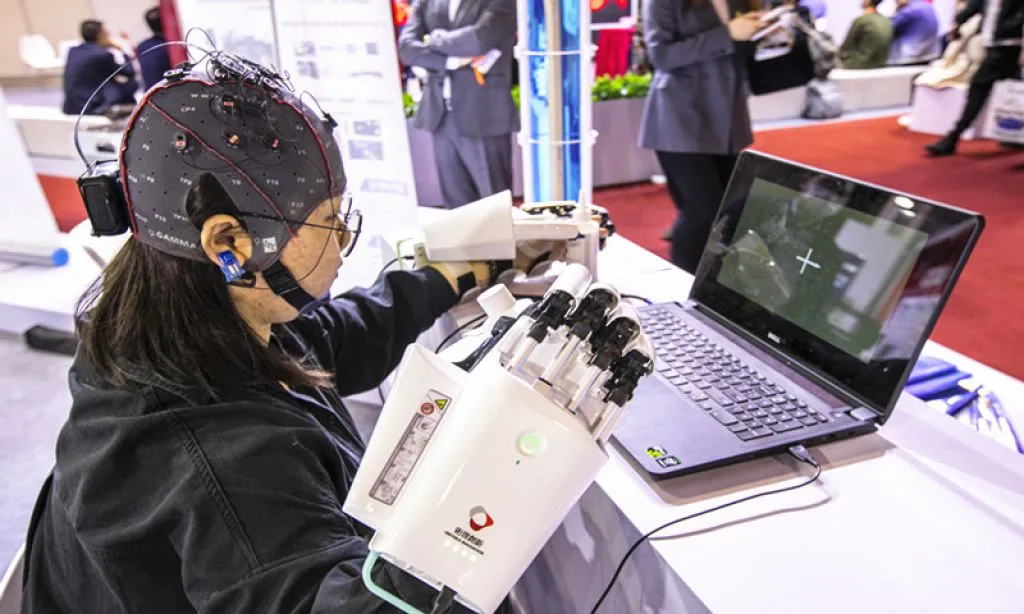
China’s brain-computer interface industry is moving quickly from laboratory research into hospitals, as we covered in our story on Diagens launching iMedLoop as a full-chain medical AI ecosystem, rehabilitation centers and the medical device market, as policymakers, clinicians and investors try to turn neurotechnology into a practical tool for treating paralysis, stroke, epilepsy and other neurological disorders.
The shift is being driven by a combination of clinical demand and state industrial policy. China included brain-computer interfaces, or BCIs, in its 2026 government work report, signaling that the technology has become part of the country’s broader strategy for advanced medical equipment, artificial intelligence and high-end manufacturing. Recent Chinese reports say BCI products are already being used in disease diagnosis, motor rehabilitation and neuromodulation treatment for conditions including Parkinson’s disease and epilepsy.
BCI systems read signals from the brain and translate them into digital commands. Some are non-invasive, using scalp electrodes similar to advanced EEG devices. Others are implanted on or near the brain to capture clearer signals. In clinical settings, the goal is not science fiction-style mind control, but more limited and medically useful functions: helping patients move a cursor, operate a robotic hand, train damaged neural pathways or receive more responsive stimulation for neurological disease.
From research trials to medical devices
The most significant recent development is the speed at which China is translating BCI research into clinical testing and regulatory approval. A July 2026 landscape analysis of China’s BCI clinical ecosystem identified 134 registered clinical trials, 26 investigator-initiated trials and five BCI-related products approved by the National Medical Products Administration as of June. The study found that trial registration has increased rapidly since 2020, with research concentrated in Guangdong, Shanghai and Jiangsu. Non-invasive systems accounted for most registered studies, while stroke rehabilitation was the leading indication.
Chinese researchers have also pushed forward with invasive and semi-invasive systems. In 2025, a Shanghai team reported a first-in-human clinical trial involving a man who had lost all four limbs in an electrical accident. After a BCI device was implanted, he was able to play chess and racing games using brain signals, according to the Chinese Academy of Sciences.
In March 2026, Chinese state media reported that regulators had approved what it described as the world’s first invasive BCI medical device for market use. The system is intended for patients with quadriplegia caused by cervical spinal cord injuries who are unable to perform grasping movements with their fingers.
That milestone does not mean BCIs are about to become routine hospital equipment. Implantable systems still face difficult questions over long-term stability, surgical risk, patient selection, data quality and cost. But the approval shows that China is building a regulatory pathway for devices that previously existed mostly in research laboratories.
Rehabilitation leads early clinical use
The strongest near-term use case is rehabilitation, especially for stroke and spinal cord injury patients. In these settings, BCI systems can detect a patient’s intention to move and connect that signal to a robotic arm, hand exoskeleton, screen-based task or virtual training environment. The patient receives feedback when the brain produces the desired signal, encouraging neuroplasticity and helping clinicians design more individualized therapy.
Chinese hospitals and research centers have been testing mind-controlled rehabilitation systems that combine EEG-based signal detection with robotics. Xinhua reported in April that China’s National Healthcare Security Administration had released a 2025 pricing guideline for neural system care services that treated BCIs as an independent category, a step intended to support wider clinical application.
For patients, the practical promise is more intensive and measurable rehabilitation. Traditional therapy often depends on repeated physical movement, but some patients cannot move enough to complete conventional exercises. A BCI can allow them to practise motor intention even when movement is weak or absent. Clinicians can also use the data to adjust therapy according to neural response rather than relying only on visible physical improvement.
Epilepsy and Parkinson’s disease are also emerging areas. Closed-loop neuromodulation systems can record neural activity and deliver stimulation when abnormal patterns are detected. That could make treatment more responsive than conventional stimulation, which may operate on fixed settings. The July 2026 landscape analysis noted approval of an invasive closed-loop deep brain stimulation system with real-time local field potential recording, alongside non-invasive EEG rehabilitation products.
China’s aging population adds urgency. Stroke, dementia and neurodegenerative disease place growing pressure on families, hospitals and insurance systems. BCIs are unlikely to solve those problems alone, but they are increasingly being framed as part of a wider toolkit that includes robotics, AI-assisted diagnosis, remote monitoring and precision rehabilitation.
Commercial race and unresolved risks
The commercial landscape is expanding alongside the clinical one. Chinese BCI companies are attracting investor attention as the field moves from prototypes to trials. TechCrunch reported in February that China’s BCI industry is scaling from research toward commercialization, supported by policy backing, clinical trials and capital interest.
The country’s approach differs from the more celebrity-driven profile of companies such as Elon Musk’s Neuralink. China’s BCI sector is developing through a network of universities, hospitals, state-backed laboratories, medical device makers and local governments. That model may help accelerate patient recruitment, hospital partnerships and regulatory coordination, though it also raises questions about transparency, informed consent and long-term patient monitoring.
Safety and ethics remain central barriers. Brain data is highly sensitive, and implanted devices carry risks that consumer-style technology does not. Patients with severe paralysis or neurological disease may be highly motivated to try experimental systems, making consent standards especially important. Researchers have warned that early enthusiasm for invasive BCIs must be balanced against the danger of overstating benefits before long-term evidence is available.
There are also technical limits. Non-invasive systems are safer and easier to scale, but they produce noisier signals. Implanted systems produce richer data, but require surgery and long-term device maintenance. Algorithms that work well for one patient may not generalize across broader clinical populations. Hospitals will need trained staff, reimbursement systems and standardized workflows before BCIs can move beyond specialist centers.
Even so, the direction is clear. China is treating BCI technology as both a medical priority and an industrial opportunity. The first wave is likely to focus on patients with severe motor impairment, stroke-related disability and movement disorders. Wider use in cognitive decline, home rehabilitation and preventive monitoring remains more speculative.
For now, the technology’s most realistic promise is not human enhancement, but restoration: helping patients regain limited movement, communication or control after devastating injury or disease. If China can combine clinical evidence, regulatory oversight and affordable manufacturing, BCIs could become one of the most closely watched frontiers in the country’s medical technology sector.