🎙 Listen to a summary of this story
China launched its first domestic AI super-cluster featuring 100,000 accelerator cards, marking a significant leap toward computing self-sufficiency.
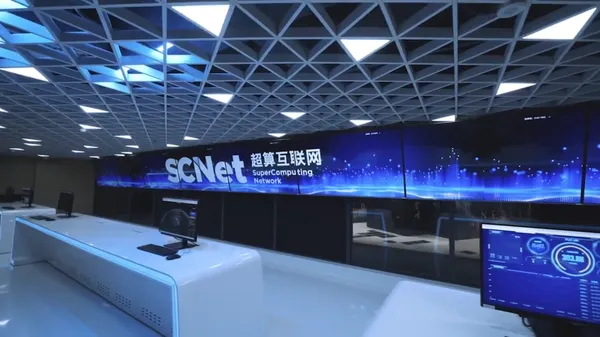
The massive deployment of advanced hardware at the Zhengzhou core node of the National Supercomputing Internet represents a critical strategic milestone in China's efforts to achieve technological independence in the global artificial intelligence sector. The newly operational super-cluster incorporates substantial domestic compute power, positioning Chinese researchers and industries to train large language models (LLMs) and develop sophisticated AI applications without reliance on foreign supply chains.
This initiative is not isolated; it signals the broader maturation of China's national computing infrastructure. Experts suggest that this development accelerates the timeline for integrating disparate supercomputing resources into a cohesive, nationwide network designed to support academic research and industrial digitalization efforts at scale.
Domestic AI Compute Infrastructure Takes Shape
The 100,000-card cluster significantly boosts China's domestic capacity, providing raw computational power essential for cutting-edge scientific modeling. The focus on entirely domestic components addresses previous geopolitical supply constraints that affected access to high-end AI accelerators globally. This capability allows Chinese tech firms and state research institutions to execute complex computations previously constrained by hardware availability.
Beyond the immediate deployment of this flagship cluster, the underlying objective is the establishment of a National Compute Grid (NCG). The NCG aims to interconnect various supercomputing centers across different provinces and academic hubs. This integrated grid concept transforms siloed computing power into a unified national resource, maximizing efficiency for users needing massive parallel processing capabilities.
The systematic development of this compute grid is crucial because AI applications are increasingly data-intensive and computationally demanding. By pooling resources nationally, the infrastructure can support large-scale collaborative projects that span multiple universities or industrial verticals, from advanced materials science to pharmaceutical discovery.
Strategic Implications for Global Technology
This accelerated buildout solidifies China's position as a major global player in AI development. The emphasis on domestic hardware is characteristic of a national strategy prioritizing technological sovereignty across critical sectors. By mastering the supply chain and deployment of advanced compute clusters, Beijing aims to mitigate risks associated with international trade disputes.
Industry analysts view the National Compute Grid not merely as an upgrade, but as foundational infrastructure comparable in scope to global research networks. Access to such centralized, massive-scale domestic computing power will profoundly impact how AI models are trained and deployed within China's rapidly digitizing economy. The move underscores a national commitment to maintaining technological leadership through indigenous industrial capacity.
The launch of this super-cluster therefore represents more than an infrastructure upgrade; it is a statement on strategic capability, signaling that Chinese institutions possess the foundational computational power required to lead in the next generation of artificial intelligence research and commercialization efforts.