
China’s Deep Dive into Underwater Data Centres
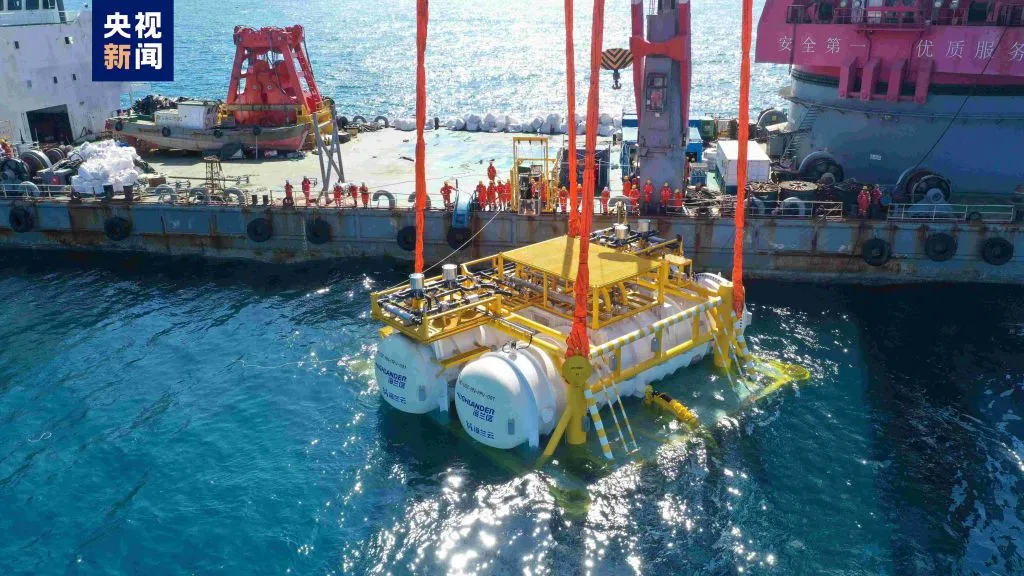
China has moved decisively beyond experimentation in underwater data centres (UDCs), turning what was once a speculative concept into a pillar of its digital infrastructure strategy. The most striking example is the newly deployed facility off the coast of Shanghai’s Lingang Special Area, which marks a global first: a commercial-scale underwater data centre directly integrated with an offshore wind farm. This development signals not just technological maturity, but a broader systems-level approach that aligns computing power with renewable energy generation.
Unlike earlier prototypes seen elsewhere, China’s UDCs are designed for scalability from the outset. The Shanghai installation delivers a capacity of 24MW and is engineered to process the enormous data volumes associated with autonomous driving systems and embodied AI applications. These workloads demand both high-density computing and energy efficiency, requirements that underwater environments are uniquely positioned to meet.
By leveraging the naturally low temperatures of seawater, these facilities dramatically reduce the need for traditional cooling systems, achieving Power Usage Effectiveness (PUE) levels as low as 1.1. This efficiency gain translates into a significantly reduced carbon footprint, a critical factor as China accelerates its AI ambitions. The integration with offshore wind power further strengthens the sustainability case, creating a closed-loop ecosystem where clean energy directly feeds high-performance computing infrastructure.
China’s preference for shallow-water deployments also reflects a pragmatic approach. These sites are easier to maintain, cheaper to install, and closer to coastal demand centres, ensuring low latency for urban and industrial users. The result is not just a technological innovation, but an emerging infrastructure model that combines energy, data, and geography into a cohesive system. Reports suggest this ecosystem approach is already being studied for broader rollout along China’s coastline (source).
More broadly, China’s rapid scaling of UDCs underscores a strategic priority: supporting the country’s AI boom with infrastructure that is both energy-efficient and future-proof. As detailed in recent coverage, underwater data centres are becoming a key enabler of this growth, positioning China at the forefront of a new frontier in computing (source, source).
The US Steps Back: From Pioneer to Pause
In contrast, the United States, once a pioneer in underwater data centre technology, has taken a step back. Microsoft’s Project Natick, launched in 2015, demonstrated that servers could operate reliably in sealed, pressurised underwater environments for extended periods. The project proved that failure rates were lower than those in traditional land-based data centres, thanks to stable temperatures and reduced human interference.
Yet despite its technical success, Project Natick was discontinued in 2024. The reasons were less about feasibility and more about economics and operational complexity. Deploying and maintaining deep-sea infrastructure remains costly, and the benefits, while real, did not outweigh the challenges within Microsoft’s broader cloud strategy. Instead, the company and others have shifted focus toward optimising terrestrial data centres and exploring alternative innovations.
This divergence highlights a fundamental difference in approach. Where China is integrating UDCs into a national infrastructure and energy strategy, US efforts have largely been confined to corporate experimentation. Without coordinated policy support or a clear pathway to commercialisation, underwater data centres in the US have struggled to move beyond pilot stages.
That said, the lessons from Project Natick continue to resonate. The project has influenced emerging concepts such as orbital data centres and other unconventional computing environments, demonstrating the value of controlled, self-contained systems (source). In this sense, the US has not abandoned innovation—it has simply redirected it.
The contrast between the two countries is therefore not one of capability, but of strategic intent. China is betting on underwater data centres as a near-term solution to its growing energy and computing demands, embedding them within a larger renewable ecosystem. The United States, meanwhile, appears more cautious, treating the technology as a niche experiment rather than a core component of its digital future.
As global demand for AI and cloud computing continues to surge, this divergence may prove निर्णative. Whether underwater data centres become a mainstream solution or remain a specialised innovation will depend not just on engineering, but on how nations choose to integrate technology, energy, and infrastructure at scale.