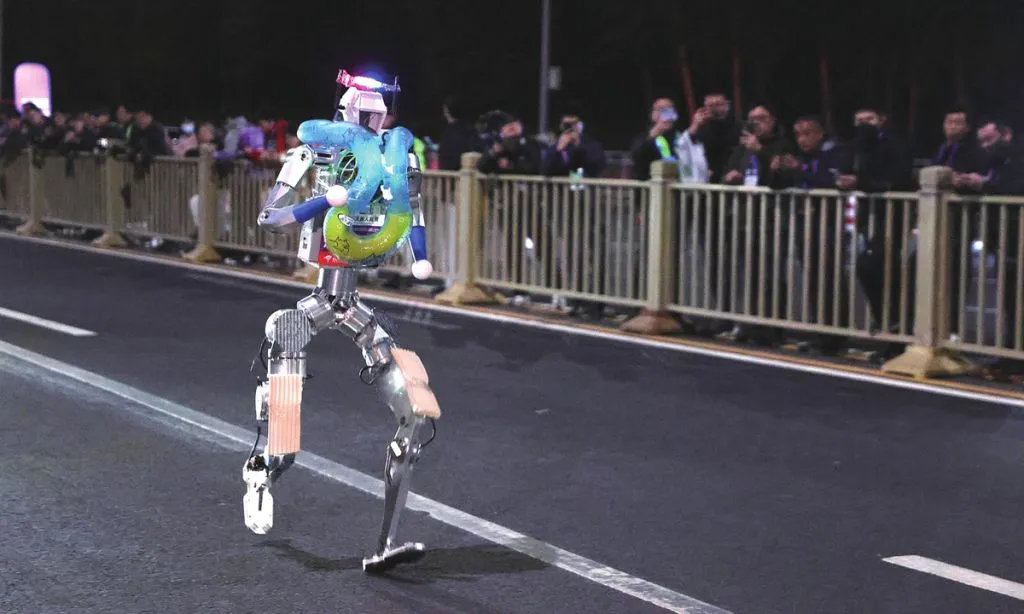
BEIJING: A Chinese humanoid robot has established a new benchmark in robotic locomotion, recording a sprint speed that approaches the capabilities of elite human athletes. The Unitree humanoid robot achieved a top speed of 10.1 meters per second during recent testing, according to technical reports and industry observers.
The milestone marks a significant leap in the development of bipedal mobility. At 10.1 meters per second, the machine is nearing the velocities seen in high-level human sprinting, demonstrating advanced stability and power output in its hydraulic or electric actuators. This achievement highlights rapid advancements in China's robotics sector, specifically in the integration of high-torque motors and real-time balance algorithms required to maintain momentum during high-speed movement.
Engineers note that achieving such speeds requires more than just raw power; it necessitates sophisticated sensory feedback loops to prevent falls during the rapid gait cycles. The Unitree model utilizes advanced perception systems to navigate terrain and adjust its center of gravity instantaneously. This level of agility is critical for future applications where humanoid robots may be required to operate in dynamic human environments, such as warehouses, construction sites, or emergency response scenarios.
The record comes amid an intensifying global race to perfect general-purpose humanoid robots. While previous iterations of bipedal robots focused on slow, deliberate walking to ensure stability, the shift toward high-speed sprinting indicates a transition toward more robust and versatile machine designs. As companies like Unitree continue to iterate on their hardware, the gap between biological movement and mechanical execution continues to narrow.
Industry analysts suggest that these breakthroughs in speed and balance are essential precursors to the commercial deployment of robots capable of performing complex physical labor alongside human workers.