How a Shenzhen battery maker became the world’s most formidable electric-car company
From Battery Workshop to Car Company
In 1995, Wang Chuanfu, a young chemist in Shenzhen, founded a company with roughly 2.5 million yuan, a loan from a relative and a view that the rechargeable-battery business had become complacent. Japanese manufacturers dominated the market with automated factories and expensive processes. Wang’s wager was unfashionable but potent: if the chemistry was understood deeply enough, and manufacturing was broken into disciplined manual steps, China’s abundant labour could produce batteries at far lower cost.
The company he called BYD began with about 20 employees. Its early advantage was not glamour but process. Engineers studied the designs of incumbent battery makers, stripped out expensive equipment where they could and built a production system suited to China’s industrial conditions. As Japanese companies moved upmarket into pricier lithium technologies, BYD squeezed more value from nickel-cadmium and nickel-metal hydride batteries for the exploding consumer-electronics industry.
By 2000, BYD had become the first Chinese supplier of lithium-ion batteries to Motorola, an important signal that it was no longer merely a domestic imitator. Two years later it listed in Hong Kong, raising capital for a move that alarmed investors: cars. In 2003, BYD acquired Xi’an Qinchuan Automobile, a troubled state-linked carmaker, gaining the licences and industrial base needed to enter the vehicle business.
To sceptics, this looked like diversification for its own sake. To Wang, it was vertical integration before the term became fashionable. If the future car would be built around a battery, then a battery company had reason to become a car company. BYD established an automotive research operation in Shanghai, bought a mould factory in Beijing and began learning how to control not merely the power source but the whole machine.
The first proof point arrived in 2005 with the BYD F3, a low-cost family sedan that became one of China’s first domestic models to sell more than 10,000 units a month. It followed the same logic as BYD’s batteries: acceptable quality, useful features and a price that incumbents struggled to match. In 2008, Warren Buffett’s Berkshire Hathaway bought roughly 10% of BYD for about $230 million. The investment gave BYD credibility abroad and, more importantly, time to pursue its bet that electrification would reorder the global car industry.
The Machine That Makes the Machines
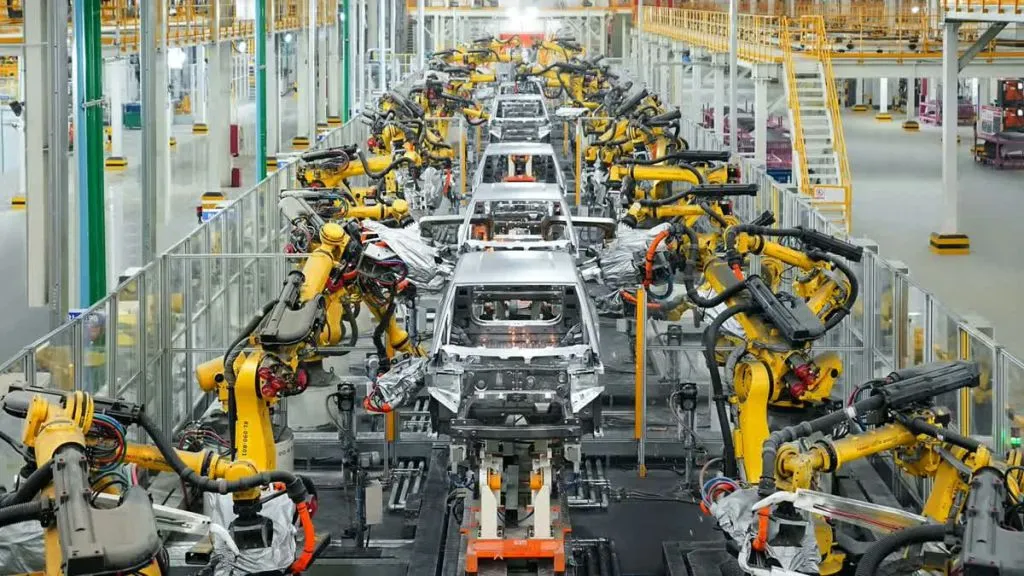
BYD’s most important product may not be any single car, but the industrial system behind it. Traditional carmakers are often assemblers of parts made elsewhere. BYD makes a striking share of its own components, from batteries and motors to power electronics, semiconductors and software. This has made the company unusually resilient in an era when chip shortages, logistics shocks and geopolitical frictions have exposed the fragility of long supply chains.
The centrepiece is the Blade Battery, introduced in 2020. Lithium iron phosphate batteries had long been considered safe and durable, but less energy-dense than nickel-based rivals. BYD’s answer was architectural rather than chemical. Its long, thin cells are arranged directly inside the pack, reducing the need for bulky module structures. The result is better space utilisation and competitive range without abandoning the safety advantages of LFP chemistry.
The company has also used plug-in hybrids as a bridge technology rather than a compromise. BYD’s Dual Mode systems are designed to be “electric first, petrol second”: the motor does most of the work, while the engine is tuned for efficient backup. The fifth-generation system, launched in 2024, claimed thermal efficiency of 46.06% and enabled models such as the Qin L DM-i and Seal 06 DM-i to advertise combined ranges of up to 2,100km. In markets where charging remains patchy, this matters. BYD is not asking customers to wait for perfect infrastructure before buying an electrified car.
That pragmatism helps explain the company’s scale. In 2025, BYD delivered about 4.6 million new-energy vehicles, including both battery-electric vehicles and plug-in hybrids. Its pure battery-electric passenger-car sales reached 2,256,714 units, overtaking Tesla’s estimated 1.64 million deliveries. Exports also surged, reaching roughly 1.05 million units, as BYD moved beyond China into Europe, Australia, Japan, Southeast Asia and Latin America.
The domestic policy environment helped. China’s new-energy vehicle rules, including the dual-credit system, rewarded companies that produced electric and plug-in hybrid vehicles while penalising manufacturers of fuel-heavy fleets. Direct subsidies, infrastructure support and public-sector electrification created a fertile home market. Yet the scale BYD has now reached suggests more than subsidy dependence. The company is using China as a base from which to export an entire industrial model.
BYD’s Scale
BYD’s next challenge is to prove that its scale can travel. Export success brings exposure to tariffs, safety scrutiny, brand perception and the politics of Chinese industrial power. Ultra-fast charging technology must satisfy consumers that speed will not come at the expense of battery health. Software-defined vehicles may also invite disputes over updates, performance changes and consumer rights.
Nor is China’s home market becoming easier. Domestic rivals such as Geely, Xiaomi and others are turning the market into a rolling price war. Growth in plug-in hybrids has begun to moderate, and the easy gains from first-time electrification are likely to diminish. BYD must therefore move from being a volume machine to a value machine: selling not just cheaper cars, but better software, higher margins and trusted technology.
Even so, the company’s rise marks a change in the balance of automotive power. BYD began by asking whether batteries could be made differently. Three decades later, it is asking whether the car industry itself can be made differently: more vertically integrated, more software-driven and more tightly bound to the economics of energy storage. The answer is no longer theoretical. It is being shipped by the million.