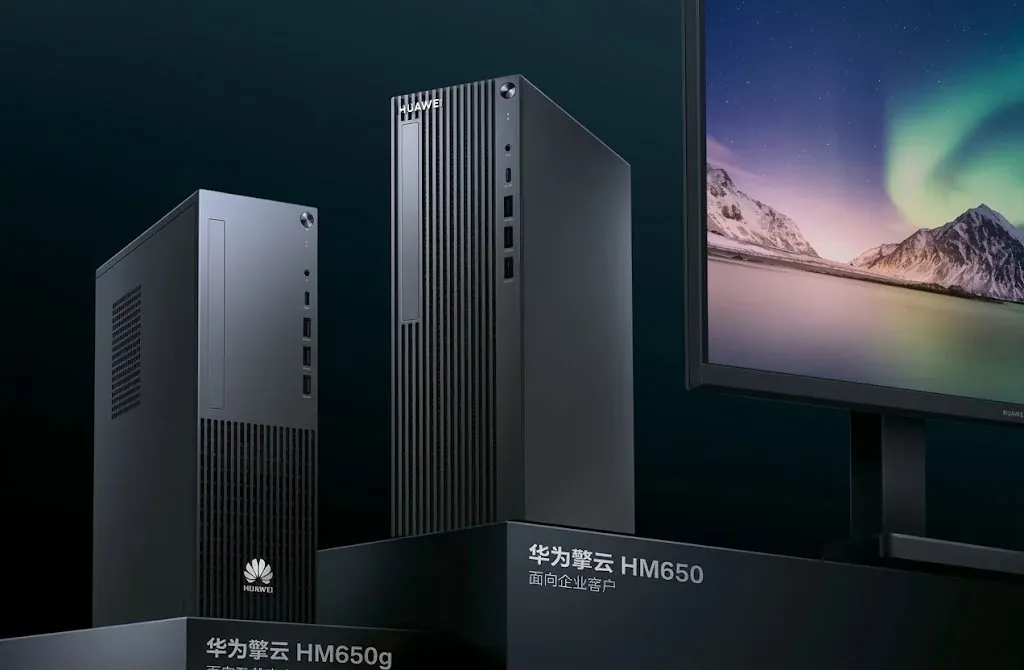
Huawei has unveiled a desktop computer built entirely with domestically sourced Chinese components, signaling a major strategic pivot away from reliance on Western semiconductor giants. The Qinyun HM650 series has been buit with its own Kirin processors and HarmonyOS software.
This hardware and software combination represents a significant operational milestone for Huawei’s domestic ambitions, demonstrating tangible progress in achieving supply chain self-sufficiency following stringent international technology restrictions.
The device, which bypasses key components from Intel and Qualcomm, directly challenges the established global dominance of these firms in the personal computing ecosystem, offering a powerful statement regarding China’s technological resilience.
Technical Architecture and Commercial Deployment
The desktop utilizes a proprietary ecosystem, integrating chips and components manufactured within the Chinese supply chain. While specific performance benchmarks against global rivals remain proprietary, the architecture is designed to facilitate deep integration with Huawei’s internal software and services.
Commercially, this product line is positioned for the domestic Chinese market, where governmental procurement and enterprise adoption are critical drivers. Its existence validates the ongoing massive state-backed investment pouring into domestic semiconductor fabrication and component engineering across China.
By controlling the entire stack—from the silicon level up through the operating system integration—Huawei mitigates the risk associated with geopolitical supply chain vulnerabilities, establishing an end-to-end technological control loop.
Geopolitical Implications and Market Shift
This move extends beyond a mere hardware product launch; it is a calculated geopolitical maneuver. It underscores the national imperative within China to reduce technological dependence, a strategy accelerated by export controls imposed by the US and allies.
The success of this fully localized hardware model serves as a proof-of-concept for broader industrial substitution across numerous high-tech sectors. It suggests that domestic Chinese manufacturers are rapidly closing the gap, not just in assembly, but in core intellectual property and component design.
For the global tech industry, Huawei’s endeavor represents a hardening of regional technological blocs. It accelerates the bifurcation of the global tech market into spheres of influence, forcing multinational corporations to navigate increasingly complex, politically charged sourcing requirements.
Ultimately, the desktop symbolizes a maturing domestic industrial ecosystem capable of supporting high-level computational demands without external licensing or component dependency, marking a fundamental shift in the competitive dynamics of global computing.